O'Donnell
also Ó Domhnaill, ODonnell, Donnell
Tír Chonaill, Red Hugh's escape, and the Flight of 1607.
- Origin
- Ulster, Ireland
- Motto
- In Hoc Signo Vinces
- Famous bearer
- Aodh Ruadh Ó Domhnaill (Red Hugh, c.1572–1602), chief of Tír Chonaill, escapee, Nine Years' War commander
- Register
- Irish family
Ranked of all time
The 10 Most Powerful Irish Clans of All Time
Ranked of all time
The 10 Oldest Clans in Ireland
Where the O'Donnell name comes from
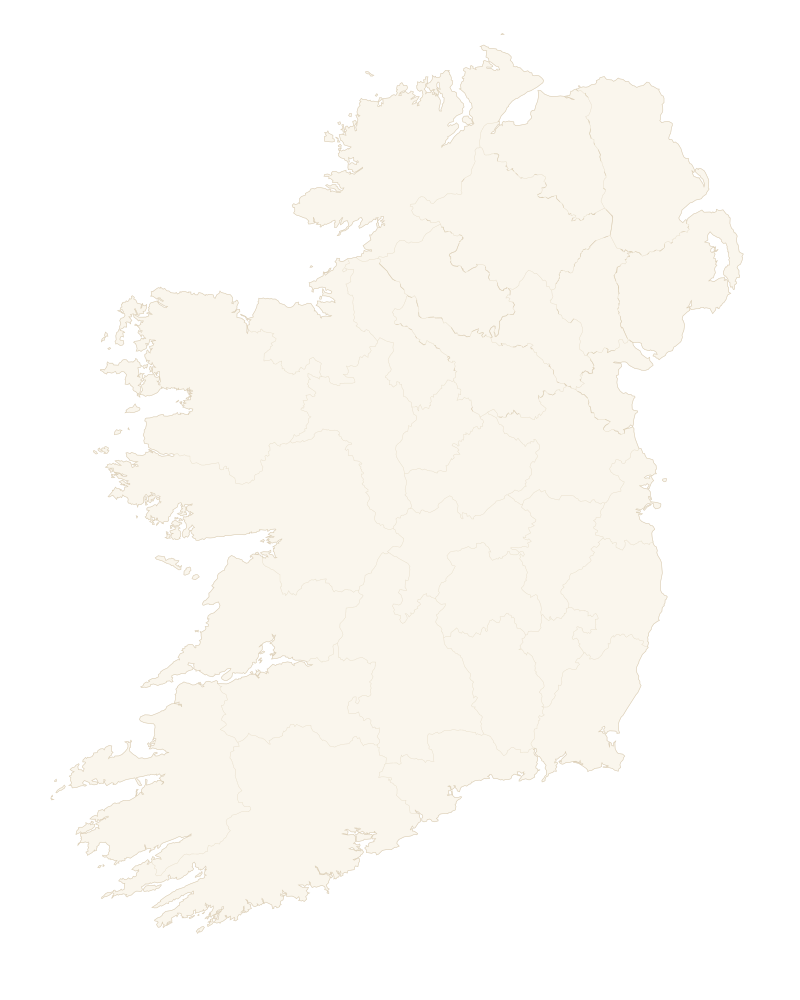
CoreHistoric reach
The seat of O'Donnell
Seat vacantChief
No one leads the O'Donnell community yet. When the movement opens, you can stand for its leadership, or help elect whoever does.
Current mission
No shared goal set yet. Once O'Donnell has leadership, it sets the public focus: a restoration, a gathering, a real-world project that helps its own.
The O'Donnell clan is being rebuilt. Join the waiting list for the movement today, and you help decide who leads it and what it does.
Help rebuild the O'Donnell clan →Motto
In Hoc Signo Vinces
“In this sign you will conquer”
What does the O'Donnell name mean?
From Ó Domhnaill, descendant of Domhnall. The Domhnall here was Domhnall Mór, king of Tír Chonaill in the early 13th century. The senior Ó Domhnaill line ruled the kingdom of Tír Chonaill, most of modern Donegal, from c.1200 to 1607. Cousin to the Highland Scots Clan Donald (Mac Domhnaill), but the Irish and Scottish lines descend from different Domhnalls and the kinship is at the legendary horizon, not the documented.
The history of O'Donnell
Conall's shield, and the sign the family fought under
The O'Donnells and the O'Neills came out of the same root and spent most of their recorded history fighting over it. Both traced descent from Niall of the Nine Hostages, High King at the start of the fifth century: the O'Neills through his son Eogan, as the Cenel nEogain, and the O'Donnells through his son Conall Gulban, as the Cenel Conaill. Conall's name is still on the ground: Tir Chonaill, the land of Conall. The surname itself fixes on a much later man, Domhnall Mor O Domhnaill, king there in the early thirteenth century.
The arms carry a story about Conall's baptism. Jocelyn of Furness, writing the Life and Acts of Saint Patrick about 1185 for Sir John de Courcy, has Patrick take the staff called the Bachal Isu, cut the sign of the cross into Prince Conall's shield with it, and tell him none of his stock would be beaten in war who fought under that sign; the episode is told again in the Lebhar Inghine i Dhomhnaill. Conall's shield and its motto, In Hoc Signo Vinces, in this sign you will conquer, have been the principal O'Donnell arms ever since.
A kingdom that was never only Donegal
Tyrconnell was bigger than the county that replaced it. It held most of modern Donegal, excepting the Inishowen peninsula, but it reached also into the barony of Carbury in County Sligo, Rosclogher in County Leitrim, Magheraboy and Firlurg in County Fermanagh, and part of southern Londonderry. A lordship that today straddles an international border was one jurisdiction under one chief, defended from seven O'Donnell castles, of which Donegal Castle on the bay was the jewel. For a period it was an independent kingdom recognised by Henry III of England.
Its wealth came partly off the water. The O'Donnell king was known on the Continent as the Fisher-King, a name earned by exporting fish traded for wine at La Rochelle. Its politics were dominated by the neighbour to the east: Tyrconnell bordered O'Neill country, and the O'Neills of Tyrone periodically pressed a claim of supremacy over it, so that much of the family's recorded history is warfare with Tyrone, alongside its own claims to northern Connacht and a wider stretch of Ulster.
The rise can be dated. Maol Seachlainn O Domhnaill, king of Tyrconnell, died in 1247; his brother Gofraidh, also a son of Domhnall Mor, is reckoned the first chieftain proper, and in 1257 he took the field at Creadran-Cille against Maurice FitzGerald, Justiciar of Ireland, and won. He died the same year of wounds taken in a separate battle against O Neill. The succession held: his brother Domhnall Og got back from Scotland in time to face down O Neill's demands, and may have been inaugurated king at Raphoe Cathedral in 1258.
The lucht tighe, and the Annals that came out of it
Tyrconnell was governed by a household, the lucht tighe, whose offices were not appointments but inheritances held by particular families for more than four centuries. The O'Friels read the chief in and inaugurated him. The MacSweeneys were marshals of the gallowglass and bearers of the standard, the O'Gallaghers commanded the cavalry, the Breslins judged as brehons, the Mac an Bhaird were the bards, the Roartys kept the Cathach of St Columba, and the McMenamins held the church lands and the castles of Donegal and Ballyshannon.
Two of those offices were filled by refugees the O'Donnells took in. When John de Courcy destroyed the kingdom of Ulaid in 1177, the Donlevy dynasty fled west, and Tyrconnell gave them sanctuary and the rank of ollamh leighis, official physicians to the O'Donnells; a branch became the MacNultys, from Mac an Ultaigh, son of the Ulsterman. The O Cleirigh, who had lost their own sub-kingdom of Ui Fiachrach Aidhne in what is now County Galway, arrived in the early thirteenth century and were taken in as poet-historians and scribes.
The consequence is one of the great books of Irish history. Onara Ultach, of the Donlevy line, married Donnchadh O Cleirigh, son of the chief of that name in Tyrconnell, and their son was Micheal O Cleirigh, born about 1590, principal author of the Annals of the Four Masters. The same physician families trained Niall O Glacain, whose Tractatus de Peste of 1629 described the petechial haemorrhages of the lung and the swollen spleen of bubonic plague. Neither man exists without an O'Donnell decision to house a beaten dynasty. The same instinct endowed the abbey founded at Donegal town by Hugh O'Donnell in 1474, where the family were patrons of the Franciscans.
Knockavoe, Farsetmore, and the terms Manus took from Henry VIII
The sixteenth century opened well. Aodh Ruadh O Domhnaill, Red Hugh the first, reigned from about 1460 until his death in 1505 and built Donegal Castle; in 1566 the Lord Deputy Sir Henry Sidney called it the largest and strongest fortress in all Ireland, and the greatest he had ever seen in an Irishman's hands. In 1522 the O'Donnells beat the O'Neills at Knockavoe.
Manus O'Donnell, who lived from 1490 to 1564 and reigned after Sir Hugh Doo, made the decision that shaped everything after. In 1541 he entered the Tudor process of surrender and regrant, giving up the Gaelic title to hold his lands from the crown; he ruled mainly from Lifford on the Foyle, and wrote the life of Colmcille himself. His son Calbhach, twenty-second chieftain, died in 1566, and in 1567 the O'Donnells beat the O'Neills again at Farsetmore, a victory that reconfirmed Tyrconnell's autonomy in Ulster.
The pressure was internal as well. Sir Hugh McManus O'Donnell, another son of Manus, was born about 1540, reigned as king of Tyrconnell and died in 1601; his eldest son Sir Donnell, seneschal of Tyrconnell and sheriff of County Donegal, was killed at the battle of Doire Leathan in September 1590. The Lifford branch was meanwhile building a rival claim: Conn O'Donnell of Lifford, son of Calbhach, died in 1583 leaving a son, Sir Niall Garbh, dynastic rival first to Red Hugh and then to Rory.
Red Hugh, the Curlew Pass, and a death in Castile
Aodh Ruadh O Domhnaill, Red Hugh, born about 1572, was seized in 1587 at around fifteen, lured aboard a ship by a trick of the Dublin administration and held in Dublin Castle as a hostage against his family. He got out on a winter night after an earlier attempt failed, crossed the snow of the Wicklow Mountains on foot and lost two toes to frostbite reaching his own country, a story told in full in the legend of his escape. Inaugurated the O'Donnell at Kilmacrenan in 1592, he took the western half of the war against the Elizabethan conquest.
His best day was in the Curlew Mountains in August 1599, where he met an English army under Sir Conyers Clifford, routed it and killed Clifford in the action: one of the sharpest Irish victories of the Nine Years War, and won by Tyrconnell rather than Tyrone. When the Spanish landed at Kinsale in 1601, the northern lords marched the length of Ireland in winter to reach them, and on the way Red Hugh planted O'Donnell kinsmen at Ardfert and Lixnaw to hold the territories of his ally FitzMaurice, Lord of Kerry.
The attempt to break the siege failed on Christmas Eve, and he would not stop. He took ship for Spain to put the case in person to Philip III for a second expedition, was received with honour at court, and died in Castile on 10 September 1602, aged twenty-nine. Two exiled MacDonlevy priests, of the physician family his ancestors had sheltered, attended him at the end with the Archbishop of Tuam. He was buried at the Franciscan friary in Valladolid, and the suspicion of poison has never been settled.
What Tyrconnell lost: Mellifont, 1607, and Basil Brooke's wing
Red Hugh's brother Rory inherited the wreckage. After the Treaty of Mellifont in 1603 the new king, James I, pardoned him and created him Earl of Tyrconnell in the Irish peerage, converting a Gaelic kingship into a crown honour held on crown terms. The honour did not hold. In September 1607 Rory led the Tyrconnell party out of Ireland alongside the earl of Tyrone; he died in Rome on 28 July 1608, and the earldom was attainted in 1614. His younger brother Cathbarr died in 1608.
For Donegal the sequel was physical. The Plantation of Ulster took the confiscated lordship, and Donegal Castle and its lands were granted to an English captain, Basil Brooke, who set a Jacobean wing against the fifteenth-century keep the O'Donnells had raised. The Brookes sold to the Gores in the 1670s; the 5th Earl of Arran vested the castle in the Office of Public Works in 1898, by which time most of it had stood ruined for close to two centuries. It was almost fully restored in the early 1990s.
The line did not simply stop. Rory's son Hugh, who took the additional name Albert at confirmation under the patronage of Archduke Albert, used the title as 2nd Earl of Tyrconnell in the Spanish realm regardless of the attainder, and died without heirs in 1642, willing his claim to Hugh Balldearg O'Donnell. At home, Manus O'Donnell, second son of Sir Niall Garbh and Nuala O'Donnell, was killed fighting for the Confederation of Kilkenny under Owen Roe O'Neill at Benburb in 1646.
Counts of Tyrconnell in the service of Europe
Dispossession turned the family into professional soldiers for other people's kings, and they kept the lost title as a name. General de brigade Daniel O'Donnell, born in 1666 to Turlough, a son of Hugh Duff O'Donnell, led an O'Donnell regiment of the French Irish Brigade against Marlborough at Oudenarde and at Malplaquet. In Austria the name became a title outright: Karl O'Donnell, Graf von Tyrconnell, 1715 to 1771, and Comte Maurice O'Donnell de Tyrconnell of Pressburg, whose son Maximilian Karl Lamoral died in 1895.
France and Spain took the rest. Comte Jean Louis Barthelemy O'Donnell, 1783 to 1836, sat in Napoleon's Conseil d'Etat and held the Legion d'honneur; Enrique O'Donnell, Conde de La Bisbal, was an Irish-Spanish nobleman and peer. The high point was Leopoldo O'Donnell y Joris, 1809 to 1867, created Duke of Tetuan, Prime Minister of Spain three times in the 1850s and 1860s.
The dukedom stayed public. The 2nd Duke of Tetuan was Spanish foreign minister and Mayordomo mayor to King Amadeo I; the 3rd Duke conducted Winston Churchill on his visit to Cuba. Others went further out again: Guillermo O'Donnell, 1936 to 2011, was an Argentine political scientist and an international campaigner for democracy, a long way from Tyrconnell and recognisably the same diaspora.
The Cathach, the white wand, and the name in Donegal
One object outlasted the kingdom. The Cathach of St Columba, kept for generations by the Roartys as hereditary custodians in the O'Donnell household, was recovered by the O'Donnell baronets of Newport House and entrusted by them to the Royal Irish Academy. The chieftainship was harder to preserve. Under the Brehon law of tanistry the O'Donnell had been elected and inaugurated in an elaborate rite; once that legal system collapsed, the succession fell back on male primogeniture, a rule the family had never used.
It was revived all the same. The Chief Herald of Ireland recognised John O'Donel of the Larkfield branch as Chief of the Name, gazetting him in Iris Oifigiuil on 11 September 1945, and he was inaugurated as The O'Donnell at the clan rally in County Donegal at Easter 1954. The claim had been contested by the Dukes of Tetuan, and the Irish state found for Larkfield, whose descent ran back to the Manus killed at Benburb. The last of that line, Fr Hugh Ambrose O'Donel, a Franciscan retired from mission work in Zimbabwe, died on 11 July 2023.
The Genealogical Office stopped recognising Chiefs of the Name in 2003, so the Clan Association of the O'Donnells of Tyrconnell keeps no chief; the 7th Duke of Tetuan is its co-patron with Count Douglas O'Donell von Tyrconnell of the Austrian branch. In Ireland the name kept surfacing. Patrick Cardinal O'Donnell, from near Glenties, rose to Archbishop of Armagh and Primate of All Ireland; Thomas O'Donnell, MP for West Kerry from 1900 to 1918 and a leading agrarian reformer, became the first member to address the House of Commons in Irish, and was promptly called to order by the Speaker.
Champions of the O'Donnell name
The bearers whose lives are inseparable from this surname. Each has their own page, biography, achievements, geography, connection to the family.
Castles the O'Donnell held
Strongholds this name held for a decade or more, look one up, or rebuild it to explore.
- Donegal Castle
Stronghold of the O'Donnell chiefs of Tyrconnell, 15th–16th centuries.
- Sligo Castle
The castle and the territory of Carbury originally belonged to the O'Donnells, princes of Tyrconnell.
The castles of the homeland
The great strongholds of the homeland, look one up, see what it looked like in its prime, and recreate it to explore.
 Ashford Castle, County MayoRestored · prime 1880
 Manderley CastleRestored · prime 1840
 Dublin CastleRestored · prime 1790
All castles in Ireland → · Strongest castles in Ireland → · Castles of Europe
Play As Your Clan
Hold a real castle against whatever you choose to send at it, take a ship out in her own service years, or stand at the shoulder of someone the record remembers. The chronicler sets the scene; the deeds are yours.
Notable bearers of the O'Donnell name
- Aodh Ruadh Ó Domhnaill (Red Hugh, c.1572–1602), chief of Tír Chonaill, escapee, Nine Years' War commander
- Rory O'Donnell, 1st Earl of Tyrconnell (1575–1608), Flight of the Earls
- Leopoldo O'Donnell, Duke of Tetuán (1809–1867), Spanish Prime Minister
- Daniel O'Donnell (b. 1961), Irish singer, Donegal
Stories of O'Donnell
Frequently asked
What does the surname O'Donnell mean?
Where does the O'Donnell family come from?
Where did the O'Donnell family historically hold territory?
Is O'Donnell Irish or Scottish?
How old is the O'Donnell surname?
What is the O'Donnell family known for?
What is the O'Donnell motto?
What does "In Hoc Signo Vinces" mean in English?
Is there a O'Donnell family crest or coat of arms?
Who is the most famous O'Donnell?
Who are some famous O'Donnells?
What stories are told about the O'Donnell family?
What is the story of Red Hugh's escape from Dublin Castle?
Is Ó Domhnaill the same family as O'Donnell?
Is ODonnell the same family as O'Donnell?
Is Donnell the same family as O'Donnell?
Where is the O'Donnell surname found today?
What does the Clan Rising page for the O'Donnell family cover?
Who is the head of the O'Donnell family today?
Neighbouring clans
- GallagherOf Tír Chonaill and the household cavalry of the O'Donnell.
- DohertyLords of Inishowen, and the revolt that triggered the Plantation of Ulster.
- BoyleTwo unrelated families, one Anglicisation, Donegal kings and the Earls of Cork.
- ClarkeAnnalists of Tír Chonaill, and the surname of the 1916 Proclamation's first signatory.