Doherty
also O'Doherty, Ó Dochartaigh, Dougherty
Lords of Inishowen, and the revolt that triggered the Plantation of Ulster.
- Origin
- Ulster, Ireland
- Motto
- Ar nDúthchas
- Famous bearer
- Sir Cahir O'Doherty (1587–1608), last Gaelic lord of Inishowen, burnt Derry 1608
- Register
- Irish family
Ranked of all time
The 10 Oldest Clans in Ireland
Where the Doherty name comes from
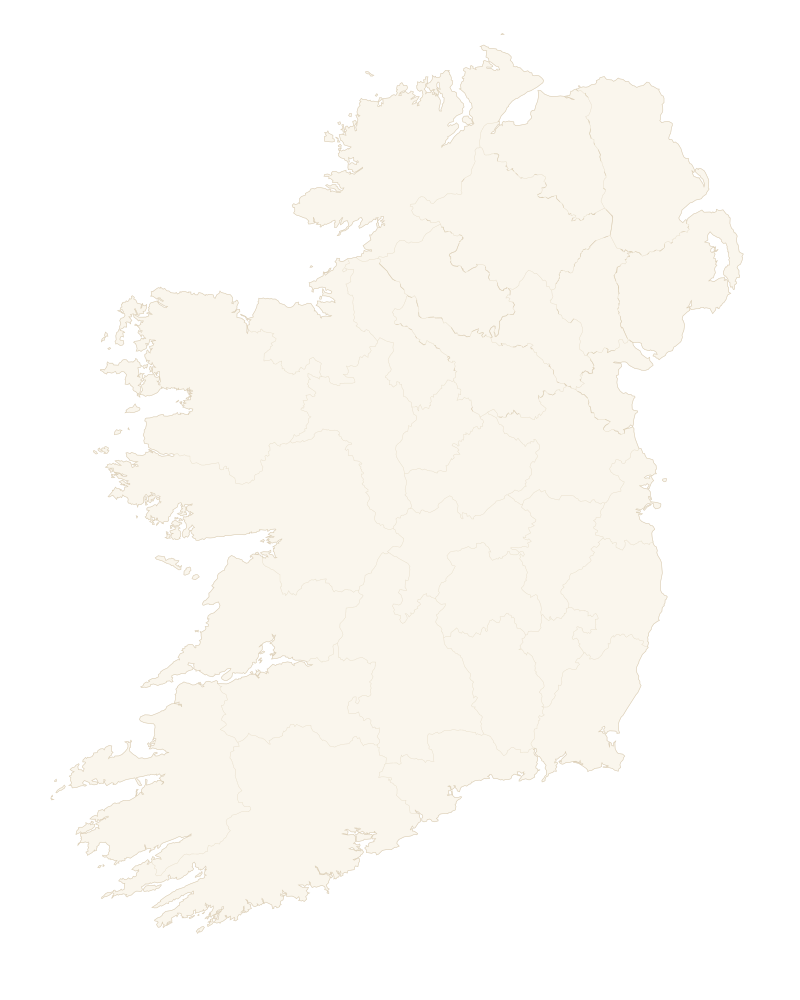
CoreHistoric reach
The seat of Doherty
Seat vacantChief
No one leads the Doherty community yet. When the movement opens, you can stand for its leadership, or help elect whoever does.
Current mission
No shared goal set yet. Once Doherty has leadership, it sets the public focus: a restoration, a gathering, a real-world project that helps its own.
The Doherty clan is being rebuilt. Join the waiting list for the movement today, and you help decide who leads it and what it does.
Help rebuild the Doherty clan →Motto
Ar nDúthchas
“Our heritage”
What does the Doherty name mean?
From Ó Dochartaigh, descendant of Dochartach. The personal name Dochartach means 'obstructive' or 'hurtful', the kind of edged Old Irish byname applied to a man hard to deal with, presumably an honorific in the warrior register in which the surnames froze. The eponymous Dochartach was a tenth-century chief of the Cenél Conaill, the kindred from which the Tír Chonaill royal house also descended. The Ó Dochartaigh ruled the Inishowen peninsula, the great triangular fist of land between Lough Foyle and Lough Swilly, as effectively a sub-kingdom of Tír Chonaill from c.1200 to 1608.
The history of Doherty
The obstructive man, and the hundred and forty ways to spell him
Ó Dochartaigh means descendant of Dochartach, and Dochartach means obstructive, or hurtful: an edged Old Irish byname for a man hard to deal with, and very probably an honorific in the warrior register in which Gaelic surnames froze. Donagh Dochartach, who lived in the ninth century, gave the family its name. He belonged to the Cenél Conaill, the dynasty medieval genealogy traced to Niall of the Nine Hostages through his son Conall Gulban, founder of the kingdom of Tír Chonaill.
That descent makes the Dohertys kinsmen of the O'Donnells, rulers of Tír Chonaill, and of the O'Gallaghers. Anglicisation did to the name what it did to every Ó name: the prefix went, the spelling drifted, and more than a hundred and forty variants are on record, of which Doherty and O'Doherty are the commonest. One trap survives: in Munster, O'Doherty is often not this name at all but Ó Dubhartaigh, anglicised Doorty in County Clare. The motto is Ar nDúthchas, our heritage.
Conor-an-Einigh takes the peninsula, 1359–1413
The family did not begin in Inishowen. They were chiefs of Cenél Eanna in the Laggan valley of present-day Donegal, their leaders elected by tanistry under Brehon law rather than handed the office by birth order, and they moved north into the vacuum left by the collapse of Meic Lochlainn rule on the peninsula. Inishowen, the triangular fist of land between Lough Foyle and Lough Swilly, was theirs from the start of the fifteenth century, held as effectively a sub-kingdom of Tír Chonaill.
Conor-an-Einigh Ó Dochartaigh (1359–1413) was the first of the clan to settle there, at Castleross in the parish of Desertegney: Díseart Einigh, the refuge of Einigh, which carries his name to this day. The parish kept producing the family for centuries. A brother of the rebel Sir Cahir O'Doherty was born in it, and so were the ancestors of the politician Joseph O'Doherty, at Gortyarrigan in the same parish.
Green Castle taken, and held for two hundred and twenty-two years
Caisleán Nua on the western shore of Lough Foyle (Green Castle, or Northburgh) was not built by Dohertys. It was completed in 1305 for Richard Óg de Burgh, 2nd Earl of Ulster, to control access to the lough, and borrows openly from Edward I's Welsh castles: its gatehouse has been compared to Harlech, the rest to Caernarfon.
Edward Bruce captured it in 1316 and held it to his death in 1318. With Norman power in western Ulster collapsing after the death of William Donn de Burgh, the Brown Earl, the O'Dohertys took the castle in 1332 or 1333 and kept it for two hundred and twenty-two years, until it was destroyed by siege in 1555. What they held was an oval curtain-walled enclosure that builds its keep into the outer defences, twin polygonal gate-towers at one end and a larger polygonal tower at the other. It survives as a ruin under state care.
Seán Mór bends the knee to Henry VIII
Seán Mór Ó Dochartaigh (c.1505–1582) held castles at Aileach, Inch and Burt, and by his day the chiefs were styled Lords of Inishowen. About 1540 he reached the bluntest sort of frontier bargain: Ó Dochartaigh would not cross the River Foyle if the English stayed out of Inishowen.
In 1541 he took the Tudor route out. Under Surrender and Regrant he knelt to Henry VIII and rose as Sir John O'Doherty, a policy built to absorb the Gaelic leadership into the new Tudor Kingdom of Ireland and the Anglican Church, converting a chief elected under Brehon law into a titled subject inheriting by primogeniture.
Burt Castle, raised in the sixteenth century to guard the southern edge of the lordship in east Donegal, shows the same drift in stone: it leans hard on Scottish Z-plan fortification, anticipating what the Plantation would raise across Ulster.
Sir John Óg and the forts on Lough Foyle
Sir John Óg O'Doherty (c.1540–1601), son of Seán Mór and Rosa O'Donnell, became lord in 1582 and lived at Burt. In 1600 an English fleet planted three forts around Lough Foyle, one of them on the O'Doherty estate at Culmore, and he defended Inishowen against the invasion; later that year he killed Colonel Sir John Chamberlain and many of the soldiers who had marched against him. Slain on 27 January 1601, he got an epitaph from the Annals of the Four Masters that has stuck: "There was not a lord of a barony amongst the Irish more distinguished for manual action and hospitality, or more bold in counsel than he."
The succession was disputed, and the Crown chose the heir. Sir Henry Docwra, Governor of Derry, backed the fifteen-year-old Cahir, who fought on the Crown's side in the Nine Years' War and was knighted for his bravery. Burt was the point of it: the castle commanded the ground that let Docwra land food and open an offensive against Red Hugh O'Donnell, and a garrison of a hundred men under Captain John Vaughan sat in it. Cahir moved in during 1601, installed by the government that would shortly dispossess his family.
Rosa Ní Dhochartaigh, from Rathmullan to Louvain
Sir John Óg's daughter Rosa (c.1588–1660), Sir Cahir's younger sister, married Cathbarr O'Donnell, younger brother of Rory O'Donnell, last King of Tyrconnell and 1st Earl of Tyrconnell. On 14 September 1607 Cathbarr, Rosa and her infant son Hugh boarded a French ship at Rathmullan on Lough Swilly bound for La Coruña, with the Earls O'Neill and O'Donnell and a great number of the nobility of Ulster. The Four Masters mourned the sailing as a company whose like the sea had not borne.
Cathbarr died of fever in Italy the following year and left her a widow at twenty. In 1613 or 1614, in Flanders, she married Owen Roe O'Neill, an Irish officer in the Spanish army and great-grandson of Conn O'Neill, 1st Earl of Tyrone. She came back to Ireland in 1642 when Owen Roe returned to serve the Irish Confederacy, landing at Wexford with Colonel Richard O'Farrell, bringing supplies and reinforcements for her husband's Ulster Army, which beat a Scottish force at Benburb in 1646.
Owen Roe died at Cloughoughter Castle in Cavan in November 1649; Rosa, then in Galway, arrived days too late. After the Cromwellian conquest she lived out her life in Brussels, and was buried at the Franciscan College of St Anthony of Padua at Louvain, under a slab set up by her son Hugh O'Donnell naming her the Most Excellent Lady Rosa O'Docharty, daughter and sister of Chiefs of Inishowen.
Doagh Island, Culmore, and Chichester's 170,000 acres
The lordship's last war was planned in its most remote corner. Carrickabraghy Castle sits on a rocky outcrop at the north-western tip of Doagh Island, at the head of Pollan Bay, built before 1600 by Phelemy Brasleigh O'Doherty, Feilimí Brasleach Ó Dochartaigh, Lord of Carraig Bhrachaí, the kinsman with whom the chief Sean Óg Ó Dochartaigh sheltered the clan's livestock from English raids. Its seclusion was the point, and in 1608 Sir Cahir chose it to plan his revolt.
He set up a headquarters at Doe Castle near Creeslough, built in the early 1400s and one of Tír Chonaill's strongest fortifications, and took Culmore (an ancient O'Doherty fort held by the Crown since 1559) in April 1608, the day before he destroyed the English settlement at Derry. Castles at Strabane and Lifford burned too, and the Derry prisoners were held at Burt.
The counter-attack came fast. Richard Wingfield, the King's Marshal and 1st Viscount Powerscourt, recovered Derry; troops from Dublin overran Inishowen, took Burt after a siege and freed the prisoners; and Cahir was killed at the Rock of Doon during the Battle of Kilmacrennan. Sir Arthur Chichester crushed the remainder and was granted the Lordship of Inishowen with the whole of O'Doherty's 170,000 acres. O'Doherty's Keep at Buncrana, inhabited in 1602, was seized. In 1615 Patrick O'Doherty built O'Doherty's Tower in Derry to satisfy a tax liability owed to the O'Donnells. By 1784 the leading branch had left Ireland and has not returned.
The Buncrana spinner's son who built the first general union
John Doherty was born at Buncrana on the Inishowen peninsula in 1798, son of a cotton-spinner. The family left for Manchester about 1808 in the ordinary Irish economic migration of the period, and the boy went to the spinning frames at ten, rising from child piecer to full operative spinner by sixteen. Active in the Lancashire spinners' trade societies from that same age, he ran the Manchester strike of 1818 at twenty as the unpaid organiser of its fund and committee, and served two years in Lancaster Castle for it, the imprisonment in which he wrote the tracts that became foundation literature of the British trade-union movement.
In December 1829 he brought the delegates of the cotton-spinning societies of Lancashire, Cheshire, Yorkshire, Glasgow and Belfast together at Manchester as the Grand General Union of Operative Spinners, the first union in British history to span every society of a single trade across the United Kingdom and Ireland. On 28 June 1830, at the Manchester Lyceum, he founded the National Association for the Protection of Labour: the first to span multiple trades across multiple regions, precursor of the Trades Union Congress, about a hundred and fifty thousand members across cotton, weaving, iron, building and mining, with its own paper, The Voice of the People.
He ran the Ten Hours Movement through the 1830s and 1840s and supported Lord Ashley's Ten Hours Bill of 1847, which capped the hours of women and young persons across the British textile industry. He died at Manchester on 14 April 1854, aged fifty-six, and is buried in the Hulme Roman Catholic cemetery, an Inishowen patronymic carried out of a spinner's house and onto the founding documents of organised labour in Britain.
The white wand, Cahir's sword, and the reunions
In July 1990 an O'Dogherty clan gathering installed Dr Ramón Salvador O'Dogherty of Spain as Chief of the Name at the ancient inaugural stone at Belmont House in Derry, with the traditional white wand of office and the sword Cahir O'Doherty carried at his death in 1608. The recognition rested on the Chief Herald's policy of acknowledging descendants by English primogeniture rather than tanistry, and when Terence MacCarthy was exposed as a fraudulent MacCarthy chief the category, Ramón O'Dogherty's claim included, lost its credibility.
The unofficial machinery proved more durable than the title. The Ó Dochartaigh Clann Association was formed in the 1980s by American and Canadian clanfolk, based in Michigan, operated from Inch Island in County Donegal from 1985 to 1999 and from Buncrana to 2007, and is now a charitable society near Seattle. Irish reunions have run every five years since 1985, premiered the film Roots of a Man in 2005, marked the four hundredth anniversary of Cahir's death in July 2008, and lost the 2020 gathering to COVID.
Shannen Doherty (1971–2024) was an American actress; Pete Doherty (b. 1979), of The Libertines, comes of the Liverpool-Doherty diaspora. The heaviest concentration of the name, though, is still where Conor-an-Einigh put it: the Inishowen peninsula and the vicinity of Derry.
Champions of the Doherty name
The bearers whose lives are inseparable from this surname. Each has their own page, biography, achievements, geography, connection to the family.
Castles the Doherty held
Strongholds this name held for a decade or more, look one up, or rebuild it to explore.
- Carrickabraghy Castle
Held by the Ó Dochartaigh; Feilimí Brasleach Ó Dochartaigh was Lord of Carraig Bhrachaí at the time of the English invasion of Ireland.
- Burt Castle
Stronghold of the O'Dohertys of Inishowen from its 16th-century construction until the collapse of O'Doherty's Rebellion in 1608.
- Northburgh Castle
A stronghold of the O'Doherty family after the death of William Donn de Burgh.
The castles of the homeland
The great strongholds of the homeland, look one up, see what it looked like in its prime, and recreate it to explore.
 Ashford Castle, County MayoRestored · prime 1880
 Manderley CastleRestored · prime 1840
 Dublin CastleRestored · prime 1790
All castles in Ireland → · Strongest castles in Ireland → · Castles of Europe
Play As Your Clan
Hold a real castle against whatever you choose to send at it, take a ship out in her own service years, or stand at the shoulder of someone the record remembers. The chronicler sets the scene; the deeds are yours.
Notable bearers of the Doherty name
- Sir Cahir O'Doherty (1587–1608), last Gaelic lord of Inishowen, burnt Derry 1608
- Pete Doherty (b. 1979), musician (The Libertines), Liverpool-Doherty diaspora
- Shannen Doherty (1971–2024), American actress
Stories of Doherty
Frequently asked
What does the surname Doherty mean?
Where does the Doherty family come from?
Where did the Doherty family historically hold territory?
Is Doherty Irish or Scottish?
How old is the Doherty surname?
What is the Doherty family known for?
What is the Doherty motto?
What does "Ar nDúthchas" mean in English?
Is there a Doherty family crest or coat of arms?
Who is the most famous Doherty?
Who are some famous Dohertys?
What stories are told about the Doherty family?
What is the story of Cahir O'Doherty burns Derry?
Is O'Doherty the same family as Doherty?
Is Ó Dochartaigh the same family as Doherty?
Is Dougherty the same family as Doherty?
Where is the Doherty surname found today?
What does the Clan Rising page for the Doherty family cover?
Who is the head of the Doherty family today?
Neighbouring clans
- O'DonnellTír Chonaill, Red Hugh's escape, and the Flight of 1607.
- GallagherOf Tír Chonaill and the household cavalry of the O'Donnell.
- BoyleTwo unrelated families, one Anglicisation, Donegal kings and the Earls of Cork.
- ClarkeAnnalists of Tír Chonaill, and the surname of the 1916 Proclamation's first signatory.