Clarke
also Clark, Ó Cléirigh, Mac an Cléirigh
Annalists of Tír Chonaill, and the surname of the 1916 Proclamation's first signatory.
- Origin
- Ulster, Ireland
- Famous bearer
- Mícheál Ó Cléirigh (c.1590–1643), Franciscan annalist, chief compiler of the Annals of the Four Masters
- Register
- Irish family
The Clarke arms and country

Coat of armsClarke of Stone-cum-Ebony EscutcheonBorne by the Stone-cum-Ebony Escutcheon line, one branch of the name rather than all of it.Robin S. Taylor · CC BY-SA 4.0 
Coat of armsEscutcheon of the Clarke baronets of Rupertswood (1882)Borne by the Rupertswood line, one branch of the name rather than all of it.Charles Matthews · CC BY-SA 4.0

.svg)
- Coat of arms: Granted to an individual and inherited down that one documented line. These are the arms of particular families of the name, not of everyone who shares the surname.
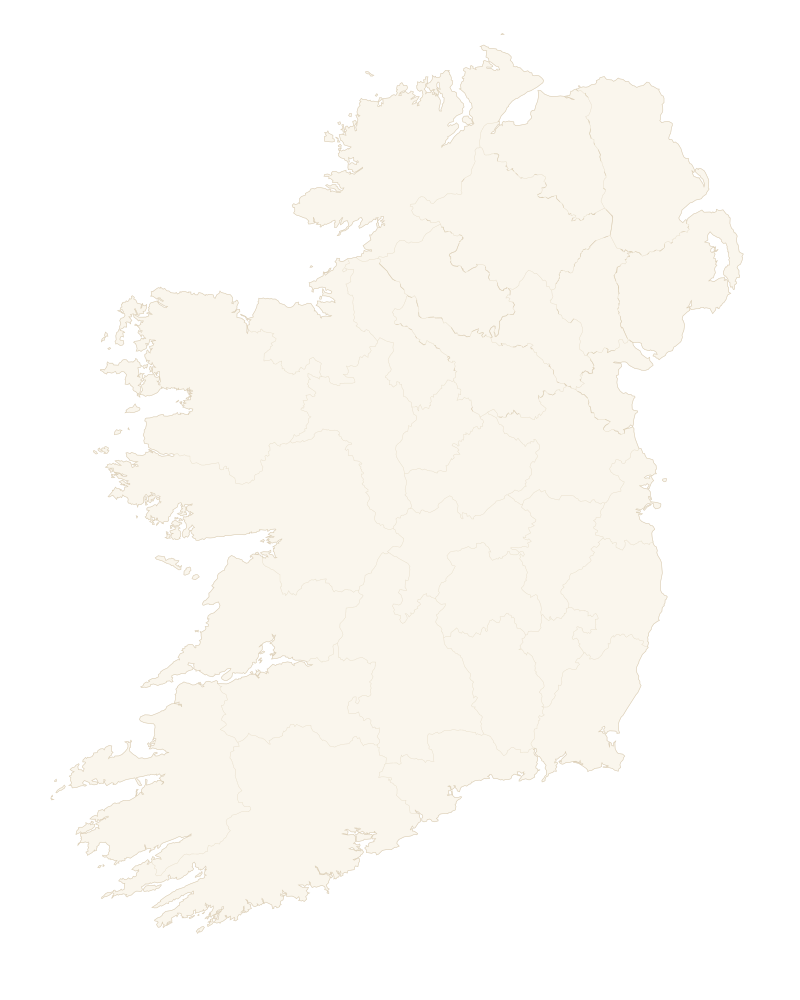
CoreHistoric reach
The seat of Clarke
Seat vacantChief
No one leads the Clarke community yet. When the movement opens, you can stand for its leadership, or help elect whoever does.
Current mission
No shared goal set yet. Once Clarke has leadership, it sets the public focus: a restoration, a gathering, a real-world project that helps its own.
The Clarke clan is being rebuilt. Join the waiting list for the movement today, and you help decide who leads it and what it does.
Help rebuild the Clarke clan →What does the Clarke name mean?
Anglicisation of Ó Cléirigh, descendant of the cleric. The Ó Cléirigh were a learned bardic family of Donegal originally, hereditary historians and poets to the O'Donnell kings of Tír Chonaill from the 13th century. The greatest single act of Ó Cléirigh scholarship was the compilation of the Annals of the Four Masters (1632–1636) at the Franciscan convent of Bundrowes. The English form Clarke (or Clark) is also independently used by Plantation settlers of English origin, particularly across Ulster, and the modern surname pool reflects both lineages.
The history of Clarke
Descendant of the cleric, and a second road to the same word
Clarke and Clark mean the same thing and arrive by two different roads. The English name is the medieval clerk, the literate man of the courts and the charters, from Latin clericus by way of Old French clerc, and that story is told on the Clark page. The Irish name is Ó Cléirigh, descendant of the cleric: an independent formation from the same Latin root, made inside another language by people who had no use for the English one.
The grammar is the tell. In Irish, Ó (historically Ua) means descendant and Mac means son, each followed by a name or noun in the genitive; the catalogue carries Mac an Cléirigh, son of the cleric, beside the Ó form. The Irish name is therefore a lineage name, fixed on the descendants of a particular churchman and handed down as a family's property, not a job label pinned to one literate man in one parish.
Ireland was taking surnames before most of Europe
Hereditary surnames reached western Europe only in the eleventh century, and in England they were not general until about 1400. Ireland was ahead of that. Surnames began there during the century of declining Uí Néill dominance, which closed in 1002 when Brian Boru of the Dál gCais took the high kingship, putting Ireland among the first countries in Europe to use them.
What a Gaelic surname attached to was the fine, the kinship group: the chief and his patrilineal relatives, but also unrelated clients who took the name of the leading lineage as a show of allegiance. Those clients were barred from election as chief and were kin to nobody in it, yet they carried the surname and passed it on. Every large Gaelic name holds two populations from the beginning, and a Clarke today may descend from either.
Galway, Antrim, and the road north into Tír Chonaill
The Irish form of the name is credited to County Galway and County Antrim, and from those two it spread into County Donegal and County Dublin. The Galway strand sits inside Uí Fiachrach Aidhne, the southern branch of the Uí Fiachrach, where the O'Clerys are listed among the chiefly families beside the O'Shaughnessys, the O'Heynes and the O'Donnells.
The move that made the name matter was north into Tír Chonaill, the country of Cineál Chonaill, whose chiefs were the O'Donnell dynasty. From the thirteenth century the Ó Cléirigh were hereditary historians and poets to the O'Donnell kings there, an office rather than a compliment: under Gaelic lordship the learned families were an institution of the kingdom. There is no Ó Cléirigh castle in the record. What this family held was the record itself.
The four masters at Bundrowes, 1632 to 1636
Mícheál Ó Cléirigh (c.1590–1643) trained as a Franciscan at Louvain and returned to Ireland in 1626 with an explicit project: to save the historical record before the Plantation reduced the bardic schools to nothing. He travelled the country reading and copying whatever manuscripts had survived, salvage work done in the knowledge that the world which produced them was ending.
The synthesis was compiled at the Franciscan convent of Bundrowes between 1632 and 1636, with Cú Choigcríche Ó Cléirigh, Cú Choigcríche Ó Duibhgheannáin and Fearfeasa Ó Maoil Chonaire. The Annals of the Four Masters is the foundational chronicle of Gaelic Irish history. Beside it stand the Donegal Annals, the Book of Genealogies and the Calendar of Saints.
The Ó Cléirigh Book of Genealogies is counted among the few great Irish genealogical collections, with the Book of Ballymote, the Book of Lecan and Dubhaltach MacFhirbisigh's Leabhar Mór na nGenealach. Such compilations set out the agnatic descent of chiefs rather than of every member of a clan.
The century that turned Ó Cléirigh into Clarke
In the sixteenth century English common law was introduced throughout Ireland with a centralised royal administration, and the county and the sheriff replaced the country and the clan chief. When the Kingdom of Ireland was created in 1541 the Dublin administration set out to draw the Gaelic chiefs in, inventing titles such as Baron Upper Ossory and Earl of Tyrone. Surrender and regrant replaced tanistry, the election of a chief from among the agnatic cousins, with primogeniture.
The early seventeenth century finished the old order. In 1607 the senior Gaelic chiefs of Ulster left Ireland to recruit support in Spain, failed, and ended their lives in Rome. After that the authorities in Dublin held real control of the whole island for the first time, disarmed the native lordships and cleared the way for the Plantation of Ulster. The learned families lost the patrons whose kingdoms had paid for them.
Anglicisation did the rest to the name. Most Gaelic surnames of Ireland were anglicised at some point, and the usual treatment was to strip the prefix or reduce it to O' and respell the remainder by English rules, so that Ó Fathaigh became Fahey and Ó Ceallaigh became Kelly. For Ó Cléirigh the clerks reached instead for an English surname that already carried the same meaning. That form was also being carried into Ulster by Plantation settlers of English origin, so the modern pool holds both lineages under one spelling.
Hurst Castle, Dungannon, and fifteen and a half years
Thomas James Clarke was born at Hurst Castle on the Solent coast of Hampshire on 11 March 1858, son of James Clarke, a sergeant of the Royal Artillery from Carrickfergus in County Antrim, and of Mary Palmer of Clogheen in County Tipperary. The family followed his father's postings through his boyhood in South Africa and settled on the father's discharge in 1865 at Dungannon in County Tyrone. He took the Fenian pledge of the Irish Republican Brotherhood in his eighteenth year and emigrated to New York in 1880.
He sailed for England in April 1883 under the assumed name Henry Hammond Wilson, as part of the Clan na Gael dynamite campaign of 1881 to 1885, was arrested at Birmingham that same month, and on 14 June 1883 was convicted at the Old Bailey of treason-felony and sentenced to penal servitude for life. He served fifteen and a half years in Chatham, Portland and Portsmouth convict prisons, refused throughout to seek any remission, and was released under amnesty in 1898 as the senior surviving Fenian prisoner of the period.
The tobacconist's shop at 75A Parnell Street
Clarke returned to New York, married Kathleen Daly of the Limerick Daly Fenian family in 1901, took American citizenship in 1905, and came back to Dublin in 1907 in his forty-ninth year. The small tobacconist's shop he opened at 75A Parnell Street became the operational headquarters of the rebuilt Irish Republican Brotherhood for nine years. He joined the IRB Supreme Council in 1908 and became Treasurer in 1911, turning it into the disciplined body that took control of the Irish Volunteers from 1913.
He stood with Pearse, Connolly and the other signatories on the steps of the General Post Office in Sackville Street on Easter Monday, 24 April 1916, as the Proclamation of the Irish Republic was read. As the oldest of the seven and the senior surviving Fenian he was named, by agreement of the Military Council he had substantially created, the first signatory. He fought through Easter Week with the GPO garrison and was executed at Kilmainham Gaol on 3 May 1916 in his fifty-ninth year. His name stands first on the Proclamation, which is reproduced on the state documents of the Republic.
Kathleen Clarke, and the windows of Harry Clarke
Kathleen Clarke (1878–1972) carried the name forward after 1916 in her own right. Daughter of the Limerick Fenian John Daly, she was a founder of Cumann na mBan, became the second woman to hold the office of lord mayor of Dublin when she took it in 1939, and sat as a Fianna Fáil senator.
Harry Clarke (1889–1931) was no relation to either of them, which is the ordinary condition of a name this common. He was the great Dublin stained-glass artist of the Irish Arts and Crafts movement, and his windows are the other thing the Clarke name is known for in Ireland. The annalists set the country's memory down in ink; a Clarke of no kin to them set it in light and lead.
Champions of the Clarke name
The bearers whose lives are inseparable from this surname. Each has their own page, biography, achievements, geography, connection to the family.
Historic Places, Rebuilt
Explore the streets and seats the Clarke name knew, rebuilt with AI as they stood in history.
Historic Places, Rebuilt · New
The MacDonnell stronghold on its Antrim sea-stack, whole and inhabited, Clan Donald astride the North Channel.
Historic Places, Rebuilt · New
Georgian Dublin in the year of Rocque's great map, College Green, the Liberties' weavers, the Liffey quays and Christ Church.
Historic Places, Rebuilt · New
The walled City of the Tribes at its Spanish-trade height, the quays, Lynch's Castle, and the fourteen merchant families.
The castles of the homeland
The great strongholds of the homeland, look one up, see what it looked like in its prime, and recreate it to explore.
 Ashford Castle, County MayoRestored · prime 1880
 Manderley CastleRestored · prime 1840
 Dublin CastleRestored · prime 1790
All castles in Ireland → · Strongest castles in Ireland → · Castles of Europe
Play As Your Clan
Hold a real castle against whatever you choose to send at it, take a ship out in her own service years, or stand at the shoulder of someone the record remembers. The chronicler sets the scene; the deeds are yours.
Notable bearers of the Clarke name
- Mícheál Ó Cléirigh (c.1590–1643), Franciscan annalist, chief compiler of the Annals of the Four Masters
- Tom Clarke (1858–1916), IRB leader, first signatory of the 1916 Proclamation
- Kathleen Clarke (1878–1972), Cumann na mBan founder, lord mayor of Dublin
- Harry Clarke (1889–1931), stained-glass artist of the Irish Arts and Crafts movement
Stories of Clarke
Frequently asked
What does the surname Clarke mean?
Where does the Clarke family come from?
Where did the Clarke family historically hold territory?
Is Clarke Irish or Scottish?
How old is the Clarke surname?
What is the Clarke family known for?
Is there a Clarke family crest or coat of arms?
Who is the most famous Clarke?
Who are some famous Clarkes?
What stories are told about the Clarke family?
What is the story of Tom Clarke's signature?
Is Clark the same family as Clarke?
Is Ó Cléirigh the same family as Clarke?
Is Mac an Cléirigh the same family as Clarke?
Where is the Clarke surname found today?
What does the Clan Rising page for the Clarke family cover?
Who is the head of the Clarke family today?
Neighbouring clans
- KellySecond most common Irish surname, the Uí Maine of Galway, and six other dynasties besides.
- BurkeThe de Burgo Lords of Connacht, Hibernis ipsis Hiberniores.
- O'DonnellTír Chonaill, Red Hugh's escape, and the Flight of 1607.
- JoyceOf Iar Connacht and Galway city, one of the Tribes, and the family of James Joyce.