Boyle
also O'Boyle, Ó Baoighill
Two unrelated families, one Anglicisation, Donegal kings and the Earls of Cork.
- Origin
- Ulster, Ireland
- Motto
- Honor virtutis praemium
- Famous bearer
- Richard Boyle, 1st Earl of Cork (1566–1643), Munster planter, the Great Earl
- Register
- Irish family
Ranked of all time
The 10 Most Powerful Irish Clans of All Time
The Boyle arms, crest badge and country

Crest badgeClan member crest badge - Clan BoyleCeltus · CC BY-SA 3.0 
Coat of armsBoyle armsWikimandia · CC BY-SA 4.0 
Coat of armsEngraved bookplate with the arms of the Boyle familyPOP · CC0


- Crest badge: The chief's crest inside a belt and buckle: the badge a clansman wears to show whose following he is in.
- Coat of arms: Granted to an individual and inherited down that one documented line. These are the arms of particular families of the name, not of everyone who shares the surname.
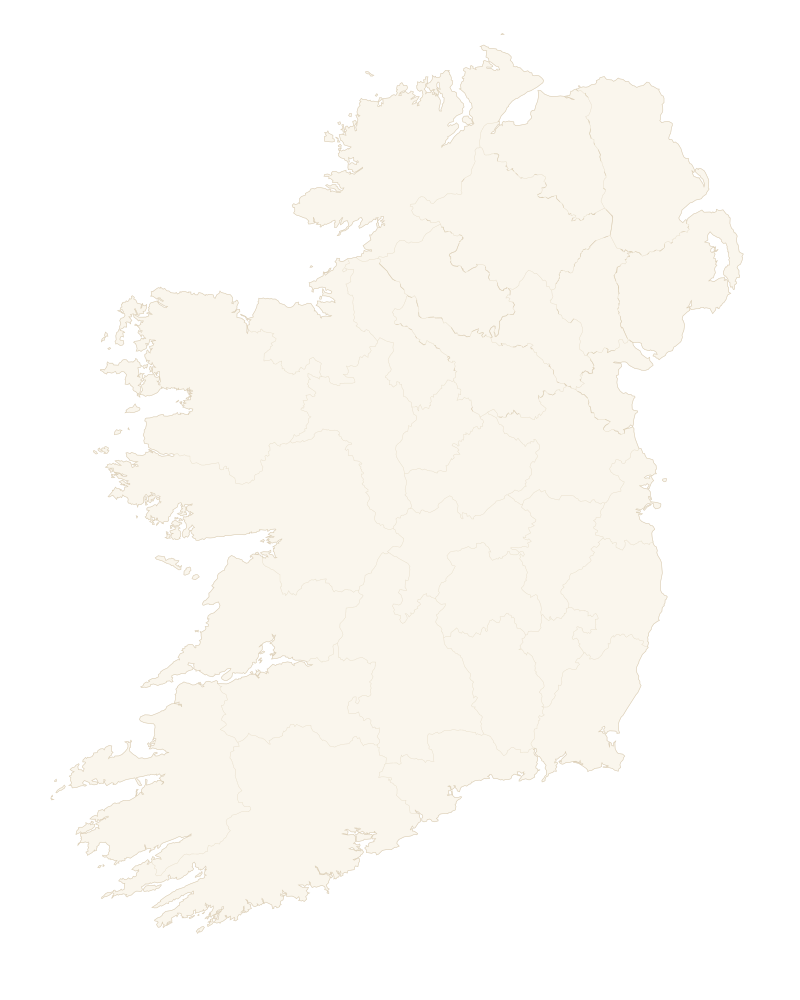
CoreHistoric reach
The seat of Boyle
Seat vacantChief
No one leads the Boyle community yet. When the movement opens, you can stand for its leadership, or help elect whoever does.
Current mission
No shared goal set yet. Once Boyle has leadership, it sets the public focus: a restoration, a gathering, a real-world project that helps its own.
The Boyle clan is being rebuilt. Join the waiting list for the movement today, and you help decide who leads it and what it does.
Help rebuild the Boyle clan →Motto
Honor virtutis praemium
“Honour is the reward of virtue”
What does the Boyle name mean?
Two distinct origins, both Anglicised as Boyle. The Gaelic Ó Baoighill, descendant of Baoigheall ('vain pledge'), was a 10th-century Donegal kindred, the third great northern dynasty alongside the O'Donnells and O'Dohertys. Separately, the Anglo-Norman Boyles came to Ireland from Herefordshire in the late 16th century, Richard Boyle, 1st Earl of Cork (1566–1643), the great Munster planter. The two surnames are unrelated; the Donegal-Boyle and the Cork-Boyle pool are entirely distinct in their lineage and converged only in the modern English orthography.
The history of Boyle
One spelling, three families that never met
The Boyle name in Ireland covers two lineages with nothing in common but their English spelling. Ó Baoighill, descendant of Baoigheall ('vain pledge'), was a tenth-century Donegal kindred, the third great northern dynasty beside the O'Donnells and the O'Dohertys. The Boyles of Cork were Anglo-Norman incomers out of Herefordshire in the late sixteenth century, brought to Munster by Richard Boyle, first Earl of Cork.
A third strand runs through Lowland Scotland, where Clan Boyle of Ayrshire took its name from Beuville near Caen and appears as David de Boivil, witness to a charter, in 1164. The Gaelic name meanwhile travelled the standard road of anglicisation, on which Ó and Mac were dropped outright or reduced to O', so that Ó Baoighill flattened to O'Boyle and then to Boyle. In the north-west of Ireland it became one of the most common family names of all.
Chiefs of the Three Tuaths, then lords of Boylagh
The Ó Baoighill were one of the principal families of the Cenél Conaill, the branch of the Northern Uí Néill descended from Conall Gulban, son of Niall of the Nine Hostages. Their first recorded standing was as Chiefs of the Three Tuaths in the north-west of Tír Chonaill. The family genealogy runs back through Aneisleis Ó Baoighill, named as a Donegal chieftain, into the same Cenél Conaill stock that produced the Ó Domhnaill kings of Tyrconnell and the O'Dohertys.
When the Three Tuaths passed to the Mac Suibhne, the MacSweeneys, the Ó Baoighill did not vanish; they moved their lordship west to Tír Ainmhireach on the Atlantic coast. That district took their name, Críoch Bhaoigheallach, O'Boyle's country, and it survives on the modern map as the barony of Boylagh, west of the Glenties.
The lordship the English records could not see
From the eleventh century to the Plantation the Boyles held Boylagh as a sub-lordship under the Ó Domhnaill kingdom, one of the three great kindreds of Tír Chonaill with the Ó Domhnaill and the Ó Gallchobhair, taking positions across political administration, ecclesiastical patronage and native military organisation: not simply a landed family, but part of the working machinery of a Gaelic state.
Western Tyrconnell saw little Anglo-Norman penetration, so the Ó Baoighill barely appear in English or Anglo-Irish administrative sources before the sixteenth century, while the Ó Domhnaill rulers turn visible in Crown records under the Tudors.
1607, and the family that stayed put
The early seventeenth century broke the Gaelic aristocracy of Ulster. In 1607 the senior Gaelic chiefs left Ireland to seek support in Spain, failed, and spent the rest of their lives in Rome. After the Flight of the Earls the Dublin authorities took real control of the whole island for the first time, disarmed the native clans and cleared the way for the Plantation of Ulster; tanistry, election from among a chief's male cousins, gave way to English primogeniture.
The Plantation displaced most Donegal Gaelic surnames from their ground. Boylagh was the exception, and Cardinal Tomás Ó Fiaich counted the Boyles there among the Gaelic clan structures still in continuous local possession in the modern era. The political thread held too: James Boyle (1863–1936) sat as Member of Parliament for West Donegal from 1900 to 1902 for the Irish Parliamentary Party.
Twenty-seven pounds, and most of east Cork
Richard Boyle came ashore in Munster in 1588 with twenty-seven pounds in his pocket. By his death in 1643 he was the wealthiest man in Ireland and Lord Treasurer of it, holding through the Munster Plantation an estate that ran to most of east Cork and west Waterford. The motto the family carries, Honor virtutis praemium, honour is the reward of virtue, reads like the self-account of a man who had landed with nothing and meant the record to show why.
The seat he chose was Lismore, above the Blackwater in County Waterford, on the site of a seventh-century monastery and school where Prince John, Lord of Ireland, raised the first castle in 1185. It had belonged to the FitzGerald Earls of Desmond until their lands were broken up after the killing of the fourteenth Earl in 1583, and then to Sir Walter Raleigh, who sold it during his imprisonment to Boyle. Lismore passed by marriage to the Cavendishes in 1753, was rebuilt in Gothic style for the sixth Duke of Devonshire, and is their Irish home still.
Cork, Burlington, Orrery and Shannon
The Cork line ran on through four more titles. Richard Boyle (1612–1698) became first Earl of Burlington and Lord High Treasurer of Ireland; Roger Boyle (1621–1679) first Earl of Orrery, soldier, statesman and dramatist; Francis Boyle (1623–1699) first Viscount Shannon, Privy Councillor and governor of County Cork. Henry Boyle (1669–1725), first Baron Carleton, was Lord Treasurer of Ireland.
The eighteenth century spread the family further. Richard Boyle, second Viscount Shannon (1675–1740), became a field marshal; Henry Boyle, first Earl of Shannon (1682–1764), founded a line that ran through four more earls to 1890; Richard Boyle, third Earl of Burlington (1694–1753), was an architect. John Boyle, fifth Earl of Cork (1707–1762), was a writer and a friend of Jonathan Swift, and Mary Boyle, Countess of Cork and Orrery (1746–1840), kept one of the literary houses of her age. William Boyle, twelfth Earl of Cork (1873–1967), rose to Admiral of the Fleet.
The fourteenth child who broke Aristotle
Robert Boyle was born at Lismore Castle on 25 January 1627, the seventh son and fourteenth child of the Great Earl and his second wife Catherine Fenton. He went to Eton at eight in 1635, and left in 1639 with his elder brother Francis on the long European tour under the Genevan tutor Isaac Marcombes. He was at Florence in January 1642 when Galileo died, and read the Dialogue Concerning the Two Chief World Systems by candlelight in Marcombes's house in the months that followed. He came back to England in 1644 to a dead father and a civil war.
He inherited Stalbridge in Dorset and had a chemical laboratory built in the house by 1649. From 1654 he was at Oxford, drawn by the natural philosophers gathered round John Wilkins at Wadham College, the Invisible College that became the nucleus of the Royal Society in 1660. He took on the young Robert Hooke as his curator of experiments, and between 1657 and 1659 the pair rebuilt Otto von Guericke's air pump into the central instrument of seventeenth-century experimental physics.
New Experiments Physico-Mechanical appeared at Oxford in 1660, and its second edition of 1662 carries in an appendix the first quantitative gas law in the history of chemistry: at fixed temperature, the volume of a gas varies inversely with the pressure on it. The Sceptical Chymist of 1661 broke with Aristotle's four elements and Paracelsus's three principles, and put in their place the definition of an element as a substance that cannot be decomposed further by chemical analysis. He was a founding fellow of the Royal Society at its incorporation in July 1662, declined its presidency in 1680 rather than swear the oath required, and died at Pall Mall on 31 December 1691, a week after his sister Katherine, Lady Ranelagh, in whose house he had worked for twenty-three years. His will endowed the Boyle Lectures, which began in 1692 and were revived in 2004.
Sauchieburn, and the road to the Earldom of Glasgow
The Ayrshire Boyles held Kelburn by 1275, when Richard de Boyville is recorded on the lands; Henry de Boyville was keeper of Dumfries, Wigtown and Kirkcudbright castles around 1291, and Richard and Robert de Boyvil both appear on the Ragman Rolls of 1296, submitting to Edward I. Six generations after that first Richard, John Boyle was killed at Sauchieburn in 1488 fighting for James III. The estates were forfeited, and his son, another John, had them restored by James IV.
The family backed Mary, Queen of Scots, and then Charles I, and suffered for the second choice. Their fortunes turned when John Boyle of Kelburn was returned as a Commissioner of Parliament and his eldest son David followed him, becoming Lord Boyle of Kelburn in 1699 and Earl of Glasgow in 1703. David sat as one of the commissioners for the Treaty of Union, and in the Jacobite rising of 1715 raised and armed troops for the Hanoverian government at his own expense.
Fontenoy, a bankrupt earl, and Brazilian graffiti
John Boyle, third Earl of Glasgow, was wounded at Fontenoy in 1745 and again at Lauffeld in 1747, and afterwards served nine consecutive years as Lord High Commissioner to the General Assembly of the Church of Scotland. David Boyle, a grandson of the second Earl, became Solicitor General for Scotland in 1807 and Lord Justice General in 1841, retiring in 1852 after forty-one years of legal service. George Boyle, fourth Earl, was Lord Lieutenant of Renfrewshire from 1810, and his eldest son John was captured by the French off Gibraltar in 1807.
George Frederick Boyle, sixth Earl, came close to ending the line's fortunes. Gripped by Pre-Raphaelite notions of form and beauty, he ran a monumental building programme, renovating Kelburn and funding churches across Scotland, until the estate was bankrupted in 1888 and the assets sold. Kelburn was saved by the purse of his cousin David, who succeeded as seventh Earl in 1890, served as Governor of New Zealand from 1892 to 1897, and was created Baron Fairlie in 1897 to secure a Scottish peer a seat in the Lords.
Kelburn has been in Boyle possession since the twelfth century, its core a thirteenth-century keep remodelled in the sixteenth, and no house in Scotland has been lived in by one family for longer. The grounds opened as a country park in 1977, and when the concrete facing was found in 2007 to need replacing, Lord Glasgow invited four Brazilian graffiti artists to decorate the walls, then sought permission in 2011 to keep the painting on a category A listed building. Stanely, near Paisley, ended the other way: held by the Earls of Glasgow in the eighteenth century, sold by the fourth Earl to the Paisley Water Company, and partly submerged by their reservoir since 1837.
Champions of the Boyle name
The bearers whose lives are inseparable from this surname. Each has their own page, biography, achievements, geography, connection to the family.
Historic Places, Rebuilt
Explore the streets and seats the Boyle name knew, rebuilt with AI as they stood in history.
Castles the Boyle held
Strongholds this name held for a decade or more, look one up, or rebuild it to explore.
- Lismore Castle
Held by the Boyle Earls of Cork in the 17th century, after Sir Walter Raleigh's tenure from 1589.
- Rowallan Castle
Held by the Boyle Earls of Glasgow.
- Kelburn Castle
Boyle lands since the 12th century; seat of the Boyle Earls of Glasgow from 1703, held to this day.
- Stanely Castle
The Boyle Earls of Glasgow held Stanely in the 18th century, until the 4th Earl sold it to the Paisley Water Company.
Landmarks the Boyle held
Palaces, houses and great buildings tied to this name, look one up, or rebuild it to explore.
- Chiswick House
Designed and built by Richard Boyle, 3rd Earl of Burlington, as his Palladian villa, completed in 1729.
The castles of the homeland
The great strongholds of the homeland, look one up, see what it looked like in its prime, and recreate it to explore.
 Ashford Castle, County MayoRestored · prime 1880
 Manderley CastleRestored · prime 1840
 Dublin CastleRestored · prime 1790
All castles in Ireland → · Strongest castles in Ireland → · Castles of Europe
Play As Your Clan
Hold a real castle against whatever you choose to send at it, take a ship out in her own service years, or stand at the shoulder of someone the record remembers. The chronicler sets the scene; the deeds are yours.
Notable bearers of the Boyle name
- Richard Boyle, 1st Earl of Cork (1566–1643), Munster planter, the Great Earl
- Robert Boyle (1627–1691), chemist, founder of the Royal Society
- Susan Boyle (b. 1961), Scottish-Irish singer of Donegal-Boyle descent
- Danny Boyle (b. 1956), film director (Trainspotting, Slumdog Millionaire)
Stories of Boyle
Frequently asked
What does the surname Boyle mean?
Where does the Boyle family come from?
Where did the Boyle family historically hold territory?
Is Boyle Irish or Scottish?
How old is the Boyle surname?
What is the Boyle family known for?
What is the Boyle motto?
What does "Honor virtutis praemium" mean in English?
Is there a Boyle family crest or coat of arms?
Who is the most famous Boyle?
Who are some famous Boyles?
What stories are told about the Boyle family?
What is the story of Robert Boyle and The Sceptical Chymist?
Is O'Boyle the same family as Boyle?
Is Ó Baoighill the same family as Boyle?
Where is the Boyle surname found today?
What does the Clan Rising page for the Boyle family cover?
Who is the head of the Boyle family today?
Neighbouring clans
- O'DonnellTír Chonaill, Red Hugh's escape, and the Flight of 1607.
- GallagherOf Tír Chonaill and the household cavalry of the O'Donnell.
- DohertyLords of Inishowen, and the revolt that triggered the Plantation of Ulster.
- ClarkeAnnalists of Tír Chonaill, and the surname of the 1916 Proclamation's first signatory.