
Ireland · Restored
Donegal Castle
Caisleán Dhún na nGall
Donegal Castle is a late medieval tower house and manor complex in the centre of Donegal Town, County Donegal, Ireland. Built as the O'Donnell stronghold in the 15th century, it later received a Jacobean manor wing and a small gatehouse and is today conserved and open to the public.
Its prime
1620
Today
Restored
As it stood in 1620
What Donegal Castle looked like in its prime.
A tall 15th-century rectangular keep with a projecting angular corner tower stands attached to a later Jacobean manor wing with steep gabled dormers and large mullioned windows. A small gatehouse mirrors the keep’s stonework. Most masonry is rough grey local limestone with some sandstone dressings; a 17th-century boundary wall encloses a grassed courtyard. In prime condition the roofs are pitched and fully covered, the tower and manor display multiple glazed mullioned windows and timber floors internally.
Its story
The story of Donegal Castle.
Hugh Roe O'Donnell's Tower House, 1460s
The name Dún na nGall translates as fort of the foreigner, and may recall a Viking fortress destroyed in the area in 1159, though hundreds of years of building over the ground have left no archaeological trace of it. The castle itself came much later. Hugh Roe O'Donnell I, a wealthy chief of the O'Donnells, raised it in the 1460s or early 1470s, on a bend of the River Eske near the mouth of Donegal Bay. His family were Lords of Tír Conaill and, from the fifth century to the sixteenth, among the most powerful Gaelic dynasties in Ireland. In 1474 Hugh Roe and his wife Nuala founded a Franciscan friary further down the river; local tradition holds that a tunnel joined the two, but no evidence of one has been found.
Sir Henry Sidney's Report, 1566
In 1566 the English Lord Deputy of Ireland, Sir Henry Sidney, visited Donegal and wrote to William Cecil, the Lord High Treasurer and later Baron Burghley, calling it "the largest and strongest fortress in all Ireland". He went further: "it is the greatest I ever saw in an Irishman's hands: and would appear to be in good keeping; one of the fairest situated in good soil and so nigh a portable water a boat of ten tonnes could come within ten yards of it". The castle was reckoned one of the finest Gaelic castles in Ireland, and the judgement came from the Crown's own chief officer in the country.
The Flight of the Earls and Basil Brooke
In 1607, after the Nine Years' War, the leaders of the clan left Ireland in the Flight of the Earls, and on their way out they severely damaged the tower house, so that it could not be turned against the Gaelic clans they were leaving behind. It did not stay broken long. During the Plantation of Ulster the castle and its lands were granted to an English captain, Basil Brooke, who had the keep quickly repaired and then remade it: new windows, a gable, and a large manor-house wing in the Jacobean style set against the fifteenth-century tower.
The Gores, Ruin and the Office of Public Works
The Brookes held Donegal until the 1670s, when they moved to near Lisnaskea in County Fermanagh and sold the castle to the Gore dynasty, who later became Earls of Arran in the Peerage of Ireland. Under the Gores it fell into a ruinous state in the early eighteenth century, and for most of the last two centuries the majority of the buildings lay in ruins. In 1898 the 5th Earl of Arran vested the castle in the Office of Public Works.
The Office of Public Works partially restored the site in the early 1990s, re-roofing and re-flooring the tower house in keeping with the styles and techniques of the fifteenth and seventeenth centuries, repairing the stonework, and putting a partial roof over the manor wing. Some of the oak timbers came from the Colebrooke Estate outside Brookeborough, the same County Fermanagh the Brookes had left Donegal for three centuries before.
Step inside
9 places to explore in 1620.
The record describes 9 distinct spots at Donegal Castle, including 1 interior: tower house interior chamber with oak timbers. Create your own photoreal reconstruction and explore every one, more scenes means more rooms, more angles, and more of the place to stand in.
Build Your Own Castle
Recreate Donegal Castle with AI to explore it.
The artist rebuilds it as it stood in 1620, a photoreal reconstruction that belongs to you alone. Pay with coins, no subscription needed.
Recreate this castle →Defend this castle →Whose castle
Clans who held Donegal Castle.
The families that held Donegal Castle for a decade or more across its history, follow a name to its clan.
Stronghold of the O'Donnell chiefs of Tyrconnell, 15th–16th centuries.
From the archive
Donegal Castle on paper: the measured plan and period views.
The survey plan and photographs below are the ground truth this page's reconstructions are checked against, drawn and photographed while the castle was still a working garrison. Every image is public-domain or openly licensed, with its source named.
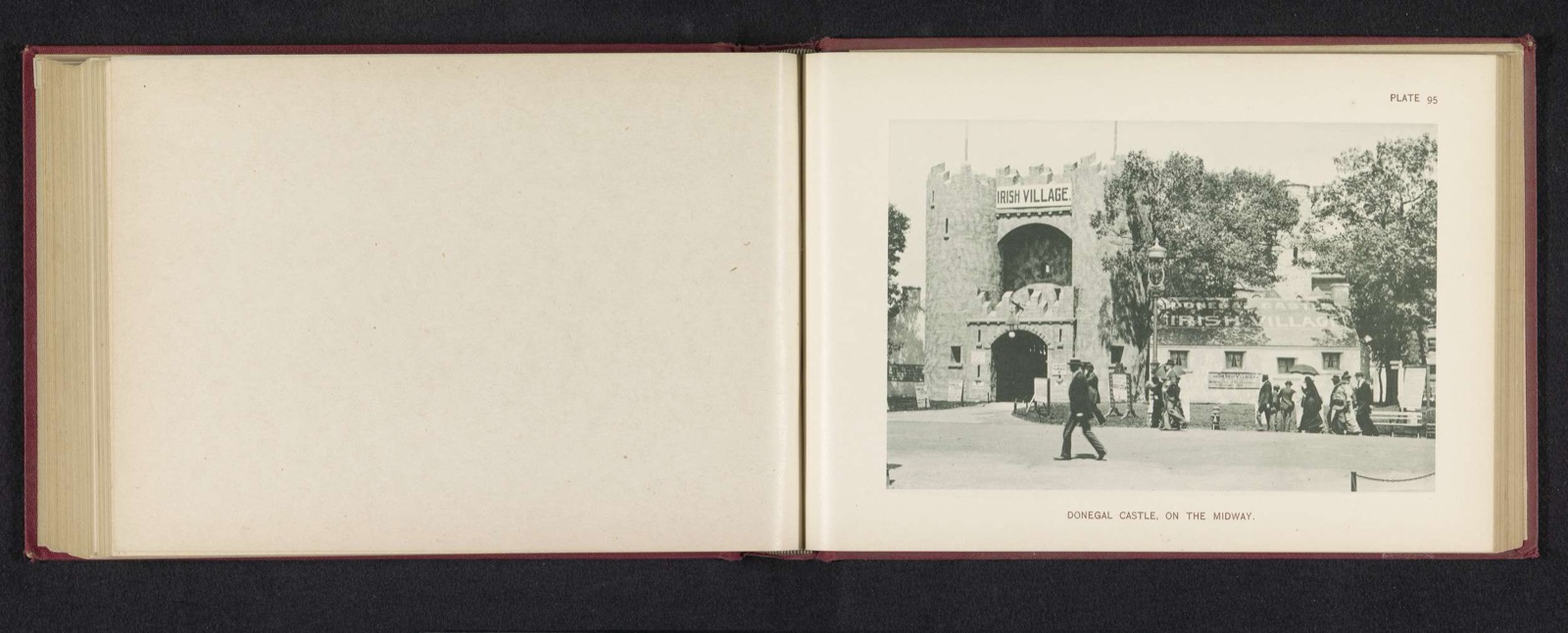
Gezicht op de bijdrage van Ierland met een replica van het Donegal Castle op de World's Columbian Exposition i
1893 · Rijksmuseum (via Europeana)
Public domain


