
Austria · Restored
Hohenwerfen Castle
Festung Hohenwerfen
Hohenwerfen Castle is a medieval rock fortress perched on a 155-metre limestone pillar above the town of Werfen in the Salzach valley, built for the prince-archbishops of Salzburg in the 11th century. It served as a fortified residence, hunting retreat and state prison and remains a largely intact, museumized fortress today.
First raised
1075
Its prime
1617
Today
Restored
Ranked among Europe’s castles
As it stood in 1617
What Hohenwerfen Castle looked like in its prime.
Perched atop a sheer 155-metre rock, the fortress reads as a compact complex of light-coloured plastered residential ranges and stout grey stone curtain walls. A long, angled masonry ramp and gatehouse descend the rock to a lower outer bailey with round towers capped by conical slate roofs; the inner keep is a rectangular palas with rows of windows and red-and-white shutters. Rounded bastions, crenellated parapets and wooded alpine slopes surround the site; at prime the buildings are intact and occupied.
Its story
The story of Hohenwerfen Castle.
Gebhard's Bulwark in the Investiture Controversy, 1075–1088
Archbishop Gebhard of Salzburg took the side of Pope Gregory VII against King Henry IV, and the king's loyalists plundered and laid waste his archbishopric for it. His answer was to build in haste. Between 1075 and 1078 he raised Hohenwerfen and Hohensalzburg together (both far smaller than the fortresses that now carry their names), and had Petersberg Castle at Friesach in Carinthia extended as well, three strongholds securing the route through the Eastern Alps along the Salzach. The first work at Hohenwerfen was modest: a ring wall of roughly 35 by 35 metres enclosing a small palas and a chapel, of which only fragments of masonry survive.
The rock closes the only approach to the Pass Lueg from the south, where the Salzach runs through a narrow valley, the key point on the old alpine road carrying Salzburg's traffic towards Graz and south-eastern Europe, and towards Venice and Italy. Gebhard's speed protected the bishop's city and its church treasure, and barred Henry IV, after his walk to Canossa, the shorter way home through the eastern Alpine passes. It did not save the archbishop himself: he was driven out of Salzburg, returned only in 1086 with the backing of the Bavarian duke Welf I, and died at Hohenwerfen two years later.
This Far and No Further: Konrad I's Fortress and Its Prisoners
Archbishop Konrad I took the papal side in the same quarrel and enlarged both of the great bishops' castles. His medieval biography preserves a saying of his about Hohenwerfen and the Salzach valley: this far you may come, but no further. Between 1127 and 1142 he set a larger palas at right angles to the old one and joined it to the chapel, both built into the continuous castle wall and together making the monumental block that still dominates the rock. Frescoes uncovered in the chapel in 1983 show the angels' battle against the Whore of Babylon, readable as the papal cause against the emperors, alongside a knight in 12th-century dress whose almond shield carries a Latin motto: the whole world may come, but nobody passes unpunished. A century after the Crusades came arrow slits, defensive oriels, a zwinger and flanking towers, after which the archbishops largely stopped building.
The fortress also served as a state prison, which gave it a somewhat sinister reputation; prisoners spent their days there in inhumane conditions, and for some those days may have been their last. Not all were common criminals: Archbishop Adalbert III was arrested here by his own ministeriales in 1198, and Count Albert of Friesach was held in 1253.
The Fires of 1525 and 1931
In the Peasants' War, farmers and miners from the south of the archbishopric moved on Salzburg in 1525 and 1526, setting fire to Hohenwerfen and damaging it badly; the Styrian governor Siegmund von Dietrichstein was taken prisoner by the insurgents and brought here in 1525. The rebuilding under Archbishop Matthäus Lang added a blocking-arch building with its gate guard and a small bastion, and further substantial work on the outer wards was finished by 1534 under the threat of a Turkish attack. Prince-Archbishop Wolf Dietrich von Raitenau was imprisoned here after Bavarian troops captured him in 1611, and Paris Lodron, trying to keep Salzburg out of the entanglements of the Thirty Years' War, strengthened the fortress along with the walls of his capital.
After the secularisation of Salzburg from 1803 the castle decayed under Bavarian rule, until Archduke Johann restored it between 1824 and 1833, after which it served as a hunting seat. Archduke Eugen bought the estate in 1898 and kept his large art and weapons collection there. In January 1931 a smouldering fire destroyed much of the east and south tracts and almost all of the north tract; the Burgahnl, the fortress bell cast at Innsbruck in 1568 and still rung on high feast days, was got out, but the loss was heavy. Eugen sold much of his collection to pay for the rebuilding, and in 1938 was forced to sell the castle itself to the Reichsgau Salzburg. During the Second World War it housed a Gauführerschule of the NSDAP, opened on 5 March 1939 by Salzburg's Gauleiter Friedrich Rainer; at the war's end it passed to the state of Salzburg, served at first as a training centre for the gendarmerie, and has been open to visitors since 1987.
Step inside
10 places to explore in 1617.
The record describes 10 distinct spots at Hohenwerfen Castle, including 3 interiors: front of the palas (residential range), prison / dungeon cells, weapons hall / armory. Create your own photoreal reconstruction and explore every one, more scenes means more rooms, more angles, and more of the place to stand in.
Build Your Own Castle
Recreate Hohenwerfen Castle with AI to explore it.
The artist rebuilds it as it stood in 1617, a photoreal reconstruction that belongs to you alone. Pay with coins, no subscription needed.
Recreate this castle →Defend this castle →Whose castle
Clans who held Hohenwerfen Castle.
The families that held Hohenwerfen Castle for a decade or more across its history, follow a name to its clan.
Habsburg
Long held by the House of Habsburg; owned by Archduke Eugen of Austria until sold in 1938.
From the archive
Hohenwerfen Castle on paper: the measured plan and period views.
The survey plan and photographs below are the ground truth this page's reconstructions are checked against, drawn and photographed while the castle was still a working garrison. Every image is public-domain or openly licensed, with its source named.
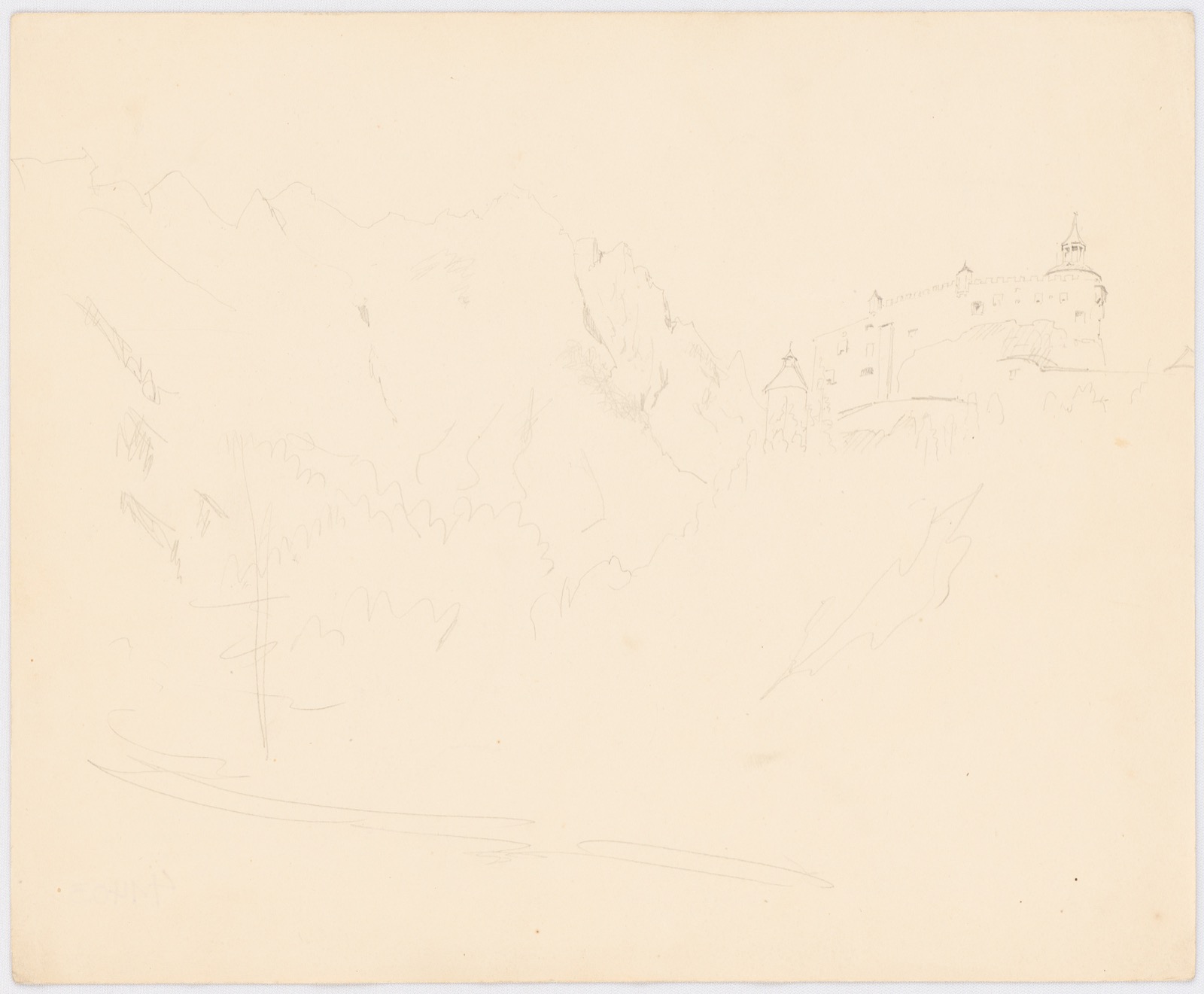
Festung Hohenwerfen, Salzburger Land: Perspektivische Ansicht
· Museum of Architecture at Berlin Institute of Technology (via Europeana)
CC0 (no rights reserved)


