
Austria · Restored
Itter Castle
Schloss Itter
Itter Castle (Schloss Itter) is a hilltop castle in Itter, Tyrol, rebuilt in the late 19th century on medieval foundations. Perched above the entrance to the Brixental valley, the present building is a 19th/early-20th-century Tudor Revival residence. During World War II it was used as a prison for prominent French detainees and was the scene of the 1945 Battle for Castle Itter.
First raised
1241
Its prime
1900
Today
Restored
As it stood in 1900
What Itter Castle looked like in its prime.
Set atop a wooded knoll above the Brixental valley, the castle presents a tall, square, crenellated keep rising beside a long rectangular main block capped by a continuous battlemented parapet. Pale rendered masonry walls punctuated by narrow pointed-arch (lancet) windows define the facades; a lower residential wing with hipped metal roofs and arched ground-floor openings adjoins an arcaded loggia and external stair. A crenellated outer curtain wall terraces the slope below, with Alpine peaks beyond.
Its story
The story of Itter Castle.
Regensburg's Bailiffs and the Peasants' War
A fortress on the knoll at the entrance to the Brixental is first mentioned in a deed of 1241, though building on the site may go back to the 10th century. The valley was a possession of the Prince-Bishops of Regensburg, and the castle served as an administrative seat of the Counts of Ortenburg in their capacity as Vogt bailiffs, protecting the Regensburg estates against incursions by the neighbouring Archbishops of Salzburg. Salzburg acquired the Brixental all the same in 1312, and in 1380 the Regensburg bishops sold Itter itself to Archbishop Pilgrim II.
Feuds and breaches of the public peace were banned within Itter's Burgfrieden jurisdiction, but the castle was devastated during the German Peasants' War in 1526. When the seat of the local administration moved to Hopfgarten in the 17th century, the buildings decayed. The Brixental remained Salzburg's until 1805, when it fell to the newly established Kingdom of Bavaria; the Bavarian government left the ruin to the citizens of Itter, who used it as a quarry. The Final Act of the Congress of Vienna brought the valley into the Austrian crown land of Tyrol in 1816.
Sophie Menter's House, 1884–1902
The present building was raised on the foundations of the old one from 1878 onwards. Sophie Menter (pianist, composer and student of Franz Liszt) bought it as a residence in 1884. Liszt himself stayed there, as did the young Arthur Rubinstein, and Pyotr Ilyich Tchaikovsky orchestrated one of his compositions during a visit in 1892. Menter sold the castle in 1902, and later owners remodelled it extensively in the Tudor Revival style it carries today.
A Dachau Subcamp for French Prisoners, 1943–1945
After the Anschluss of 1938, the Reich government leased the castle from its owner, Franz Grüner, in late 1940. On 7 February 1943 SS Lieutenant General Oswald Pohl seized it from Grüner under orders from Heinrich Himmler, and by 25 April 1943 it had been converted into a prison. It was established to hold prominent French prisoners considered valuable to Nazi Germany, and was administered as a subcamp of the Dachau concentration camp.
Those held there included the former prime ministers Édouard Daladier and Paul Reynaud; the generals Maurice Gamelin and Maxime Weygand, a former commander-in-chief; the former tennis champion Jean Borotra, later General Commissioner of Sports in the Vichy regime; François de La Rocque, leader of the right-wing Croix de Feu movement; the trade union leader Léon Jouhaux; the politician and diplomat André François-Poncet; and Michel Clemenceau, son of Georges Clemenceau. Albert Lebrun, the former president of the republic, was held for three months in 1943 before being sent back to France for health reasons, and Marie-Agnès de Gaulle, a Resistance member and sister of General Charles de Gaulle, was interned at the castle in April 1945. Itter also held a number of Eastern European prisoners detached from Dachau, who were used for maintenance and other menial work.
The Battle for Castle Itter, 4–5 May 1945
On the afternoon of 4 May 1945 the commander of the Dachau prison, Eduard Weiter, fled to Itter, where he died in unclear circumstances. The SS-Totenkopfverbände guards fled, and shortly afterwards the prisoners armed themselves and waited for an anticipated attack by Waffen-SS troops still resisting surrender. Members of the Austrian resistance were among the defenders. Two Sherman tanks of the 23rd Tank Battalion of the US 12th Armored Division, under Captain John C. Lee Jr., arrived together with anti-Nazi elements of the Wehrmacht under Major Josef Gangl, and together they held off SS reconnaissance probes through the night. The fighting continued through the morning of 5 May, with a force of 100–150 SS pressing the attack, until reinforcements from the American 142nd Infantry Regiment arrived at about four o'clock that afternoon.
Hotel and Private Ownership since 1950
Itter fell into disrepair after the war until Willi Woldrich acquired it in 1950 and turned it into a luxury hotel. The hotel ran into financial difficulty and was taken over by a holding company, then sold to a private owner in 1985. It has remained in private hands since and is not open to the public.
Step inside
8 places to explore in 1900.
The record describes 8 distinct spots at Itter Castle, including the full exterior approach. Create your own photoreal reconstruction and explore every one, more scenes means more rooms, more angles, and more of the place to stand in.
Build Your Own Castle
Recreate Itter Castle with AI to explore it.
The artist rebuilds it as it stood in 1900, a photoreal reconstruction that belongs to you alone. Pay with coins, no subscription needed.
Recreate this castle →Defend this castle →From the archive
Itter Castle on paper: the measured plan and period views.
The survey plan and photographs below are the ground truth this page's reconstructions are checked against, drawn and photographed while the castle was still a working garrison. Every image is public-domain or openly licensed, with its source named.
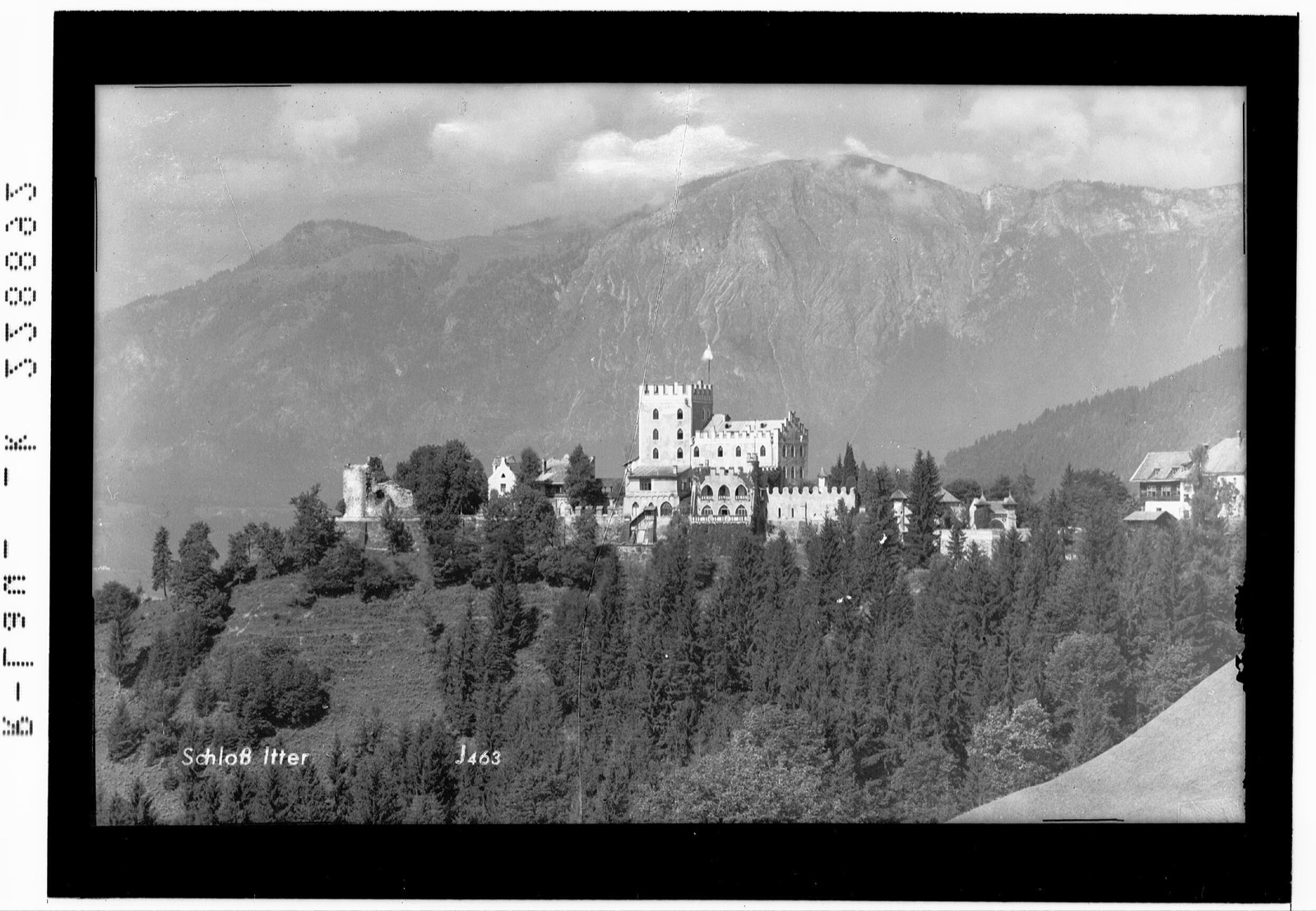
Schloss Itter
· Vorarlberg State Library (via Europeana)
CC BY


