Austria · Restored
Lockenhaus Castle
Burg Lockenhaus
Burg Lockenhaus is a medieval hilltop castle in Lockenhaus, Burgenland, Austria, built in Romanesque and Gothic phases around 1200 and altered through the 17th century. The complex contains multiple courtyards, a tall square keep, residential ranges and extensive subterranean chambers. It is today a restored cultural venue and part of the Naturpark Geschriebenstein.
First raised
1200
Its prime
1670
Today
Restored
As it stood in 1670
What Lockenhaus Castle looked like in its prime.
Perched on a wooded spur above the town, the castle is an irregular multi-range complex of exposed local stone and white‑washed plastered walls; steep hipped slate roofs cover residential ranges while at least one tall square keep and several smaller polygonal towers rise above the courtyards. Two distinct courtyards lie within the curtain; narrow slit windows and small rectangular openings puncture the walls. The site faces the Güns Valley with the town and a small lake visible to the east.
Its story
The story of Lockenhaus Castle.
Burg Lockenhaus was built around 1200 in Romanesque and Gothic styles in the Güns Valley of Burgenland, and was initially called "Leuca" or Léka. The lords of the castle ran from the Güssinger (1266–1390) to the Kanizsay (1390–1535), the Nádasdy (1535–1676) and the Esterházy (1676–1968); notable owners included Duke Frederick the Warlike, Henry II of Güssing, the Bohemian king Ottakar II and King Maximilian II.
Castle and town saw substantial improvements under Francis III Nadasdy (1622–1671), Lord Lieutenant, Royal Council, Chief Chamberlain and, from 1664, Chief Justice. In 1676 Count Paul Esterhazy, Nadasdy's brother-in-law, took possession. Beneath the castle lies the Nadasdy family sepulchre, built of square stones and vaulted in round arches resting on columns, with a second sepulchre dug deep into solid rock beneath the lord's rooms.
In 1968 Professor Paul Anton Keller and his wife Margaret bought the castle, then in ruins, and sold all their possessions to refurbish it; since 1980 it has belonged to the Professor Paul Anton Keller Foundation. The restored complex, multiple courtyards, a tall square keep and extensive subterranean chambers, is now a cultural venue within the Naturpark Geschriebenstein.
Step inside
11 places to explore in 1670.
The record describes 11 distinct spots at Lockenhaus Castle, including 6 interiors: rittersaal (gothic knights' hall), double‑apsed kultraum (first floor), chapel in a tower with frescoes and more. Create your own photoreal reconstruction and explore every one, more scenes means more rooms, more angles, and more of the place to stand in.
Build Your Own Castle
Recreate Lockenhaus Castle with AI to explore it.
The artist rebuilds it as it stood in 1670, a photoreal reconstruction that belongs to you alone. Pay with coins, no subscription needed.
Recreate this castle →Defend this castle →Whose castle
Clans who held Lockenhaus Castle.
The families that held Lockenhaus Castle for a decade or more across its history, follow a name to its clan.
Güssinger
Lords of Lockenhaus, 1266–1390.
Kanizsay
Lords of Lockenhaus, 1390–1535.
Nádasdy
Held Lockenhaus 1535–1676; Francis III Nadasdy (1622–1671) substantially improved castle and town, and the family sepulchre lies beneath the castle.
Esterházy
Count Paul Esterhazy, Nadasdy's brother-in-law, took possession in 1676; the family held it until 1968.
From the archive
Lockenhaus Castle on paper: the measured plan and period views.
The survey plan and photographs below are the ground truth this page's reconstructions are checked against, drawn and photographed while the castle was still a working garrison. Every image is public-domain or openly licensed, with its source named.
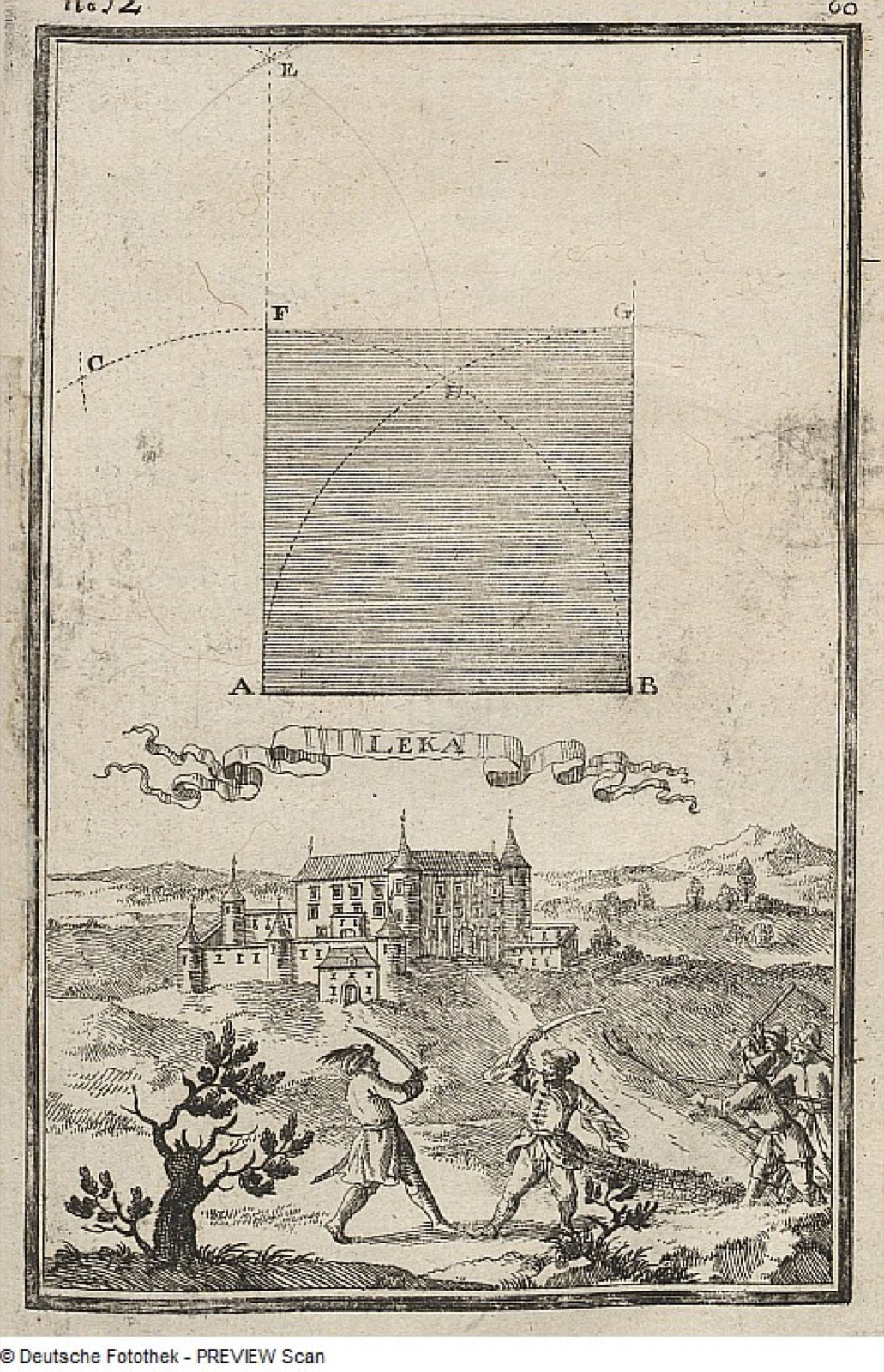
Quadrat, Ansicht der ungarischen Stadt und Festung Leka (Lockenhaus)
· Deutsche Fotothek (via Europeana)
Public domain