
Austria · Restored
Riegersburg Castle
Riegersburg Castle is a large medieval fortress built atop a steep basalt volcanic neck above the town of Riegersburg in Styria, Austria. The present complex retains extensive multi-level defensive walls, terraces and a compact summit castle complex that today houses a museum and exhibitions.
Its prime
1653
Today
Restored
Ranked among Europe’s castles
As it stood in 1653
What Riegersburg Castle looked like in its prime.
Perched on a steep basalt volcanic neck, the castle forms a stepped silhouette of terraced curtain walls and bastions climbing to a compact summit complex. The upper buildings cluster around a square clock tower with a white clock face, and low rectangular wings with red-tiled roofs. Multiple lower red-roofed guardhouses and small pavilions punctuate the long stone curtain walls. Steep vineyard terraces and packed stone retaining walls run up the hill; the masonry is a mix of pale dressed stone and darker volcanic rock.
Its story
The story of Riegersburg Castle.
Ruotkerspurch on the Basalt Cone
The castle rock is a volcanic neck standing over a hundred metres above the country, steep on three sides. A refuge fort stood on it from Carantanian times, the 7th century onwards. The upper fortress, later called Kronegg, was probably raised on the northern knoll before or around 1100, and the castle enters the record as Ruotkerspurch, the stronghold of a Rüdiger, dated 1138 in the Styrian charters and 1122 by other accounts.
By 1142 it was held by Hartnid von Traisen-Ort, who styled himself "von Riegersburg"; from him castle and lordship went to his son-in-law Richer von Hengist (1130–1168), ancestor of the Riegersburg-Wildon family. To hem that house in, Margrave Otakar III had a princely counter-fortress built around 1140 to 1150, with the market of Riegersburg at its foot; this Lower Fortress, later Lichtenegg, was run by burgraves for the sovereign.
The Kuenring Revolt and the Walsee Takeover, 1249–1363
When Leutold of Riegersburg-Wildon died in 1249 the upper fortress passed through his daughter Gertrud to her husband, Albero V of Kuenring-Dürnstein. In 1295 Leutold of Kuenring rose with the Austrian nobility against Duke Albrecht, and his defeat forced him to sell his "Haus Rugerspurch" in 1299 to Ulrich I of Walsee-Graz. The Walseer then gathered in the whole lordship, and in 1320 the sovereign's lower fortress with it, first in pledge and at last as a hereditary fief. The Styrian line died out in 1363, its lands going to the Upper Austrian Walsee-Enns after a contested inheritance with the Habsburgs.
Duke Ernst's Siege of 1412 and the Cutting of the Eselsteig
In the Walsee feud Reinprecht II of Walsee-Enns allied with Duke Albrecht V against Duke Ernst. In 1412 the Walsee burgrave rode out from Riegersburg on raids against Ernst's princely holdings and laid waste large parts of eastern Styria. That autumn Ernst took the lower castle after a short siege, and the garrison of the upper castle had to surrender with it. Emperor Sigismund's intervention returned most of Reinprecht's forfeited Styrian possessions, Riegersburg among them, in 1417.
Around 1420 the Walseer had the Eselsteig cut out of the west face of the rock, a stair 120 metres long that freed the upper castle from the old main approach. From then the two castles stayed united in one hand, and were never taken again, neither by the Hungarians nor by the Turks. Reinprecht III repaired the works in 1434, but his son Wolfgang pledged the castle away in 1456, and it was sold to Reinprecht von Reichenburg in 1479.
The Gallerin's Fortress, 1648–1672
Andrä von Graben came into Riegersburg in 1539 by marrying the Reichenburg heiress Polixena, but a formal defect returned it to the sovereign after his death. Erasmus von Stadl, lord from 1571, remodelled the high castle in late Renaissance style; Georg Christoph von Ursenbeck bought it in 1618. A court judgment carried it to Seyfried von Wechsler in 1637 and, by two inheritances, to Elisabeth Katharina Wechsler, wife of Freiherr von Galler, in 1648.
The Gallerin, "schlimme Liesl" to Styria, paid her first husband, the Court War Council president Hans Wilhelm von Galler, 15,000 gulden to keep him out of joint ownership so that she alone controlled castle and lordship. Her second, Colonel Detleff von Kapell, fell at Mogersdorf in 1664; the third, Hans von Stadl, she divorced. With the Ottoman frontier at times only 20 to 25 kilometres off, she rebuilt the defences at enormous cost, and Field Marshal Raimondo Montecuccoli called the result the strongest fortress of Christendom. Antonio Solari completed her white summer dining hall in 1658, its inscription owning the bill: "Building is a fine pleasure. What it costs me, I well know."
Purgstall Completion, the 1822 Auction and 8 May 1945
The outworks and the three-kilometre wall enclosing fifteen hectares (behind which the people of the district and their cattle could shelter in an emergency) were finished only from 1676, after the Gallerin's death in 1672, by the counts of Purgstall, to whom the lordship had come through her heiress daughter Regina. The first four gates followed between 1678 and 1690, the work of the master builder Bartholomäus Ebner. The great Feldbach witch trial ran from 1673 to 1675; among its best-known victims was Katharina Paldauf.
When the Riegersburg counts of Purgstall died out in 1817 the inheritance was divided among seventeen people, who sold it at public auction in 1822 to Prince Johann von Liechtenstein. On 8 May 1945 the castle was taken by the 10th Guards Rifle Division of the Soviet forces advancing on Graz. The Liechtensteins, who hold it still, saved it from the ruin that threatened after the destruction of that year.
Step inside
9 places to explore in 1653.
The record describes 9 distinct spots at Riegersburg Castle, including 2 interiors: museum historical room (history displays), witchcraft exhibition room. Create your own photoreal reconstruction and explore every one, more scenes means more rooms, more angles, and more of the place to stand in.
Build Your Own Castle
Recreate Riegersburg Castle with AI to explore it.
The artist rebuilds it as it stood in 1653, a photoreal reconstruction that belongs to you alone. Pay with coins, no subscription needed.
Recreate this castle →Defend this castle →Whose castle
Clans who held Riegersburg Castle.
The families that held Riegersburg Castle for a decade or more across its history, follow a name to its clan.
Walseer
Among the castle's later medieval owners; feuded with the sovereign of Styria in 1415.
Galler
Held by the Gallers; Lady Galler's daughter carried the castle by marriage to the Purgstalls.
Purgstall
Held by the Purgstall family until the line died out in 1817.
Liechtenstein
Bought by Johann Josef von Liechtenstein in 1822; still owned by the Princely Family of Liechtenstein.
From the archive
Riegersburg Castle on paper: the measured plan and period views.
The survey plan and photographs below are the ground truth this page's reconstructions are checked against, drawn and photographed while the castle was still a working garrison. Every image is public-domain or openly licensed, with its source named.
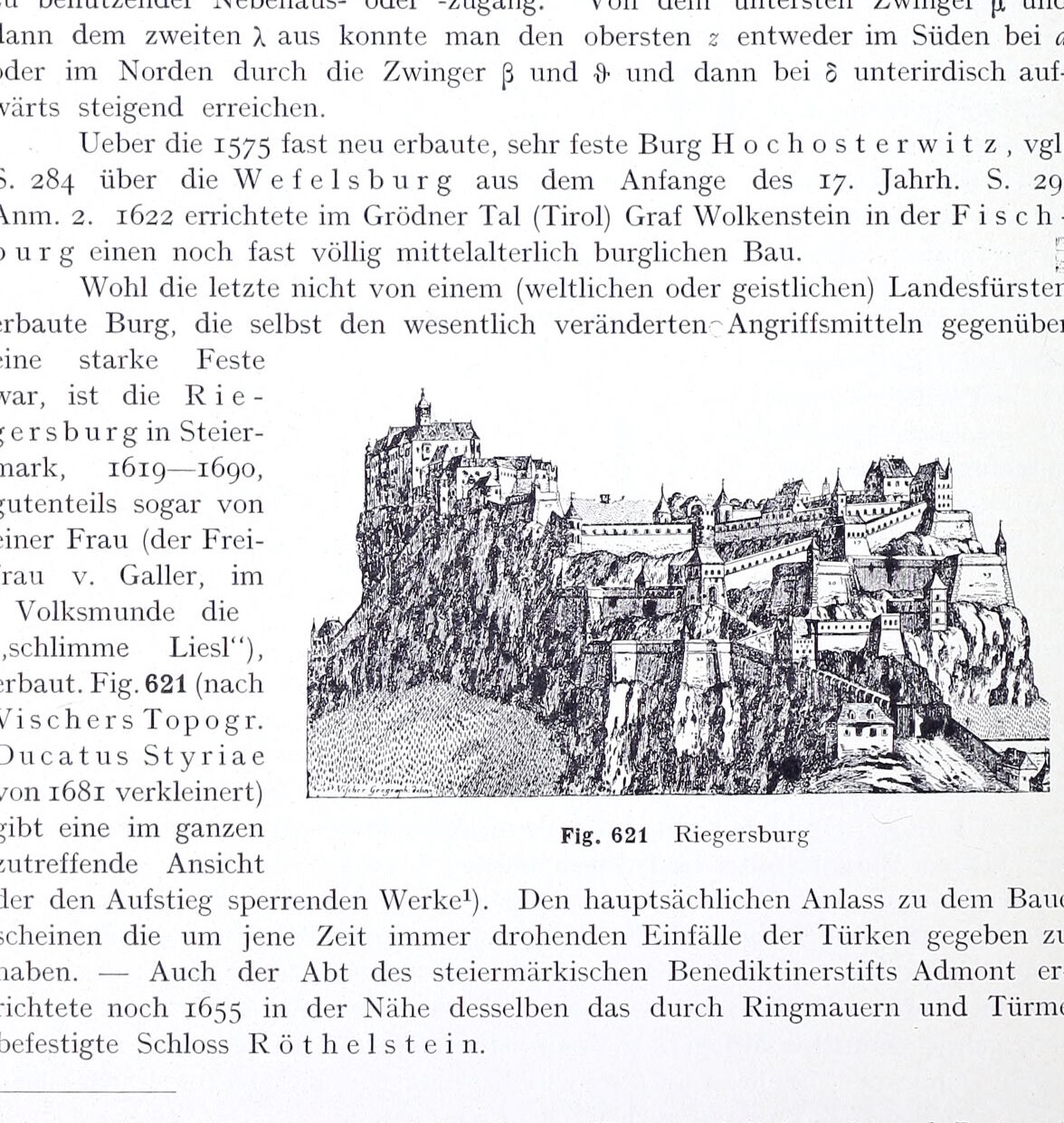
Fig. 621 Riegersburg
1912 · Otto Piper, Burgenkunde (1912)
Public domain


