
Austria · Restored
Rosenburg Castle
Schloss Rosenburg
Rosenburg is a cliff-top castle in Rosenburg-Mold, Lower Austria, notable for its large Renaissance rebuild and later 17th-century expansion. Perched above the valley of the River Kamp, it preserves a mix of medieval and Renaissance fabric and today houses a museum and staged historical events. The von Hoyos-Sprinzenstein family remain the owners.
First raised
1175
Its prime
1614
Today
Restored
As it stood in 1614
What Rosenburg Castle looked like in its prime.
Perched on a steep rocky crag above the Kamp valley, Rosenburg presents pale plastered curtain walls and a long, multi-level roofline punctuated by numerous round turrets with conical grey roofs and a taller square bergfried with a steep hipped roof. Façades show regularly spaced rectangular windows and several chimney stacks; a tall pointed Gothic chapel window is visible on an outer wall. A continuous arcaded gallery runs along inner ranges, and dense woodland frames the cliff below.
Its story
The story of Rosenburg Castle.
Goczwin's Small Castle and the Hussite Raid, 1175 to 1433
The first written record of the Rosenburg dates from 1175. The castle sits on a cliff above the valley of the River Kamp in Lower Austria, 345 metres above sea level, and the first building on the rock was raised in the 12th century in the Romanesque style. Of the small castle of Goczwin von Rosenberg only the foundations remain, in the base of the present keep. In 1433 the Catholic Rosenburg was razed by Hussite forces.
Kaspar von Rogendorf's Gothic Castle, 1476 to 1487
In 1476 the Rosenburg was greatly extended under Kaspar von Rogendorf (died 1506), chamberlain of Emperor Frederick III, and recast in the Gothic style then in fashion. The chapel and most of the outermost walls are the best-preserved work of that campaign. Through the 15th century the castle served repeatedly as a stronghold in the fighting against the Hungarians. In 1487 it was sold to the brothers Jakob and Christoph Grabner, of the lords von Graben; the place was then still called Rosenberg.
The Grabner Press and the Renaissance Rebuilding, 1555 to 1604
The Grabners' descendants took up the Protestant faith over the course of the 16th century and made the Rosenburg a centre of Protestantism in Lower Austria. Leopold Grabner zu Rosenburg (1528-1583) set up a printing press in the castle to print Protestant literature, and in 1555 brought Dr Christoph Reuter from Bruck in der Pfalz as house and castle preacher. Another of the Grabner preachers, Gabriel Dürnbacher, used the form Rosenburg in 1569, in place of the older Rosenberg.
Between 1593 and 1597 Leopold's son Sebastian II Grabner (died 1610) had the greater part of the Gothic castle pulled down and rebuilt in Renaissance style with thirteen towers. The debts he ran up on that work drove him to sell the Rosenburg in 1604 to his kinsman Hans Jörger zu Tollet.
Counter-Reformation and the Storming by the Horner Bund, 1611 to 1681
The Counter-Reformation put a Catholic lord back in the castle in 1611, in the person of Cardinal Franz von Dietrichstein (1570-1636). He sold it in 1614 to Vinzenz Muschinger, who built on further; around that year the Rosenburg gained a large tournament ground and 46 arcades. On 9 July 1620 the castle was stormed by Protestant troops of the Horner Bund, named for the nearby town of Horn. A memorial column in the castle garden records 300 men, women and children said to have died in the assault, an event for which there is otherwise no historical evidence; it is on account of it that the folk ballad Es liegt ein Schloss in Österreich has been linked with the Rosenburg since the 17th century.
Owners changed often thereafter. In 1659 castle and lordship passed to Johann Joachim Enzmilner, Count of Windhag (1600-1678), who extended the buildings again and had Clemens Beutler engrave the Rosenburg for the second edition of his estate topography, the Topographia Windhagiana, in 1673. After Enzmilner's death the property went for a time to Ferdinand Max von Sprinzenstein, and in 1681 the marriage of his daughter Maria Regina to Count Leopold Karl Hoyos carried Horn, Rosenburg and Raan, with the fortress of Kamegg and Mold, into the line that took the name Hoyos-Sprinzenstein.
Fires, Restoration and the Castle Museum, 1721 to 2010
Lightning burned down the home farm in 1721. In 1751 a fire spreading from the inner courtyard destroyed parts of the castle, the chapel among them; repairs carried out between 1752 and 1755, including new roof trusses, slowed the decay. After a further fire in 1800 the Rosenburg was barely used for some sixty years. From 1859 Ernst Karl von Hoyos-Sprinzenstein (1830-1903) restored the decaying castle at great personal expense, taking his guide from Beutler's engravings of 1673, and made it one of the first castles in Austria open to the public.
A second restoration campaign ran from 1984 to 1990, for the Lower Austrian provincial exhibition Adel im Wandel, held at the Rosenburg in 1990 and seen by 360,000 visitors. The castle is a listed monument and holds a museum; its armoury shows weapons of the 15th to 18th centuries, while the prehistoric collection assembled by Candidus Ponz von Engelshofen (1803-1866) was withdrawn from public display in 2012. Falconry displays have been given from April to October since 1986, and theatre has been performed on the open-air stage beside the castle every year since 2004. Markus Hoyos has held the Rosenburg since 2010.
Step inside
8 places to explore in 1614.
The record describes 8 distinct spots at Rosenburg Castle, including 3 interiors: central courtyard, arcaded gallery along the courtyard, chapel (exterior and interior view). Create your own photoreal reconstruction and explore every one, more scenes means more rooms, more angles, and more of the place to stand in.
Build Your Own Castle
Recreate Rosenburg Castle with AI to explore it.
The artist rebuilds it as it stood in 1614, a photoreal reconstruction that belongs to you alone. Pay with coins, no subscription needed.
Recreate this castle →Defend this castle →Whose castle
Clans who held Rosenburg Castle.
The families that held Rosenburg Castle for a decade or more across its history, follow a name to its clan.
Rogendorf
Count Kaspar von Rogendorf, chamberlain of Emperor Frederick III, held the castle and vastly extended it in Gothic style from 1476 until its sale in 1487.
Grabner
Jakob and Christoph Grabner of the lords Von Graben bought the castle in 1487, and their descendants held it into the Protestant era.
Hoyos-Sprinzenstein
The von Hoyos-Sprinzenstein family survive today as owners of the Rosenburg.
From the archive
Rosenburg Castle on paper: the measured plan and period views.
The survey plan and photographs below are the ground truth this page's reconstructions are checked against, drawn and photographed while the castle was still a working garrison. Every image is public-domain or openly licensed, with its source named.
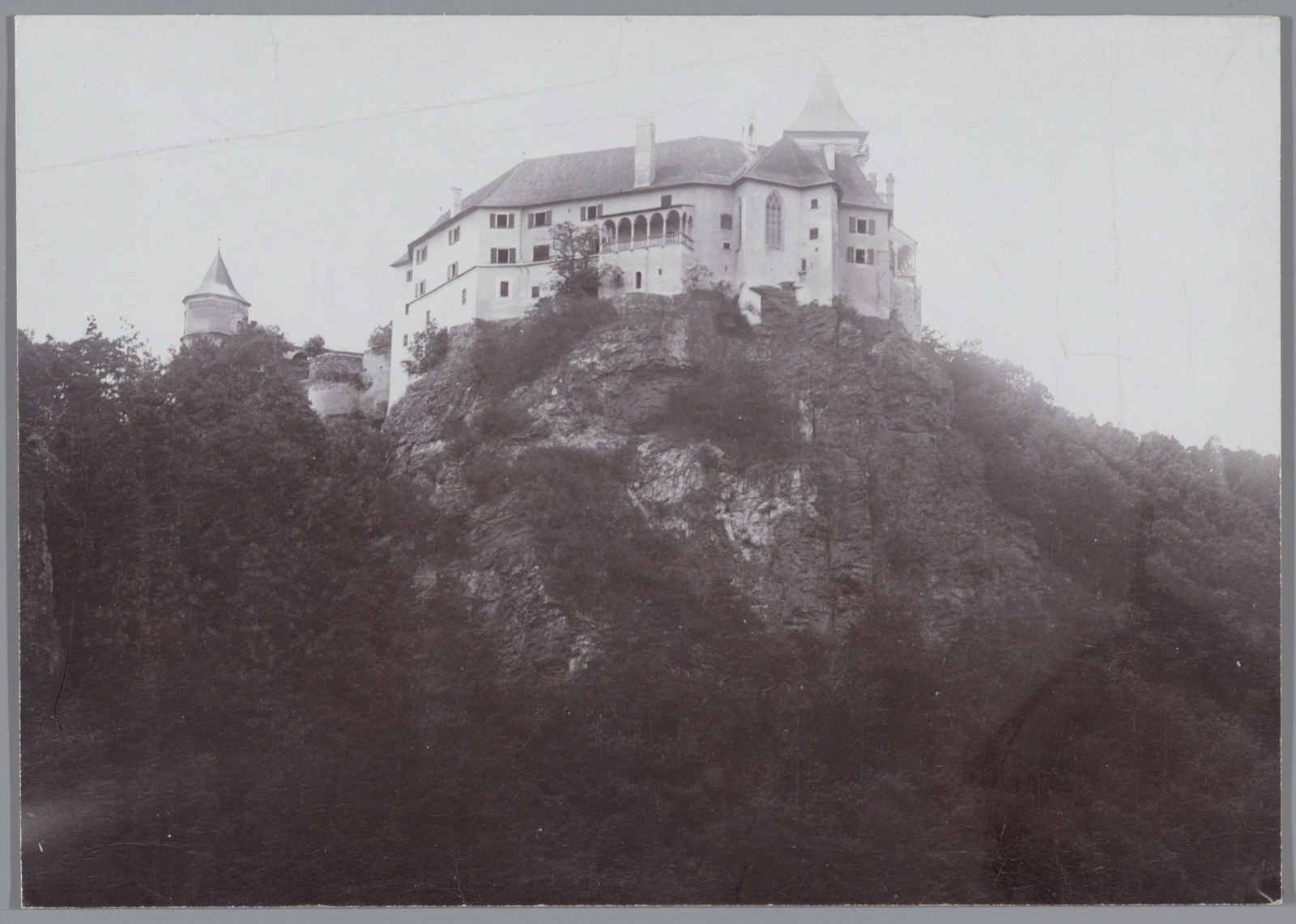
Gezicht op het kasteel Rosenburg
· Rijksmuseum (via Europeana)
Public domain
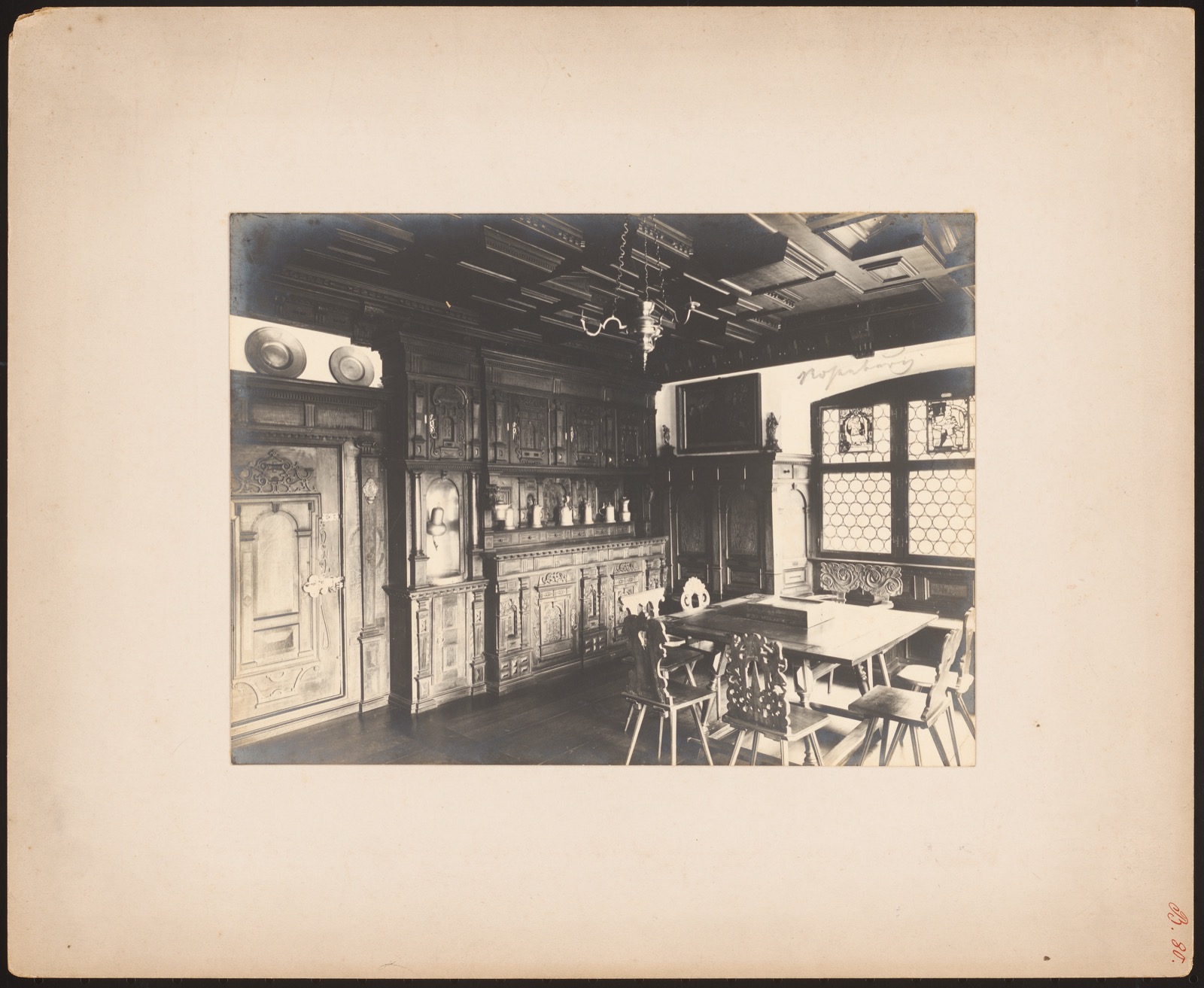
Schweizerisches Landesmuseum, Zürich: Inneraum (Rosenburg)
· Museum of Architecture at Berlin Institute of Technology (via Europeana)
CC0 (no rights reserved)


