Clan Rising
Hazmburk today

Czechia · Ruin

Hazmburk

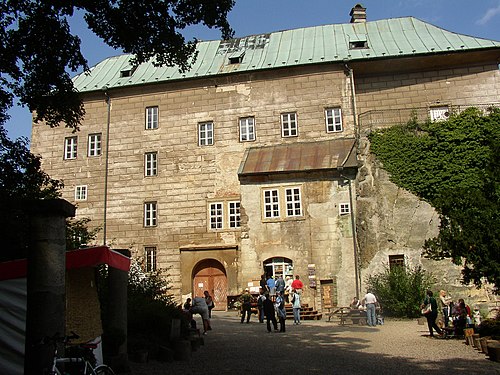
Hazmburk is a medieval hilltop castle ruin on a solitary 429 m hill near Klapý in the Ústí nad Labem Region of the Czech Republic. A late 13th-century stronghold expanded in the mid-14th century, its two prominent towers and stretches of curtain wall are the most visible remains. The site fell into disuse after the Hussite period and survives today as a ruin open to visitors in summer.

Photograph via Wikimedia Commons

First raised

1300

Its prime

1350

Today

Ruin

As it stood in 1350

What Hazmburk looked like in its prime.

Perched on a bare rocky summit, the castle in its prime presents two dominant towers, a tall cylindrical drum keep and a high rectangular tower, rising above continuous curtain walls that enclose a compact inner bailey with adjoining service ranges. The towers are finished with crenellated parapets; timber-roofed domestic buildings sit against the inner walls. The masonry is predominantly dark grey ashlar and rubble, and the whole complex crowns the isolated hill with fields and low hills visible below.

Its story

The story of Hazmburk.

Hazmburk, Hasenburg, "Hare Castle" in German, crowns a solitary 429-metre hill above the village of Klapý in the Lower Ohře Table. A smaller first castle was built on the summit in the late thirteenth century by the Lichtenburg noble family; in 1335 Zbyněk Zajíc, a powerful aristocrat of the age of Charles IV, purchased it and made it the centre of his estates.

The stronghold was expanded in the mid-fourteenth century, and its two prominent towers and stretches of curtain wall remain the most visible survivals. The castle fell into disuse after the Hussite period and has stood as a ruin since, open to visitors in summer.

Step inside

7 places to explore in 1350.

The record describes 7 distinct spots at Hazmburk, including 2 interiors: inner bailey (courtyard), top of the cylindrical keep. Create your own photoreal reconstruction and explore every one, more scenes means more rooms, more angles, and more of the place to stand in.

Approach up the hillInner bailey (courtyard)Top of the cylindrical keepBase of the cylindrical towerSmaller rectangular towerCurtain wall and battlementsView from the parapet over the plain

Build Your Own Castle

Recreate Hazmburk with AI to explore it.

The artist rebuilds it as it stood in 1350, a photoreal reconstruction that belongs to you alone. Pay with coins, no subscription needed.

Recreate this castle →Defend this castle →

Whose castle

Clans who held Hazmburk.

The families that held Hazmburk for a decade or more across its history, follow a name to its clan.

  • Lichtenburg

    Built by the Lichtenburg noble family in the late 13th century.

  • Zajíc

    Purchased by Zbyněk Zajíc in 1335 and made the centre of his family's estates.

Questions about Hazmburk

What is the history of Hazmburk?

Hazmburk began as a late 13th-century hilltop stronghold built by the Lichtenburg noble family. In 1335, Zbyněk Zajíc purchased it and made it the centre of his estates, then expanded the castle in the mid-14th century. It resisted repeated Hussite attacks before falling into disuse and becoming a ruin.

What is inside Hazmburk / what can you see in it?

Inside Hazmburk are the inner bailey, palace buildings and a surviving water cistern. The upper castle contained three buildings adjoining the inner curtain wall, while the buildings and the White Tower were reached from first-floor level by galleries and bridges. The top of the cylindrical keep is also a documented interior viewing point.

Who owns Hazmburk now?

Hazmburk is owned by the Czech Republic. It is also protected as a cultural monument of the Czech Republic. The supplied information does not identify a separate current operator.

Why was Hazmburk built, and what was it used for?

Hazmburk was built as a fortified hilltop stronghold and later served as the centre of the Zajíc family's estates. Its elevated position and defensive towers supported military use, while the enclosed buildings provided a base for the castle's residents and garrison. It later lost its importance and was abandoned.

Where is Hazmburk?

Hazmburk stands on a solitary 429-metre hill near Klapý, in the Ústí nad Labem Region. The hill is in the Lower Ohře Table, and the castle is located in the municipality of Klapý. Libochovice is 3.5 kilometres south-east of the castle.

When was Hazmburk built?

Hazmburk was built in the late 13th or early 14th century, so it belongs to the medieval period. The site's first-raised year is 1300, while the architectural account describes the castle itself as probably built in the first half of the 14th century. Major expansion took place in the mid-14th century.

Was Hazmburk ever attacked or besieged?

Hazmburk was besieged by Hussite forces in 1424 and again in 1429, but neither attempt captured the castle. In 1424, Jan Žižka conquered Libochovice but failed during the assault on Hazmburk. The castle therefore remained in the hands of its defenders during these attacks.

Which family or clan held Hazmburk?

The Lichtenburg noble family built the first castle at Hazmburk in the late 13th century. The Zajíc family then held it after Zbyněk Zajíc purchased it in 1335 and made it the centre of the family's estates. The Zajíc family held the castle until 1558.

What did Hazmburk look like in its prime?

In its prime, Hazmburk presented two dominant towers above continuous curtain walls enclosing a compact inner bailey. One tower was a tall cylindrical drum keep and the other a high rectangular tower, both finished with crenellated parapets. Dark grey ashlar and rubble formed most of the masonry, with timber-roofed domestic buildings against the inner walls.

Is Hazmburk still standing / is it a ruin?

Hazmburk is still standing as a medieval castle ruin. Two prominent towers and stretches of curtain wall survive, including the taller White Tower with its crenellated top. The castle had already been described as desolate in 1586, and by the beginning of the 20th century only a ruin remained.

Can you visit Hazmburk?

Hazmburk can be visited as a public castle ruin. The site is open to the public in summer, and the taller tower has an observation deck. Visitors reach it on foot by marked tourist paths from Klapý or from Libochovice towards Třebenice.
All castles of Czechia · Castles of Europe · the best castles in Europe · explore the finished reconstructions.