
Czechia · Restored
Karlštejn Castle
Karlštejn Castle is a large Gothic royal castle in Czechia, founded in 1348 by King Charles IV to house the Imperial Regalia, Bohemian crown jewels, relics and royal treasures. Built on a wooded rocky promontory above the Berounka river, the complex is arranged on terraces and includes the imperial palace, the Marian Tower and the great tower whose central Chapel of the Holy Cross held the treasury.
First raised
1348
Its prime
1365
Today
Restored
Ranked among Europe’s castles
As it stood in 1365
What Karlštejn Castle looked like in its prime.
Karlštejn presents a tiered silhouette of three terraces: a massive square great tower rising highest with a steep hip roof, a lower imperial palace with a long rectangular block and a semi-cylindrical eastern tower, and multiple steep slate roofs and pointed spires to the east. A round well-tower with a conical roof and crenellated curtain walls zig-zag up the wooded rocky promontory; pale stone walls show narrow slit windows and a timbered gallery beneath the eaves, fully roofed and complete at its prime.
Its story
The story of Karlštejn Castle.
Charles IV Builds His Treasury, Completed 1367
Tradition, following Hájek's chronicle, has Charles IV and Arnošt of Pardubice, first Archbishop of Prague, opening the work on 10 June 1348; neither man was in Bohemia that day, and the work probably began some two years earlier, around 1346. Work was directed by Vitus of Bítov, later burgrave of Karlštejn; the builder himself goes unrecorded, and the attribution to Matthias of Arras, who died in 1352, is speculation.
Charles began with a modest building of one tower and supervised the work and its decoration himself. Only after his imperial coronation, in the mid-1350s, did he recast the half-finished castle as a royal treasury (a guarded repository for the imperial regalia and a collection of holy relics), and new towers were raised to suit. Building ran to 1365, when the Chapel of the Holy Cross in the great tower was consecrated, and the interiors were completed in 1367. In the charter of the Karlštejn chapter of 1357 Charles recorded that he had built the castle new from its foundations and named it for himself.
The Great Tower and the 78-Metre Well
The castle is three linked but almost self-contained units, each with its own defences: the great tower, the palace with the Marian tower, and the burgrave's courtyard. A ditch cut into the rock separates it from Kněží hora, and a drawbridge was the only way into the great tower's compound. That tower rises 60 metres, its walls 4 to 7.5 metres thick and its windowless front wall six metres through, screening the buildings behind it. The position was not a strong one, the surrounding hills overtop the promontory, and the layout allowed only passive defence. The well is 78 metres deep with no spring of its own: water was led in by an adit from the Budňany brook below and raised by a wheel that men trod to turn.
The Hussite Siege of 1422
The Bohemian crown jewels, until then kept in St Vitus's Cathedral, reached Karlštejn early in the 1420s, probably at the order of Charles's son Wenceslas IV. As the Hussite revolution broke out, King Sigismund had both the Bohemian and the imperial insignia taken out of the kingdom; the imperial regalia went in 1421 by way of Hungary to Nuremberg and never returned. In 1422 the castle held out against a Hussite army under Sigismund Korybut, whose catapults threw dead bodies, not plague-infected, and 2,000 carriage-loads of dung over the walls, apparently spreading infection among the defenders.
Sigismund brought the Bohemian jewels back, with the crown archive, in 1436, and they stayed at Karlštejn until 1619. The war changed what the castle was for: its burgraves guarded the jewels and the land archive. The Land Ordinance issued by Vladislaus Jagiellon in 1500 bound them by oath to protect castle, crown, jewels and privileges on pain of death, loss of honour and property and the banishment of their descendants, and to hand over the crown only to a man already duly elected King of Bohemia.
The Jewels Leave in 1619, the Swedes Arrive in 1648
On 22 June 1619, during the Estates revolt, the directors ordered the jewels moved to Prague Castle: against the military technology of the day its defences were judged no longer sufficient. Ferdinand II abolished the office of Karlštejn burgrave in 1625, and the castle passed to the Bohemian queens' use; in 1626 the Empress Eleonora pledged it to Jan Kavka of Říčany, who had its furnishings and remaining sacred objects carted away. Swedish troops took it in 1648, at the end of the Thirty Years' War, leaving it badly decayed. Maria Theresa gave it in 1755 to the new Institute of Noblewomen in Prague, which used it only as an estate office; decay continued until Emperor Francis I visited in 1812 and gave money for repairs.
Mocker's Purist Rebuilding, 1887–1905
From 1887 to 1905 the castle was rebuilt in the purist spirit to restore a supposed Gothic form: to the concept of the Viennese professor Friedrich von Schmidt until his death in 1891, then to Josef Mocker's own designs, and after Mocker died in 1899 under the engineer Krch. The work drew criticism from the early 20th century, and is now read as a rescue restoration on its own age's terms. Karlštejn has been open to the public without a break since 1905, state-owned since 1918, and a national cultural monument since 30 March 1962.
In July 1944 the castle was used for a Week of Czech Youth under the Kuratorium for Youth Education of the Protectorate of Bohemia and Moravia, decked with the arms of the Third Reich, the Bohemian kingdom and the imperial electors and chosen as the seat of the emperor who, in the organisers' phrase, had bound the Lands of the Bohemian Crown into the Holy Roman Empire.
Step inside
9 places to explore in 1365.
The record describes 9 distinct spots at Karlštejn Castle, including 5 interiors: well tower (interior), knight's hall (first floor), emperor's apartments (second floor) and more. Create your own photoreal reconstruction and explore every one, more scenes means more rooms, more angles, and more of the place to stand in.
Build Your Own Castle
Recreate Karlštejn Castle with AI to explore it.
The artist rebuilds it as it stood in 1365, a photoreal reconstruction that belongs to you alone. Pay with coins, no subscription needed.
Recreate this castle →Defend this castle →From the archive
Karlštejn Castle on paper: the measured plan and period views.
The survey plan and photographs below are the ground truth this page's reconstructions are checked against, drawn and photographed while the castle was still a working garrison. Every image is public-domain or openly licensed, with its source named.
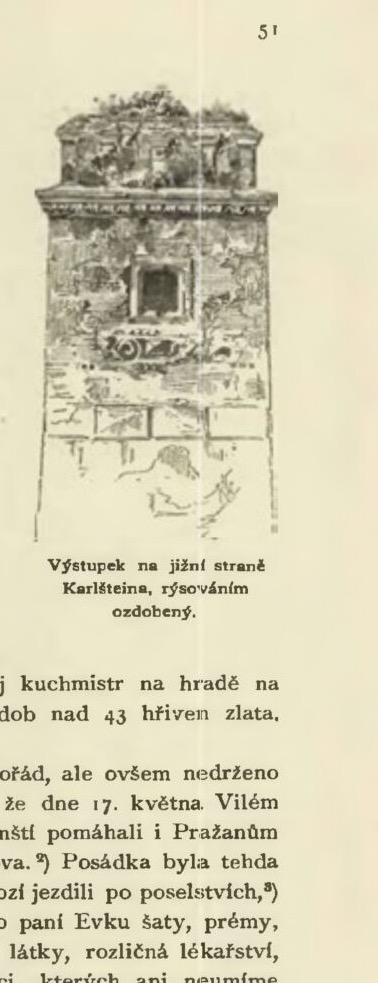
Výstupek na jižní straně Karlštejna, rýsováním ozdobený.
1890s · A. Sedláček, Hrady, zámky a tvrze Království českého, díl 6 (1882–1927)
Public domain
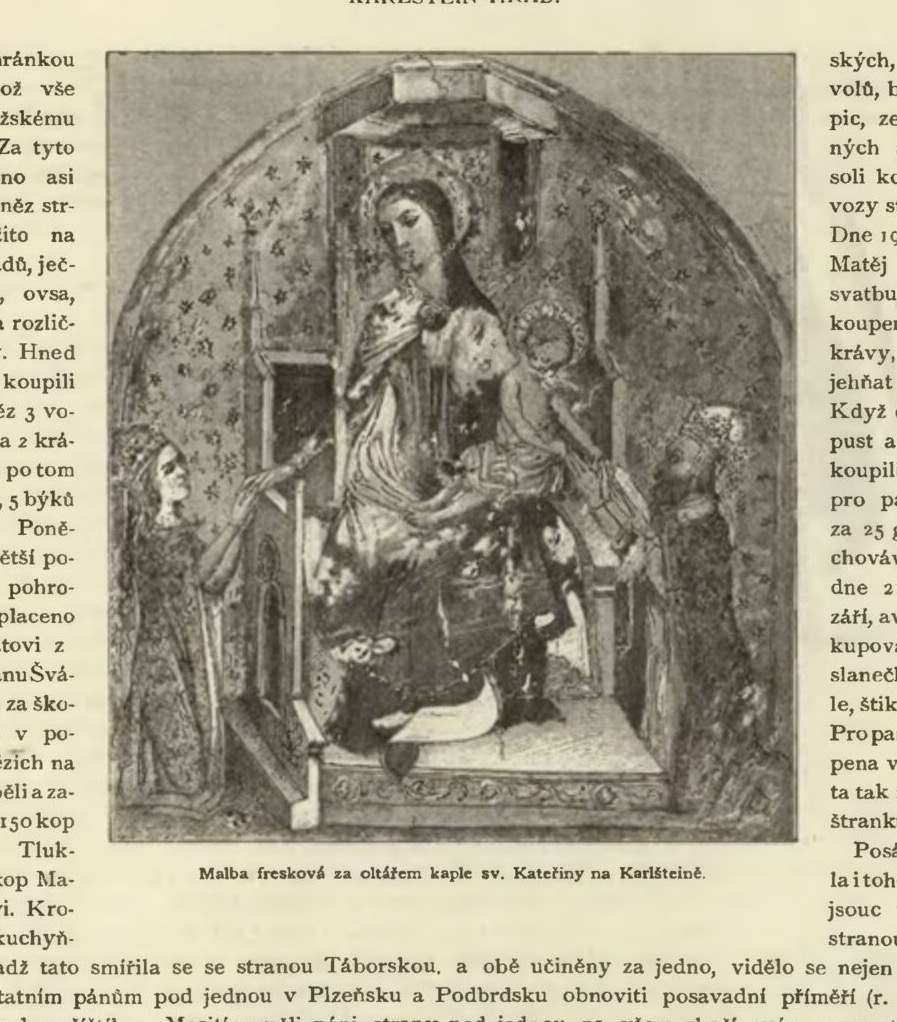
Malba fresková za oltářem kaple sv. Kateřiny na Karlštejně.
1890s · A. Sedláček, Hrady, zámky a tvrze Království českého, díl 6 (1882–1927)
Public domain
Nearby


