
Czechia · Ruin
Trosky Castle
Trosky Castle is a medieval hilltop castle ruin in the Bohemian Paradise of northern Czechia, built across the summits of two basalt volcanic plugs. The site comprises two principal towers on separate rocky spurs connected by curtain walls and ranges of buildings across the saddle between the rocks. It has been a landmark of the region since the late 14th century.
First raised
1400
Its prime
1403
Today
Ruin
As it stood in 1403
What Trosky Castle looked like in its prime.
Perched on twin basalt volcanic plugs, the castle in its prime features two distinct stone towers: Panna, a taller four-sided tower crowning the higher 57 m outcrop, and Baba, a smaller two-storey building on the lower 47 m rock. Curtain walls and three concentric rings of fortification follow the contours of the crags and connect the towers across a narrow saddle filled with residential ranges and outhouses. The masonry is pale grey stone set directly onto dark volcanic rock; the complex dominates the surrounding forested hills and open fields.
Its story
The story of Trosky Castle.
Čeněk of Wartenberg's Two Rocks, 14th Century
Trosky was founded by Čeněk of Wartenberg in the second half of the 14th century on a pair of volcanic necks, the exposed fillings of vents that once pierced the surrounding sandstones and marls, since worked on by frost and by human hands. He set a tower on each: the six-sided Baba, the Crone, on the lower rock 47 metres above the courtyard, and the four-sided Panna, the Maiden, on the higher outcrop 57 metres up. Between them ran the elongated castle core with two palaces, walls 1.5 to 2 metres thick and as much as 15 metres high, and a walled outer ward along the northern side. Neither of the two gates was protected by a ditch. In the ground floor of the smaller, largely timber palace stood a smithy that was still working in the 17th century. The name means debris, and it belonged to the crumbling rocks before it belonged to the castle.
Archaeology puts the foundation significantly earlier than the first written mention, which comes in 1396, by which date Čeněk was dead, and named in the record with the epithet "of Trosky". He no longer owned the place when he died: financial trouble in the early 1390s had forced him to make the castle over to King Wenceslaus IV, from whom it was acquired by Otto III of Bergau, first recorded as its owner in 1399.
The Opatovice Treasure and the Hussite Sieges, 1415–1428
Otto the Younger of Bergau inherited from his father and in 1415 joined Jan Městecký of Opočno in falling on the monastery at Opatovice and stripping it. For a man who passed himself off as a zealous Catholic it was an awkward piece of work, and the story that followed him is that he hid the monastery's famous treasure at Trosky, in an underground cellar sealed by a boulder so heavy that nobody could shift it. Scree eventually buried the boulder and closed the way to the valuables for good.
In the Hussite Wars the castle was one of the firm supports of the Catholic side, holding open the link between Bohemia and the Lusatian League alongside Kost, Kumburk, Frýdštejn, Bezděz and Ralsko. The Hussites tried it twice and failed both times, in 1424 and again in 1428, the second attempt pressed by Jan Královec, captain of the Taborite army, and coming shortly after the castle had burned.
Robber Knights on the Rock, 1438–1444
In 1438 or 1439 the castle fell to men who simply took it. Kryštof Šof of Helfenburg and a companion named Švejkar stormed Trosky, seized Otto the Younger himself, and settled in to prey on the villages around. An army raised by the sworn peace associations of East Bohemia and Boleslav besieged Trosky and nearby Valdštejn but could not take the rock. The feud dragged on until 1444, when the forces of Görlitz and Zittau, both towns of the Lusatian League, combined and broke Šof's band. The castle went back to Otto, who died soon afterwards, and his son Jan of Bergau inherited; Otto's widow Margareth had made Trosky her residence by that same year.
King George's Siege, 1469
Jan of Bergov sold Trosky in 1455 to Jan Zajíc of Hazmburk at Kost, who folded it into the Kost estate. As a member of the Zelená Hora Alliance he set himself against King George of Poděbrady, taking the formal office of supreme chancellor from Matthias Corvinus, and in 1467 the royal army besieged Kost to bring him to heel. The submission did not last. In 1469 George's forces laid siege to Kost, Trosky, Budyně nad Ohří, Hrubá Skála and Návarov; every one of them fell except Kost itself. The garrison at Trosky surrendered after 28 August and royal troops moved in, though Jan Zajíc then came to terms with the king, was pardoned, and had his property handed back.
The family held Trosky until 1497, when the guardian of the young heir, Zdeněk Lev of Rožmitál, sold Kost and Trosky together on 2 June to Jan of Šelmberk. His son Jindřich ran up debts heavy enough that he made both castles over to his largest creditor, Jan of Bibrštejn, and after Bibrštejn's son Kryštof the castle came to the Lobkowicz family; Kryštof of Lobkowicz and his wife Anna sold it in 1559 to Jindřich of Smiřice at Skály for 6,500 score of Bohemian groschen. By the 16th century no lord lived there, and the place was kept by the officials who ran the estate.
Swedes, Imperials and the Fire of 1648
The Smiřice estates were confiscated after Albrecht Jan Smiřický died in 1618, and in 1622 Trosky passed to Albrecht of Wallenstein. Through the Thirty Years' War it served as a fortress and was fought over hard: the Swedes took it in 1639, an Imperial army took it back a year later, and the two sides' garrisons alternated on the rock until 1648, when Imperial troops stormed and burned it for the last time. It was never repaired. When the Jesuit scholar Bohuslav Balbín came up to the ruins in 1681 he judged that, dilapidated as it was, the castle could still have been put right.
The Wallensteins kept the ruin until 1821, when they sold it to Jan Lexa of Aehrenthal, who began altering it in the romantic taste of the day. A spiral staircase intended to open the summit of Panna to visitors was started in 1841 and abandoned unfinished when Jan Lexa died in 1843. The Czech Tourist Club began repairing both towers, the walls and the gates in 1923, two years before the ruin became state property, and further work followed in 1934–1935; the later 20th century brought professional intervention to stabilise the rock mass and what was left of the buildings. A staircase to the Baba tower was built in 1999–2000, new flooring and a steel viewing gallery at its summit in early 2024. Trosky has been a national cultural monument since 2002.
Step inside
8 places to explore in 1403.
The record describes 8 distinct spots at Trosky Castle, including 3 interiors: panna tower, summit and battlements, baba tower, two-storey living quarters, underground cellar entrance blocked by a boulder. Create your own photoreal reconstruction and explore every one, more scenes means more rooms, more angles, and more of the place to stand in.
Build Your Own Castle
Recreate Trosky Castle with AI to explore it.
The artist rebuilds it as it stood in 1403, a photoreal reconstruction that belongs to you alone. Pay with coins, no subscription needed.
Recreate this castle →Defend this castle →Whose castle
Clans who held Trosky Castle.
The families that held Trosky Castle for a decade or more across its history, follow a name to its clan.
Bergau
Acquired by Otto III of Bergau in the 1390s and held by the family until 1497.
Lobkowicz
Later held by the Šelmberk, Bibrštejn and Lobkowicz families.
From the archive
Trosky Castle on paper: the measured plan and period views.
The survey plan and photographs below are the ground truth this page's reconstructions are checked against, drawn and photographed while the castle was still a working garrison. Every image is public-domain or openly licensed, with its source named.
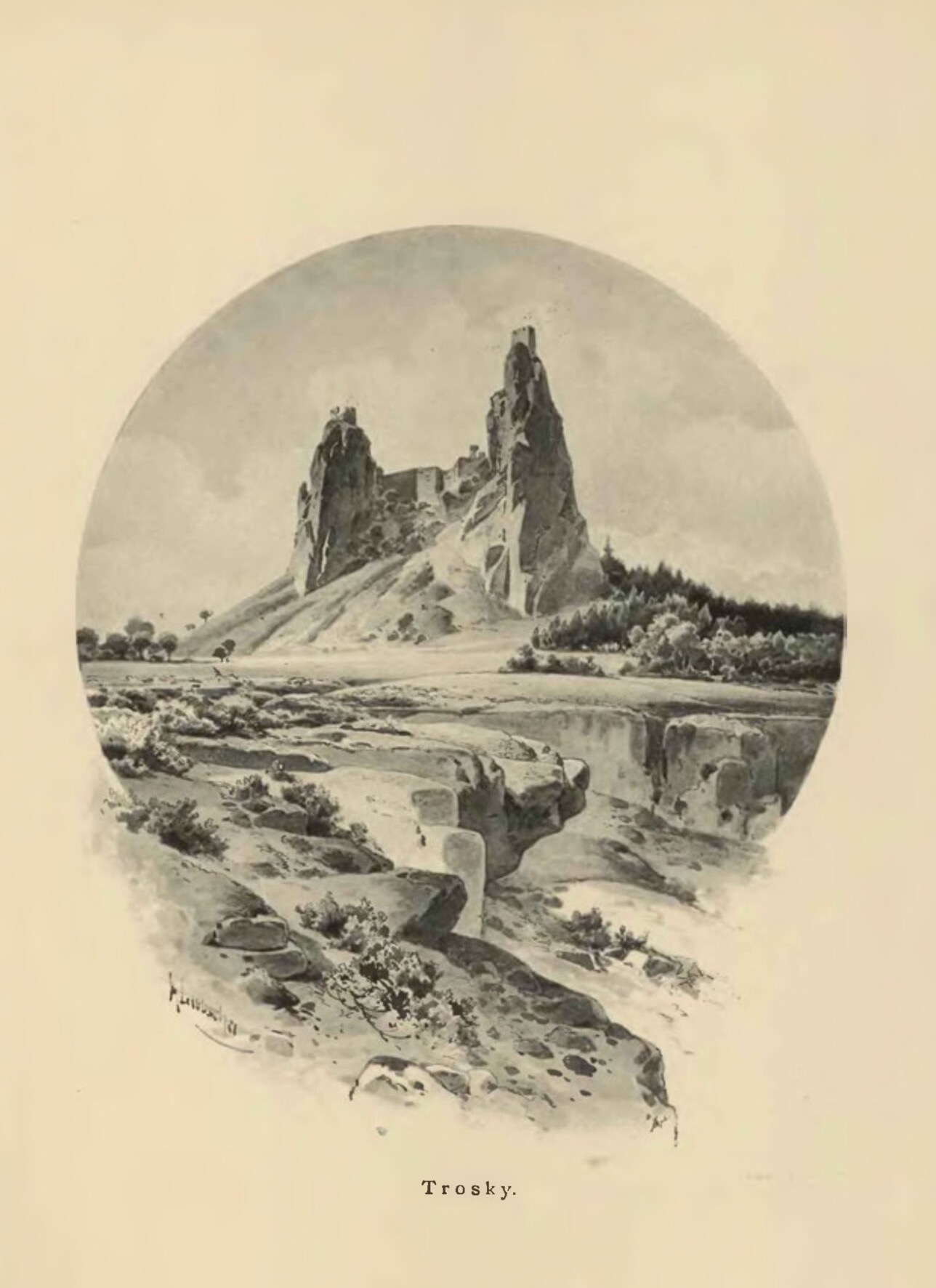
Trosky.
1890s · A. Sedláček, Hrady, zámky a tvrze Království českého, díl 10 (1882–1927)
Public domain
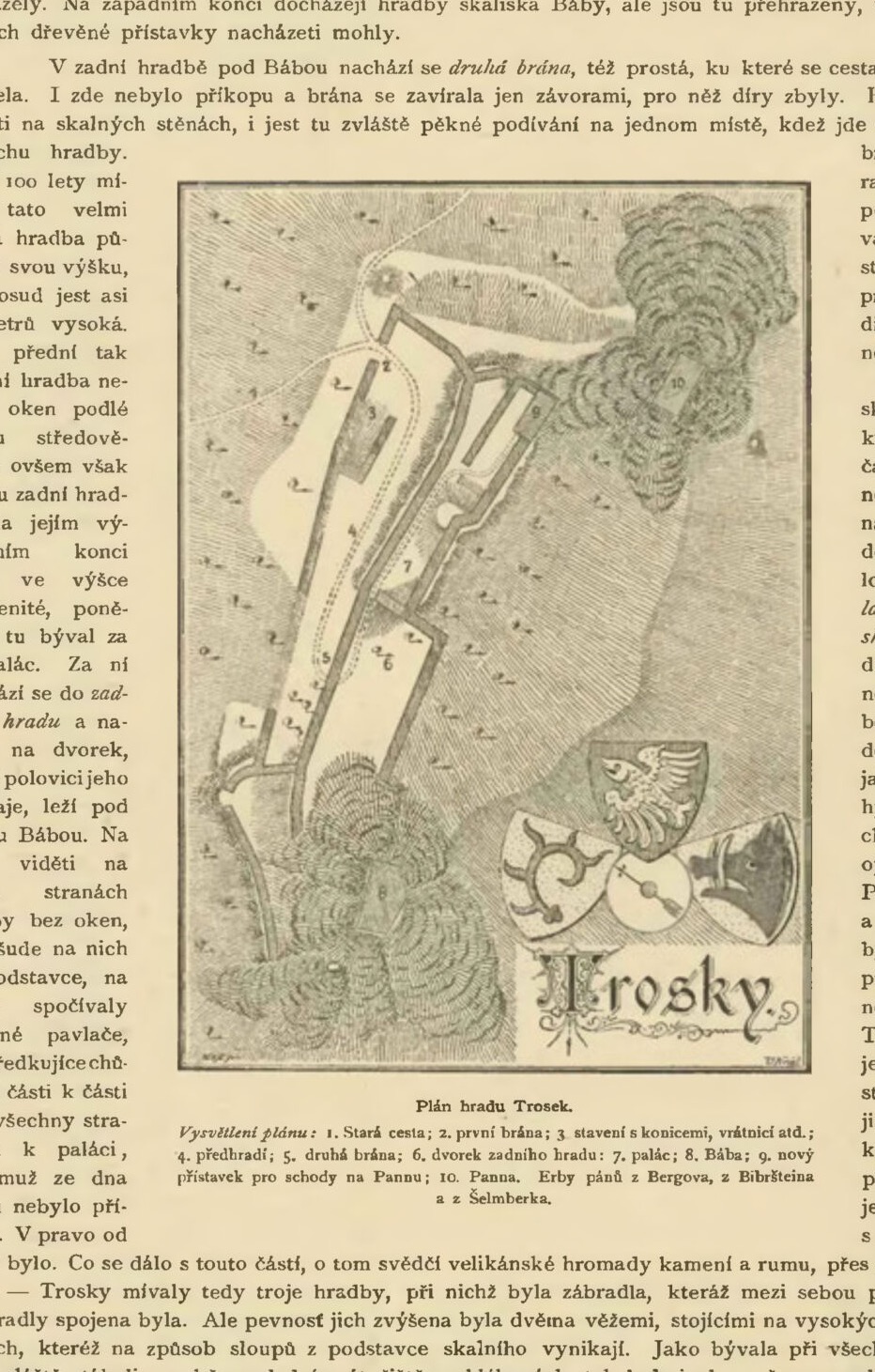
Plán hradu Trosek.
1890s · A. Sedláček, Hrady, zámky a tvrze Království českého, díl 10 (1882–1927)
Public domain


