
Czechia · Still standing
Pernštejn Castle
Pernštejn Castle is a large medieval fortress in the South Moravian Region of the Czech Republic, sited on a rock above the village of Nedvědice and the rivers Svratka and Nedvědička. Built from the late 13th century and completed in its Gothic and Renaissance form in the first half of the 16th century, it is noted for marble-like stone frames around doors and windows and for being one of the best-preserved castles in the country.
First raised
1270
Its prime
1520
Today
Still standing
As it stood in 1520
What Pernštejn Castle looked like in its prime.
Perched on a steep rock plateau with the rock rising into the buildings to the second floor, Pernštejn presents a dense complex of stone ramparts, curtain walls and outbuildings surrounded by multiple moats. A high round Barborka Tower projects above the roofs; several round towers include a clock tower and the Tower of Four Seasons. Approaches are dominated by a multi-stage barbican, semicircular Renaissance bastion and marble-framed Gothic-Renaissance portals; inner courtyards surround a spring-filled rock lake.
Its story
The story of Pernštejn Castle.
The Lords of Medlov and the Barborka Tower, 1270-1285
Pernštejn was founded by the lords of Medlov, probably between 1270 and 1285, on a rock above the village of Nedvědice and the rivers Svratka and Nedvědička. Steep rock on three sides left only the northern ridge open, and a pool fed by an unfailing spring lay inside the walls. Stephen of Pernštejn and Medlov is named in 1285; the branch that settled here dropped the old predicate for the then-fashionable name Pernštejn, probably from the German Bärenstein, the bear rock.
The first castle was a plain bergfrit design, a curtain wall with a palace and a round tower later called Barborka after St Barbara, patron of miners. Its oddity was the tower's prow, an edge turned towards the approach to throw off shot, probably copied from the royal castle at Veveří, where the lords of Medlov had served as the sovereign's administrators.
William I and the Robber Years, 1306-1422
Through the disorder after the Přemyslid dynasty died out in 1306 and the reign of John of Bohemia, notes on the castle and its masters run thin; from the first two-thirds of the fourteenth century little survives beyond the names of its lords. When Margrave John Henry died in 1375 Moravia broke into hostile, mutually harrying parties and castles became the bases of political factions and nests of robber barons. William I, who appears in documents from 1378 to 1422, headed the family then, and the Pernštejn garrison fought not only for its masters' politics but raided along almost every high road in Moravia, a good share of the takings going into William's treasury.
John I's Barbican and William II's Renaissance, 1460-1521
From the fifteenth century the castle was not only the centre of a large barony but a fortress in the struggle for Moravia and for Brno. John I carried out the largest rebuilding, which also repaired the damage of a great fire before 1460. Ditches were cut, new towers went up at the angles of the ramparts, and a square tower was raised outside the castle proper, joined to it by two wooden bridges as a last refuge should the core be taken. The work concentrated northwards, the only line an attack could come from: a tall semicircular bastion, moats with drawbridges, and a barbican whose three-metre walls carried loops for light firearms and a machicolation over the narrow way in. Past that, the only entrance stood high above the ground at the end of a wooden ramp and drawbridge, beyond which ran passages where two men-at-arms could not walk abreast.
William II of Pernštejn (1435-1521) began the last great remodelling. Where the walls could not be pushed further out, cantilevers were set in and jetties built on them, so the upper floors cover more ground than the storeys beneath. The family completed the castle in the Gothic and Renaissance form it still keeps in the first half of the sixteenth century, when they were the richest and most powerful lordly house of the Bohemian kingdom.
The Pernštejns Sell Up and the Swedes Fail, 1596-1645
The Pernštejn fortunes collapsed in the second half of the sixteenth century, and in 1596 Jan V had to sell the castle; much of the family's wealth passed to the Lobkowicz through Polyxena of Pernštejn's marriage to Zdeněk Vojtěch Popel of Lobkowicz, chancellor of the Czech kingdom. The defences earned their keep in the Thirty Years' War: while the Swedish army besieged Brno in 1645 it laid siege to Pernštejn too and failed, its cannonade taking the top storey off the tower above the third gate, never rebuilt, and apparently the wooden upper stage of the square tower. The castle sheltered the surrounding people and their goods in wartime, and the resistance it proved saw it counted among the maintained provincial fortresses into the mid-eighteenth century.
Stockhammers, Mitrovskýs and the Lost Roofs, 1710-2005
Francis of Stockhammer bought the estate in 1710, and in 1716 a Baroque chapel with frescoes by Francis Gregor Ignatius Eckstein replaced the older castle chapel. By the end of the eighteenth century the tall, decorated Gothic and Renaissance roofs had given way to low, plain roofing, and the covered wooden shooting galleries were gone.
The castle came to the Mitrovský family in 1818 and stayed with them until 1945. They did not carry out the romanticising rebuilding the nineteenth century favoured, which is why the Gothic-Renaissance castle survived, and no enemy ever took it. Declared a national cultural monument in 1995, it belongs to the Czech state. Fire broke out in the former granary on 15 April 2005, then a store for some 800 objects, mostly paintings and furniture; the most valuable objects were out on the visitor route and escaped.
Step inside
12 places to explore in 1520.
The record describes 12 distinct spots at Pernštejn Castle, including 2 interiors: entrance space with diamond vault, knights' hall (palace core hall). Create your own photoreal reconstruction and explore every one, more scenes means more rooms, more angles, and more of the place to stand in.
Build Your Own Castle
Recreate Pernštejn Castle with AI to explore it.
The artist rebuilds it as it stood in 1520, a photoreal reconstruction that belongs to you alone. Pay with coins, no subscription needed.
Recreate this castle →Defend this castle →Whose castle
Clans who held Pernštejn Castle.
The families that held Pernštejn Castle for a decade or more across its history, follow a name to its clan.
Pernštejn
Seat of the Pernštejn family, founders as Lords of Medlov c. 1270–85; they completed the castle's Gothic and Renaissance form in the first half of the 16th century.
From the archive
Pernštejn Castle on paper: the measured plan and period views.
The survey plan and photographs below are the ground truth this page's reconstructions are checked against, drawn and photographed while the castle was still a working garrison. Every image is public-domain or openly licensed, with its source named.
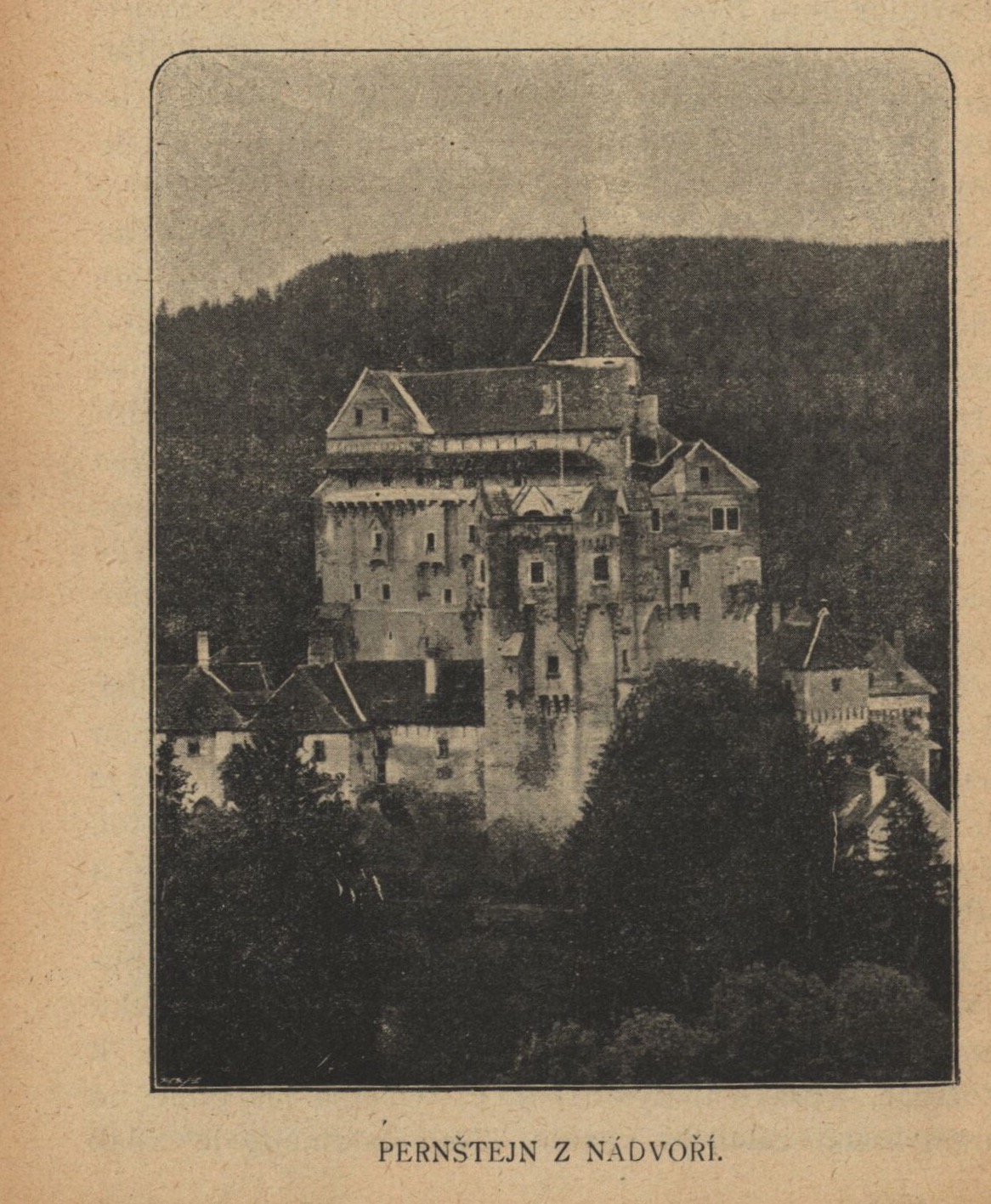
PERNŠTEJN Z NÁDVORÍ.
1922 · Výlet z Brna na hrad Pernštejn a vycházky do okolí Nedvědice
Public domain (Moravian Library)
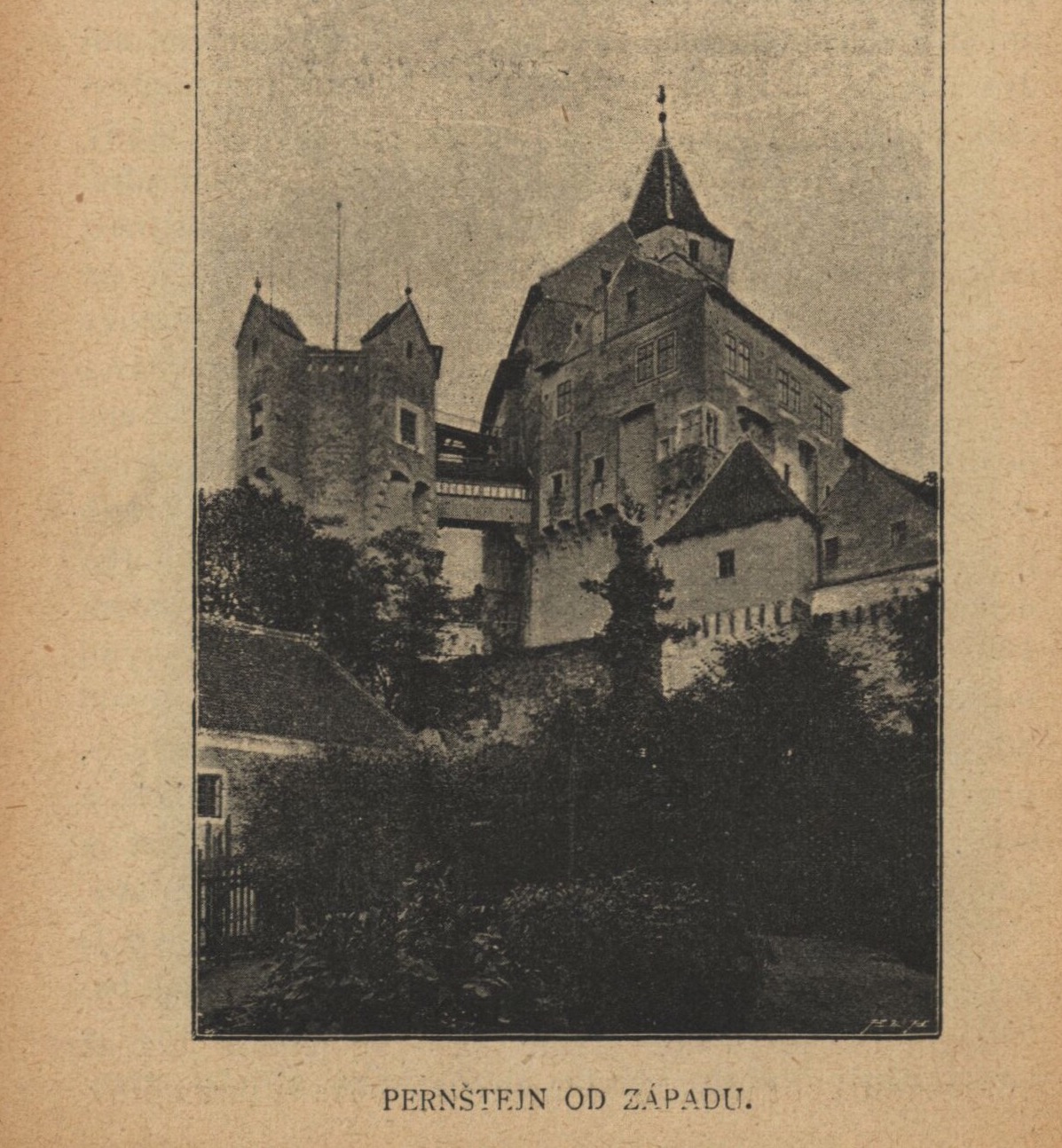
PERNŠTEIN OD ZÁPADU.
1922 · Výlet z Brna na hrad Pernštejn a vycházky do okolí Nedvědice
Public domain (Moravian Library)
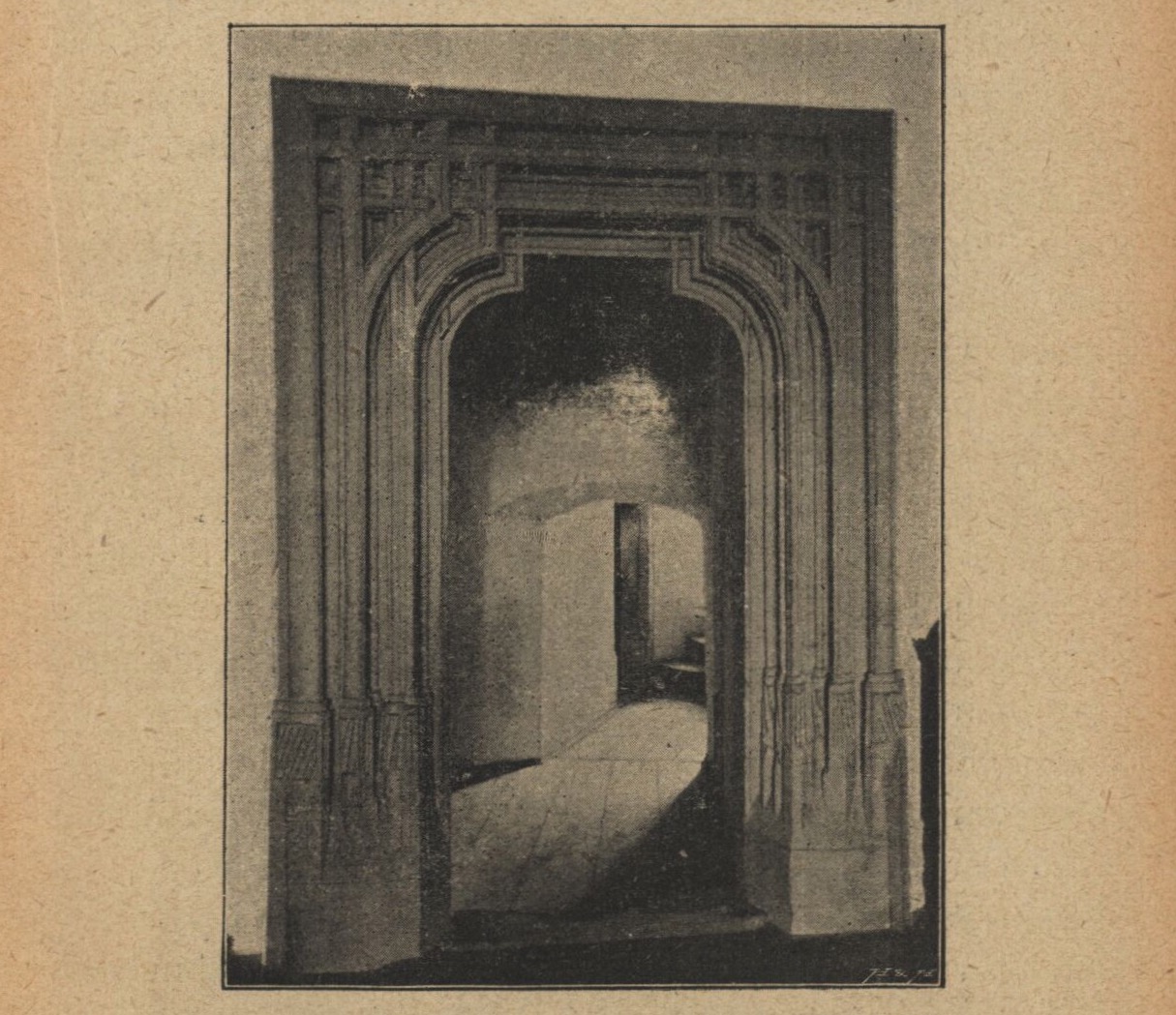
PORTÁL Z I. PATRA HRADU PERNŠTEJNA.
1922 · Výlet z Brna na hrad Pernštejn a vycházky do okolí Nedvědice
Public domain (Moravian Library)


