
Czechia · Restored
Mikulov Castle
Zámek Mikulov
Mikulov Castle is a historic castle on a rocky hill in the town of Mikulov in South Moravia, Czech Republic. The site dates to a stone castle from the late 13th century; the building visible in the photo was largely destroyed by fire at the end of World War II and later restored. Today it houses museum displays and overlooks the town and surrounding vineyards.
First raised
1300
Its prime
1944
Today
Restored
As it stood in 1944
What Mikulov Castle looked like in its prime.
A three- to four-storey rectangular main range with a symmetrical grid of tall rectangular windows sits atop a stone retaining scarp; each long façade is flanked by large cylindrical, multi-storey round towers with smooth plastered walls. Walls are finished in pale ochre plaster and capped by steep red-tiled pitched roofs; a small green copper spire rises from the central ridge. The castle stands on a rocky, terraced hill with a cobbled approach and formal garden terraces at the base.
Its story
The story of Mikulov Castle.
The Liechtenstein Border Castle, 1249–1566
Archaeological surveys point to a wooden stronghold on the hill in the 11th–12th century, built to guard the Moravian–Austrian border; after it burned, a stone castle went up in its place at the prompting of King Přemysl Otakar I or his brother Vladislav Jindřich. The castle is first documented in 1249, when the future King Přemysl Otakar II granted it, with the town, to Jindřich (Henry) of Liechtenstein. It remained the family's principal seat for three centuries and was repeatedly enlarged: by the late 13th century an outer bailey held a cylindrical tower with a stone "blade" edge, 9.5 metres across, angled to deflect cannon fire, and a wall enclosed the whole hilltop. In the 14th century a slender round tower rose over the rock passage between the courtyard and the outer bailey, and in 1380 an octagonal chapel of the Virgin Mary and St John the Evangelist was built into it; a watchtower went up on the opposite hill, later known as Kozí hrádek.
The defences held in 1426 when Hussite forces attacked the Liechtensteins, who had sided with Sigismund of Luxembourg; the castle could not be taken. Around 1540, with the Ottoman threat pressing on Liechtenstein lands, the family added deep bastions cut into the rock on the south-east, south-west, north and west sides; the north bastion reused masonry from the old palace it replaced. Financial difficulties forced Kryštof IV of Liechtenstein to sell the castle in 1560, for 60,000 thalers, to the Hungarian nobleman Ladislav Kerecsényi, who began converting it into a Renaissance residence. Tradition remembered Kerecsényi as cruel, telling of him shooting captured Ottoman prisoners from the castle terrace for amusement; in 1566 he was captured by Ottoman forces at the siege of Gyula and executed.
The Dietrichsteins, the Swedish Sack and Baroque Rebuilding, 1575–1700
Kerecsényi's son inherited Mikulov, but when he too died without heirs the estate passed into imperial administration. In 1575 Emperor Rudolf II granted it to Adam of Dietrichstein, and the family held the castle until 1945. Rebuilding culminated under Cardinal Franz of Dietrichstein (1570–1636), who moved his office and household here from Olomouc. The north bastion was rebuilt around an "Ancestors' Hall" hung with portraits of the family's dead, painted in part by Jiří Gialdi, though only fragments survive; the north and south wings were extended, and a raised corridor between the west and east wings still splits the main courtyard in two. Franz also built a theatre, wine cellar and library beside the castle; his successor Maxmilián installed a wine barrel in the cellar holding around 1,014 hectolitres, said to be the most voluminous in central Europe.
In 1645 the Swedish army took Mikulov and plundered both castle and town, carrying off much of the library to Sweden. Prince Ferdinand of Dietrichstein repaired the damage and, in the second half of the 17th century, remodelled the castle in Baroque style, adding a terrace and pavilion on the east side and, at the very end of the century, stables.
Fire and Diplomacy, 1719–1866
Fire destroyed the town and burned the castle to its foundations in 1719. The Dietrichsteins rebuilt it under the architect Christian Alexander Oedtl, adding riding-school buildings, stone statues along the approach road and a wrought-iron garden gate.
Napoleon Bonaparte used the castle's rooms in 1805 to negotiate peace terms between France and Austria. After the Austrian defeat at Sadová, an armistice between Austria and Prussia was signed at Mikulov on 26 July 1866, remembered as the Armistice of Mikulov.
The Fire of 1945 and the Restitution Claim, 1945–2010
On 22 April 1945, during the fighting that liberated the town, the castle burned again; the cause was never established. The anthropological collection of the Moravian Regional Museum had been moved to the castle for safekeeping during the war, and many of the most important finds from Předmostí u Přerova, Dolní Věstonice and the Mladeč caves were destroyed in the fire. A society for the castle's restoration formed in 1947, and the building was rebuilt to the design of the Brno architect Otakar Oplatek.
Mikulov Castle is a cultural monument of the Czech Republic, managed today by the Regional Museum in Mikulov, which uses it for permanent exhibitions, cultural events and occasionally as a hotel. In 2006 Princess Mercedes von Dietrichstein, a descendant living in Argentina, sued for the castle's restitution, extending her claim to other Mikulov properties in 2008; the district court in Břeclav rejected her claims in May 2010.
Step inside
6 places to explore in 1944.
The record describes 6 distinct spots at Mikulov Castle, including the full exterior approach. Create your own photoreal reconstruction and explore every one, more scenes means more rooms, more angles, and more of the place to stand in.
Build Your Own Castle
Recreate Mikulov Castle with AI to explore it.
The artist rebuilds it as it stood in 1944, a photoreal reconstruction that belongs to you alone. Pay with coins, no subscription needed.
Recreate this castle →Defend this castle →From the archive
Mikulov Castle on paper: the measured plan and period views.
The survey plan and photographs below are the ground truth this page's reconstructions are checked against, drawn and photographed while the castle was still a working garrison. Every image is public-domain or openly licensed, with its source named.
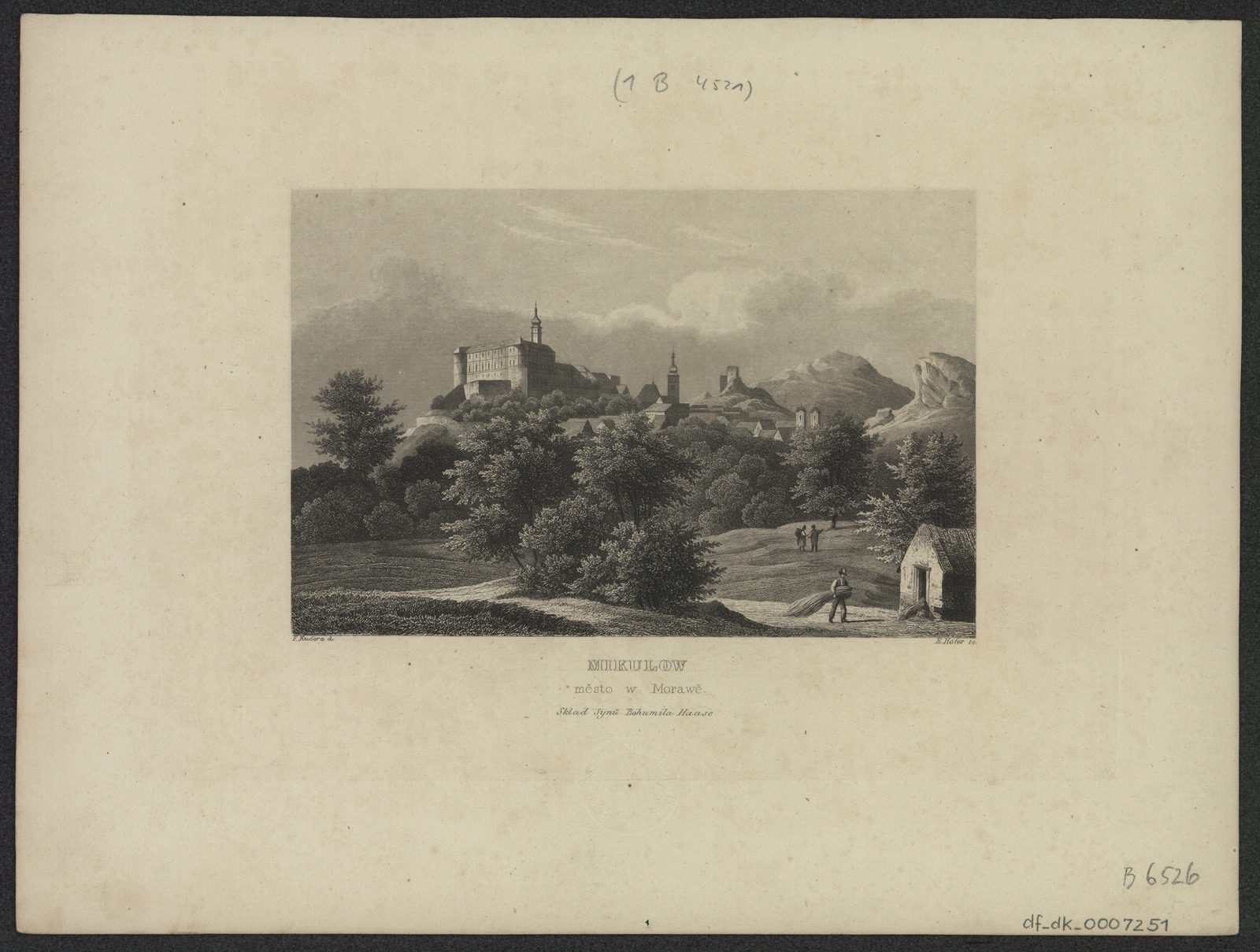
View of Mikulov (German: Nikolsburg), Stich, circa 1850
· Deutsche Fotothek (via Europeana)
CC BY-SA


