
Czechia · Still standing
Rožmberk Castle
Rožmberk Castle is a medieval castle on a Vltava river promontory near Rožmberk nad Vltavou in South Bohemia, long associated with the House of Rožmberk. The site preserves a compact main palace with towers, a lower bailey and museum interiors assembled and remodelled over centuries and opened to the public in the 19th century.
First raised
1250
Its prime
1857
Today
Still standing
As it stood in 1857
What Rožmberk Castle looked like in its prime.
Perched on a steep river promontory carved on three sides by the Vltava, the castle presents a long, white plastered main palace with painted sgraffito motifs and a steep slate roof punctuated by dormers. Two prominent towers terminate the roofline: a square, crenellated keep with corbelled battlements and a taller, roofed corner tower with a pointed, hipped cap. The lower courtyard and ramparts step down the rock toward the river, and a narrow footbridge connects the slope from the roadside village below. The façade reads as layered historic fabric finished in the 19th-century Romantic taste.
Its story
The story of Rožmberk Castle.
The Vítkovci Build a Seat on the Vltava, 1230s–1330s
The castle was raised on a Vltava promontory in the first half of the thirteenth century by Vítek the Younger of Prčice or by his son Vok, of the powerful Vítkovci family. Vok took the name Vok of Rožmberk after the site, which is regarded as the cradle of the House of Rožmberk, the "Lords of the Rose". It is first documented in 1250, in an epithet Vok was already using, some accounts date the document to 1253. The original Upper Castle held a tower known as the Jakobínka, 9.6 metres across, ringed by walls and a moat, with a market settlement growing in its barbican.
Rožmberk became the administrative and economic centre of the family's lands. In 1259 Vok founded the Cistercian monastery at Vyšší Brod and endowed it with a large part of his estate. His son Jindřich I inherited the castle in 1262, but when the Krumlov branch of the family died out in 1302, the Rožmberks inherited Český Krumlov and made it their principal seat instead. Rožmberk continued to be extended regardless: after 1330 Jindřich of Rožmberk added the Lower Castle, defended by ramparts set above a moat cut through the rock.
Pawned, Besieged and Burned, 1420–1522
In 1420 Oldřich II of Rožmberk, father of Perchta of Rožmberk, later remembered as the castle's "White Lady", pawned Rožmberk to Reinprecht von Walsee of Austria to raise money for his army against the Hussites; his sons redeemed the loan in 1456. The castle was pawned again in the mid-1460s, to Jan Popel of Lobkowicz. During the wars between the Bohemian nobility and King Jiří of Poděbrady, Rožmberk was one of the king's few strongholds in southern Bohemia: in October 1467 Zdeněk of Šternberk besieged it, and Duke Jindřich of Münsterberg relieved the garrison. Zdeněk took the castle by treachery on 9 January 1469, capturing Jan Popel and his son Děpolt and imprisoning them at Český Krumlov, then ceded it back to the Rožmberks for a payment.
The castle changed hands again in the 1470s, seized by Řehoř Třeboňský before the Rožmberks recovered it; a loyal castellan, Jošt of Pruk, was back in place by July 1478. The Upper Castle burned down in 1522 and was never rebuilt.
From the Last Rožmberk to the Švamberks, 1600–1612
Petr Vok, the last of the Rožmberks, passed the castle to his nephew Count Johann Zrinski of Seryn, son of Nikola Šubić Zrinski, on condition it would revert to him if Zrinski died first. Jan Jiří of Švamberk contested the grant, citing an older agreement that his family would inherit the whole Rožmberk estate; a settlement in 1610 gave him Zrinski's property instead. Petr Vok's death in 1611 ended the House of Rožmberk; Zrinski died the following year, and Jan Jiří of Švamberk became lord of the whole estate. Around this time the Lower Castle was extensively rebuilt as a Renaissance residence.
The Bohemian Revolt and Bucquoy's Conquest, 1615–1621
Petr of Švamberk, who took over the estate's administration in 1615, joined the Bohemian Estates' revolt against the Habsburgs as one of its directors. In May 1619 the Imperial general Charles Bonaventure de Longueval, Count of Bucquoy, captured the town below the castle; his army then withdrew, leaving the Estates' garrison in possession, but after a short siege in September 1619 it surrendered, unable to withstand bombardment by heavy guns. On 6 February 1620 Emperor Ferdinand II granted Rožmberk to Bucquoy to cover the costs of maintaining his army. Bucquoy died during the siege of Nové Zámky in 1621; his widow, Marie Magdalena of Biglia, continued to live at the castle as guardian of their son, Karel Albert.
Neo-Gothic Rebuilding and Nationalisation, 1710–1945
Rožmberk remained Buquoy property, though the family's main seat was at Nové Hrady. Albert Jindřich Karel Buquoy carried out building work on the Lower Castle between 1710 and 1716, and Jiří Jan Jindřich Buquoy remodelled it in Romantic Neo-Gothic style between 1840 and 1857, opening it as one of the first museums in Bohemia. Its picture gallery holds the portrait of Perchta of Rožmberk, the White Lady, said to have appeared several times since her death. The Buquoys kept the castle until 1945, when it was nationalised under the Beneš decrees at the end of the Second World War. It is now state property, administered by the National Heritage Institute, protected as a national cultural monument of the Czech Republic, and open to visitors.
Step inside
11 places to explore in 1857.
The record describes 11 distinct spots at Rožmberk Castle, including 4 interiors: renaissance hall (interior), knight's hall with the musical niche, picture gallery and more. Create your own photoreal reconstruction and explore every one, more scenes means more rooms, more angles, and more of the place to stand in.
Build Your Own Castle
Recreate Rožmberk Castle with AI to explore it.
The artist rebuilds it as it stood in 1857, a photoreal reconstruction that belongs to you alone. Pay with coins, no subscription needed.
Recreate this castle →Defend this castle →Whose castle
Clans who held Rožmberk Castle.
The families that held Rožmberk Castle for a decade or more across its history, follow a name to its clan.
Rožmberk
Cradle and seat of the House of Rožmberk, the "Lords of the Rose", from the 13th century.
Lobkovic
Held the castle in pawn from 1465.
Buquoy
Granted to the Count of Bucquoy after the White Mountain confiscations; held by the Buquoys until 1945.
From the archive
Rožmberk Castle on paper: the measured plan and period views.
The survey plan and photographs below are the ground truth this page's reconstructions are checked against, drawn and photographed while the castle was still a working garrison. Every image is public-domain or openly licensed, with its source named.
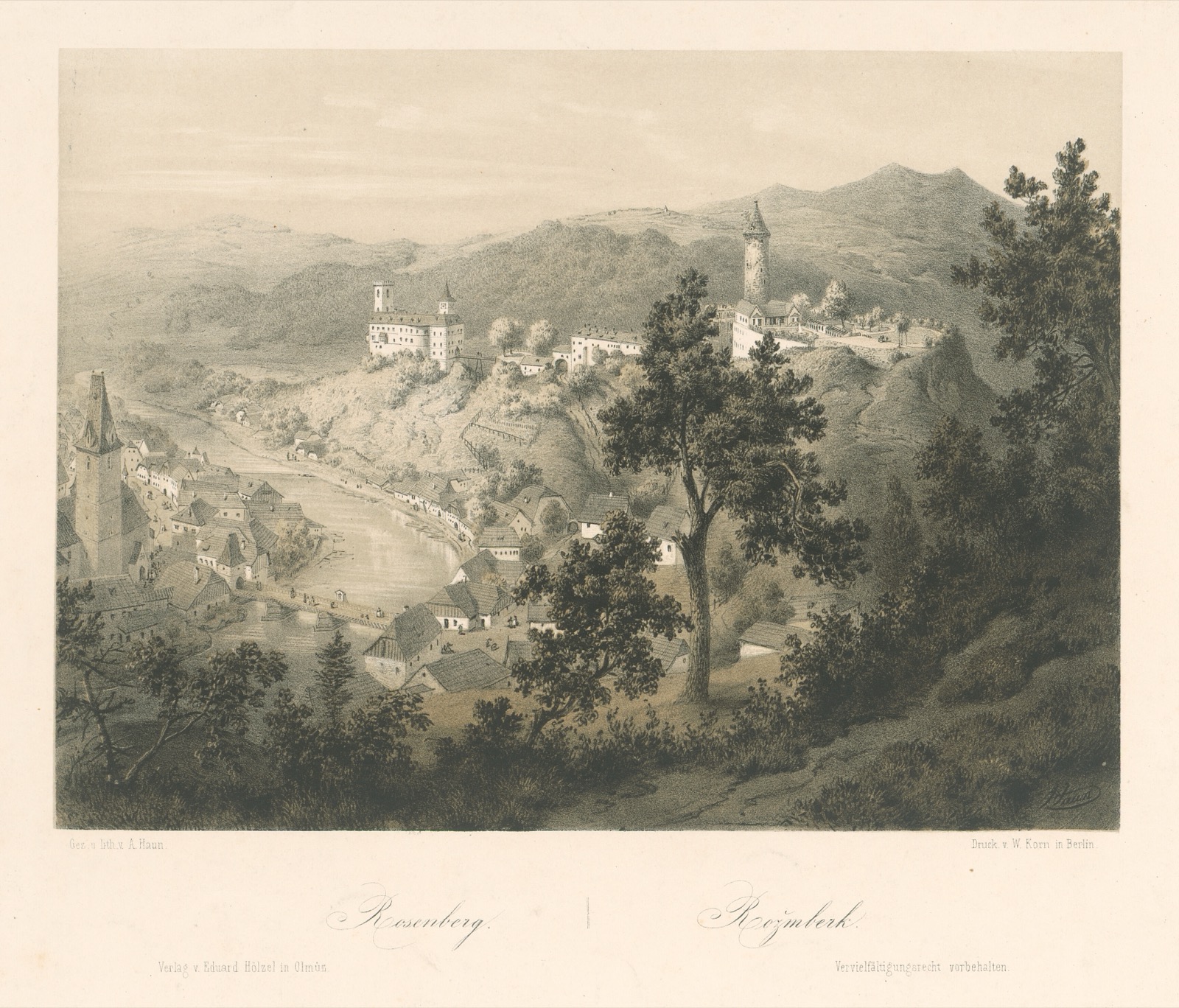
Hrad Rožmberk
· Slovak national gallery (via Europeana)
Public domain


