
Czechia · Partial ruin
Litice Castle
Litice Castle sits on a steep wooded headland above the Divoká Orlice in the Pardubice Region of the Czech Republic, founded around 1300 and heavily rebuilt under George of Poděbrady in the mid-15th century. The southern palace wing and a slim square tower survive as the best-preserved elements, while other outer walls have fallen into ruin; the site has seen periodic repairs since the 19th century.
First raised
1300
Its prime
1468
Today
Partial ruin
As it stood in 1468
What Litice Castle looked like in its prime.
Perched on a steep, tree-clad headland above a river valley, the castle reads as a compact stone complex: a slim square tower rising above a long southern palace wing with a steep pitched roof, both built of grey-brown ashlar and rubble masonry. To one side are broken lengths of curtain wall and lower ruined embankments; the main entrance passes through a gate tower set into the curtain with visible embrasures and fortified bastions low on the slope.
Its story
The story of Litice Castle.
The Drslavic Foundation and the Royal Pledges, 1300–1371
Litice was founded at the close of the 13th century, under the last Přemyslids, as part of the colonisation of a thinly settled border forest in north-eastern Bohemia that was royal land. The Drslavic family, who had raised the oldest castles of the Plzeň region at Litice u Plzně and Potštejn u Žinkov, carried the names of those seats into their new holding and built a supporting network of castles there, chiefly Potštejn and, upstream on the Divoká Orlice, Litice. The high headland looped by that river was chosen just before 1300, one of a group of Gothic castles that took their strategic advantage from the steep slopes of the Orlické Mountains.
In 1309 three leading nobles of the kingdom, Jindřich of Lipá, Jan I of Vartenberk and Jan of Klingenberk, were held prisoner at Litice after being seized by the patricians of Prague and Kutná Hora under Peregrin Puš, which suggests the castle then stood in some relation of ownership to the Prague house of Puš. Not long afterwards it became royal property: John of Luxembourg pledged it to Jindřich the younger of Lipá in 1316, and his son Charles, margrave of Moravia, redeemed it in 1333 among a run of mortgaged royal castles. It is named again in 1341 in the settlement of the estate of Mikuláš of Potštejn, and apparently still in John's reign it passed to the lords of Lichtenburk in exchange for their family centre of Lichnice. Jan of Lichtenburk sold Litice to Jindřich of Lipá in 1365, and from 1371 at the latest it belonged to the lords of Kunštát, Boček of Kunštát coming with his family to settle at the castle in that year. The two-palace core with its tower took shape during the second half of the 14th century.
Viktorin of Kunštát and the Siege of 1421
Boček of Kunštát died in 1373 and the estate passed to his son of the same name, who bought the village of Kunvald from Ješek Kdulinec in 1389 and died in 1416. One branch of the family became naturalised in Bohemia through marriage and the purchase of the Poděbrady and Pardubice estates. Litice passed next to Viktorin, who also held Náchod and later Pardubice, and who in the years of religious reform became a resolute supporter of Hussitism and a close ally of Jan Žižka of Trocnov. For that reason the castle was besieged as early as 1421 by an army of the Silesian dukes.
George of Poděbrady's Rebuilding, 1427–1472
Viktorin died in 1427 and Litice went to his son George of Kunštát and Poděbrady, later King of Bohemia, who rebuilt and enlarged the castle, damaged in the Hussite wars, after the middle of the 15th century: the extensive construction launched in 1450 buried the appearance of the oldest Gothic castle. The turbulent years after the Hussite Wars, with alliances of aristocrats contending for power in the kingdom and the Utraquist party of George among the strongest of them, called for measures to safeguard an important castle. George's reign from 1458 brought Bohemia a short peace, broken in the mid-1460s by a war in which the Papal Court instigated the resistance of the local catholic nobility and then asked Matthias Corvinus, King of Hungary, to intervene.
The work was meant to improve the castle's defence as much as the comfort of its living quarters. An extensive fortified outer bailey strengthened the northern and western sides; its front wall, twice the thickness of the other surviving stretches, carried two bastions and was plainly intended for artillery defence. The access road was interrupted at its most vulnerable point by a wall and a deep moat crossed by drawbridges, and the way in ran through a tower gate built in one piece with its guardhouse, itself covered by a rectangular bastion and a second, circular bastion below the inner castle, both served by embrasures that still survive. An inscription on the front of the gate reads: "This tower was built during the reign of His Royal Highness King George of Bohemia and Margrave of Moravia in 1468." The text dates the completion of the gate and most likely of the whole Poděbrady campaign of rebuilding.
After the fall of Tábor to George's troops in 1452 the Táborite priest Václav Koranda the elder, who had refused obedience to the land administrator, was imprisoned at Litice, while the Táborite captain Bedřich of Strážnice died in prison at nearby Potštejn. Between 1457 and 1458 a group of devout reforming Utraquist laymen settled at Kunvald on the Litice estate and laid the foundation of the Unity of Brethren, and some of the first brethren congregations arose there and on the neighbouring estates. Litice became the foremost fortress of the lords of Kunštát and George was fond of it; his family stayed there, above all his firstborn son Boček, and in 1470 his grandson Jiří of Münsterberk, duke of Münsterberg-Oels, was born in the castle. When the family property was divided in 1472 after George's death, Litice fell to Boček, who was not legally competent and who in his own lifetime ceded it to his brother and guardian Jindřich the elder of Münsterberk.
Sold for Debt: from Pernštejn to the Lords of Bubna, 1491–1608
Jindřich is named as owner of the Litice estate in 1491, and Matěj Sudlička of Borovnice is recorded in his time as captain of castle and estate. The debt he had run up in the war with Matthias Corvinus forced him to sell Litice together with Potštejn in 1495 to Vilém of Pernštejn, both estates having first been offered without success to King Vladislaus Jagiellon. Litice then lost its importance, for the centre of the extensive Pernštejn dominion became nearby Potštejn, to which the administration was transferred.
Vilém divided his estates between his sons Jan and Vojtěch in 1507; Litice went with the Bohemian property to the younger Vojtěch, who took possession only after his father's death in 1521. An estate instruction he issued in 1525 shows that no more remained at the castle than the staff needed for its barest running and upkeep, the Litice official Zicha answering wholly to the Potštejn captain Albrecht Sudlička of Borovnice and the household being paid less than men doing the same work at Potštejn. On Vojtěch's death in 1534 the estates passed to his brother Jan, whose enlargement of the dominion carried him past the limit of his means, and Jan's eldest son Jaroslav inherited the eastern Bohemian property so heavily indebted that he could not hold it. Less tolerant in religion than his father, Jaroslav refused to protect the congregations of the Unity of Brethren on his estates after King Ferdinand I renewed the St James Mandate against them, and following the defeat of the estates' revolt in 1547 he expelled the brethren.
In 1556 Jaroslav was compelled to sell the joint Potštejn and Litice estate to the Rhenish count palatine Arnošt of Bavaria, who broke it into smaller holdings and sold them on. In 1558 Litice castle, with its market town, half the town of Žamberk and eight villages, went for 6,625 threescore Bohemian groschen to Václav Okrouhlický the elder of Kněnice. He did not hold it long: after his death the estate, itself much indebted, was sold in 1562 to Mikuláš of Bubna, who made it whole again in 1575 by buying the second half of Žamberk and five further villages, and it stayed with the Bubnas until 1809. Mikuláš, who died in 1608, made the castle his family seat, but in the 1590s he built a château at Doudleby and about 1600 another at Žamberk, and divided his last years between the two.
From Ruin to State Custody, 1657 to the Present
Neither the guardian of Mikuláš's sons, Mikuláš Vratislav of Bubna, nor Mikuláš's descendants lived at Litice, and the castle was left to slow destruction. The Žamberk estate urbarium of 1657 records it as half demolished, its residential buildings fit only to serve as a store in time of danger. Bohuslav Balbín, who described the ruin as once a "very strong castle", found it abandoned by 1681, the year in which its owner František Adam of Bubna carried out the last repairs; his remark that George of Poděbrady had kept his valuables at Litice gave rise to tales that the coronation jewels were hidden in its walls when the land was threatened. The name meanwhile crossed the Atlantic, a synod of the Moravian Church at Warwick in Pennsylvania founding a new brethren colony in June 1756 and naming it Lititz after Litice. Antonín Vít of Bubna held off the decay a little in 1776 by re-roofing the northern palace and raising a tent roof above the tower, while the southern palace was left entirely to its fate.
The Žamberk estate belonged to Count Veriand Windischgrätz from 1809 until 1815, when he sold it to John Parish. The 19th century saw the rapid disintegration of some of the castle's structures; the Parishes conserved part of the masonry between 1890 and 1896 and again in 1925, and substantial work in the core followed in 1933 to 1935, securing the southern palace and giving the tower its present gallery and roofing. Litice stayed in Parish hands until the nationalisation of the large estates in 1948.
Under the state the castle was administered by the national committees, protected as a cultural monument from 1964, and transferred in 1974 to the regional centre for state monument care and nature protection at Pardubice. Masonry was conserved steadily from the 1950s to the 1970s, but once that work stopped the castle was closed to the public from the middle of the 1980s. A rescue archaeological survey ran from 1985 to 1987, and the excavation of 1986 recovered stretches of walling belonging to the earliest building. Basic securing works allowed a reopening in 1992, after which the surviving masonry was conserved in turn and a visitor circuit was laid out through the southern palace and its tower. The collapse of part of the facing wall of the northern palace closed the castle in 2015 and for most of the 2016 season while rescue building work went on. The ruin is the property of the Czech state, its care is in the hands of the National Heritage Institute, and it is open to visitors.
Step inside
9 places to explore in 1468.
The record describes 9 distinct spots at Litice Castle, including 2 interiors: southern palace first-floor hall, slim square tower vaulted chamber. Create your own photoreal reconstruction and explore every one, more scenes means more rooms, more angles, and more of the place to stand in.
Build Your Own Castle
Recreate Litice Castle with AI to explore it.
The artist rebuilds it as it stood in 1468, a photoreal reconstruction that belongs to you alone. Pay with coins, no subscription needed.
Recreate this castle →Defend this castle →Whose castle
Clans who held Litice Castle.
The families that held Litice Castle for a decade or more across its history, follow a name to its clan.
Drslavic
Founded the castle just before 1300, naming it after the family's original settlement in the Plzeň area.
Kunštát
Boček of Kunštát settled here with his family in 1371; the castle was rebuilt under George of Poděbrady in the mid-15th century.
Bubna
The lords of Bubna of Litice owned the castle from 1562.
Parish
Purchased the castle in 1815.
From the archive
Litice Castle on paper: the measured plan and period views.
The survey plan and photographs below are the ground truth this page's reconstructions are checked against, drawn and photographed while the castle was still a working garrison. Every image is public-domain or openly licensed, with its source named.
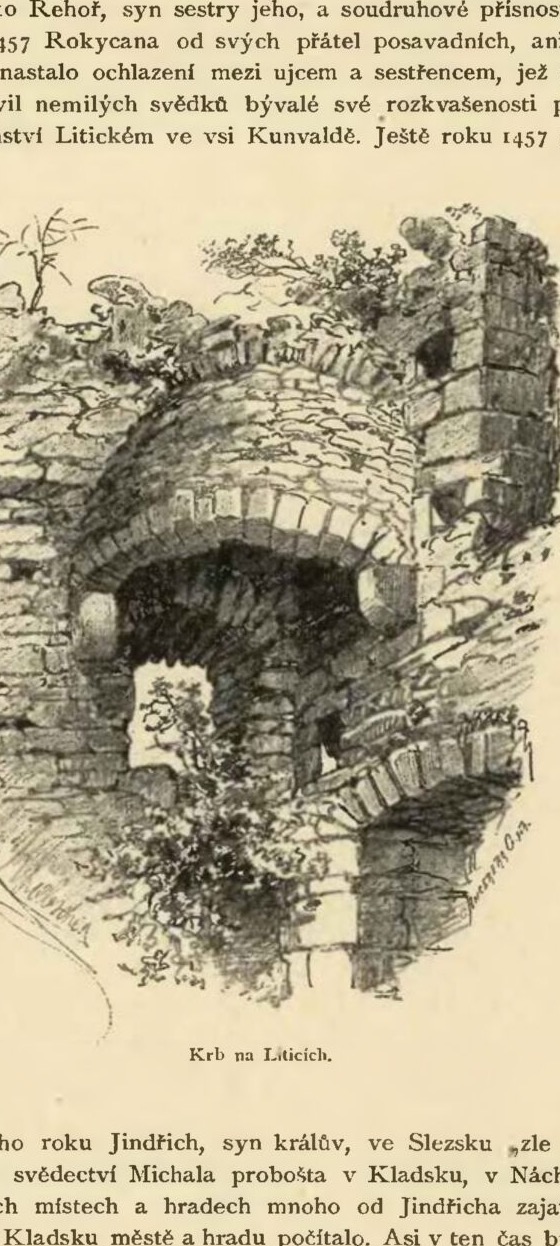
Krb na Liticích.
1890s · A. Sedláček, Hrady, zámky a tvrze Království českého, díl 2 (1882–1927)
Public domain
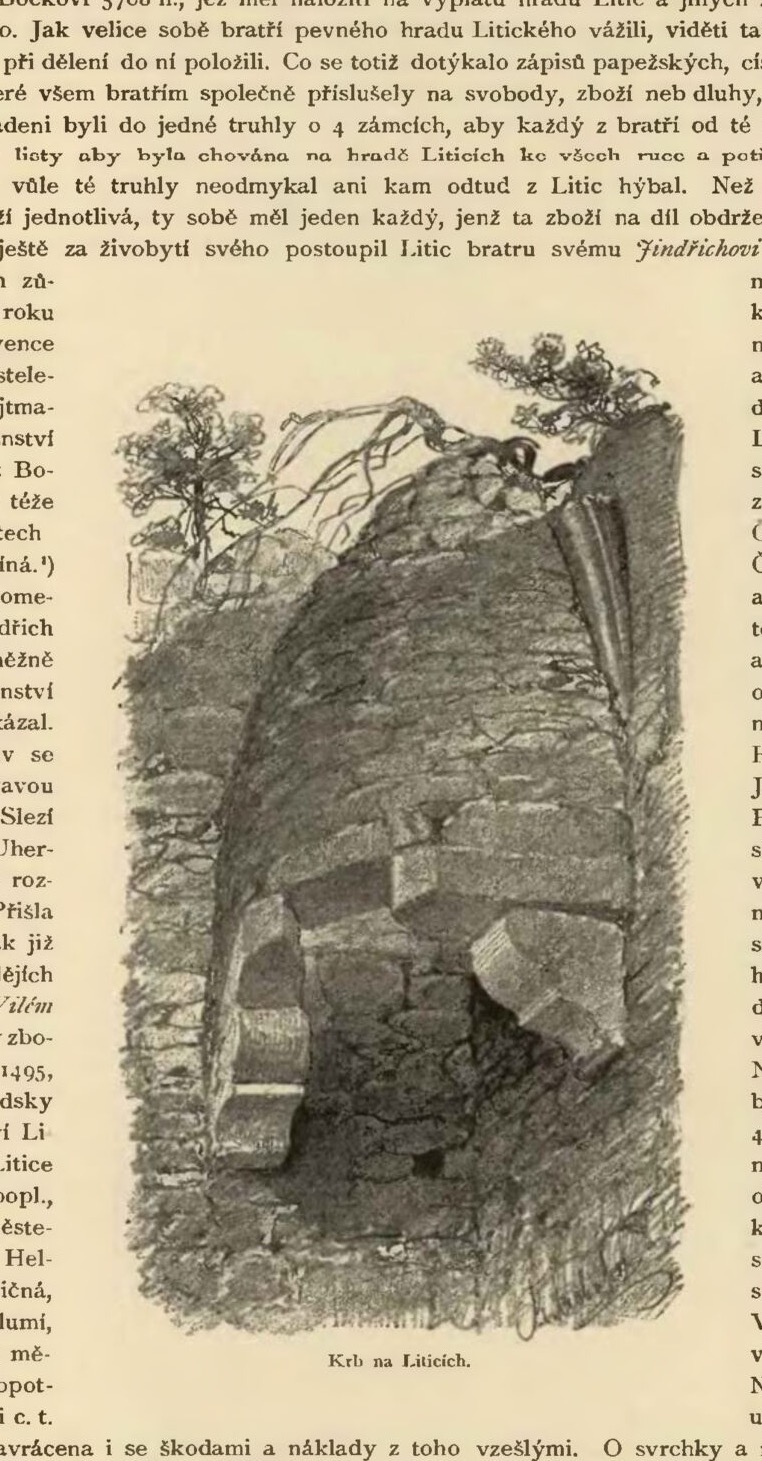
Krb na Liticích.
1890s · A. Sedláček, Hrady, zámky a tvrze Království českého, díl 2 (1882–1927)
Public domain
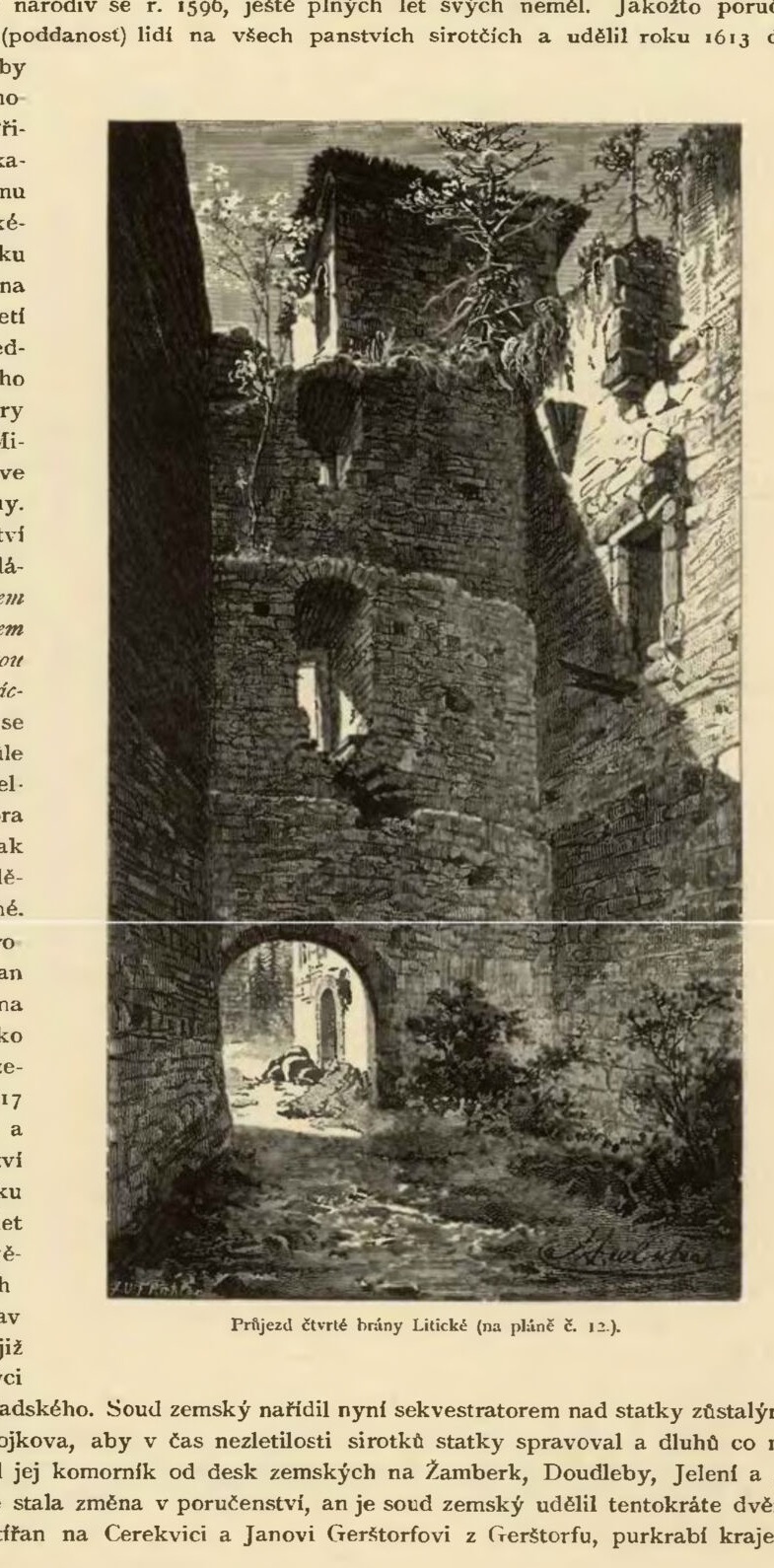
Příjezd čtvrté brány Litické (na pláne č. 12.)
1890s · A. Sedláček, Hrady, zámky a tvrze Království českého, díl 2 (1882–1927)
Public domain


