Clan Rising
Střekov Castle today

Czechia · Ruin

Střekov Castle

Střekov Castle (Schreckenstein) is a medieval fortress ruin perched on a steep basalt cliff above the Elbe River at Ústí nad Labem in northern Bohemia. Built in the early 14th century, the site retains a tall cylindrical bergfried, an oblong palas block and extensive curtain walls divided into two linked sections. It stands as a prominent riverside landmark and symbol of the region.

Photograph via Wikimedia Commons

First raised

1310

Its prime

1570

Today

Ruin

As it stood in 1570

What Střekov Castle looked like in its prime.

A two-part stone castle sitting astride a steep, monolithic dark clinkstone rock 100 metres above the Elbe, its mass broken into an irregular oblong palas block and a separate ward linked by an arched bridge over a natural moat. A tall, cylindrical bergfried with a simple pointed roof rises above the centre; low curtain walls and semi-circular bastions extend along the cliff edge. Masonry is pale-grey weathered stone, with areas of ruined walling and trees on the rock slopes below.

Its story

The story of Střekov Castle.

Střekov Castle, Schreckenstein in German, was built in the 14th century on a monolithic clinkstone rock rising steeply 100 metres above the Elbe at Ústí nad Labem, to protect the waterway and collect duties on transported goods. Its plan is unusual for its date: two sections joined by an arched bridge over a natural moat, with semi-circular bastions inspired by French architecture, possibly the first defensive design of that type in Bohemia.

Shortly after its construction the castle came into the possession of the Bohemian House of Wartenberg from Tetschen, and after changing hands several times it was acquired by the Lobkowicz family, Wenzel Popel of Lobkowicz became castellan in 1563, and in 1601 the castle passed into the direct possession of the House of Lobkowicz. Confiscated by the state in 1948 after almost 400 years, it was returned to the family in 1990.

The ruin enchanted visiting artists, Goethe, Richard Wagner and Karel Hynek Mácha among them, and Ludwig Richter fixed it in paint in Überfahrt am Schreckenstein, which hangs in Dresden's Galerie Neue Meister. Bergfried, palas and castle walls survive or have been rebuilt, and the rock remains the symbol of North Bohemia.

Step inside

8 places to explore in 1570.

The record describes 8 distinct spots at Střekov Castle, including 1 interior: domestic courtyard and former service range. Create your own photoreal reconstruction and explore every one, more scenes means more rooms, more angles, and more of the place to stand in.

Riverside approach below the cliffPath along the cliff to the castleMain gate flanked by the smaller entrance towerArched bridge over the natural moatBergfried (main tower) exteriorView from the top of the bergfried over the ElbePalas (residential block) exteriorDomestic courtyard and former service range

Build Your Own Castle

Recreate Střekov Castle with AI to explore it.

The artist rebuilds it as it stood in 1570, a photoreal reconstruction that belongs to you alone. Pay with coins, no subscription needed.

Recreate this castle →

Castle Siege

Play Castle Siege at Střekov Castle.

A strategy game played on Střekov Castle’s real ground plan: the same surveyed walls shown in the archive below. Post your finite garrison on the battlements between assaults, then hold out as rams, siege towers, trebuchets and sappers arrive in ever-worse waves.

Sign in free to see the garrison muster. One castle costs 150 Clan Coins and is yours forever.

Sign in to take command →

See every castle’s leaderboard →

Whose castle

Clans who held Střekov Castle.

The families that held Střekov Castle for a decade or more across its history, follow a name to its clan.

  • Wartenberg

    Held by the Bohemian House of Wartenberg from Tetschen shortly after the castle's 14th-century construction.

  • Lobkowicz

    Acquired by the Lobkowicz family in 1563; held until confiscated in 1948, and returned in 1990.

From the archive

Střekov Castle on paper: the measured plan and period views.

The survey plan and photographs below are the ground truth this page's reconstructions are checked against, drawn and photographed while the castle was still a working garrison. Every image is public-domain or openly licensed, with its source named.
STŘEKOV., Střekov Castle

STŘEKOV.

1890s · A. Sedláček, Hrady, zámky a tvrze Království českého, díl 14 (1882–1927)

Public domain
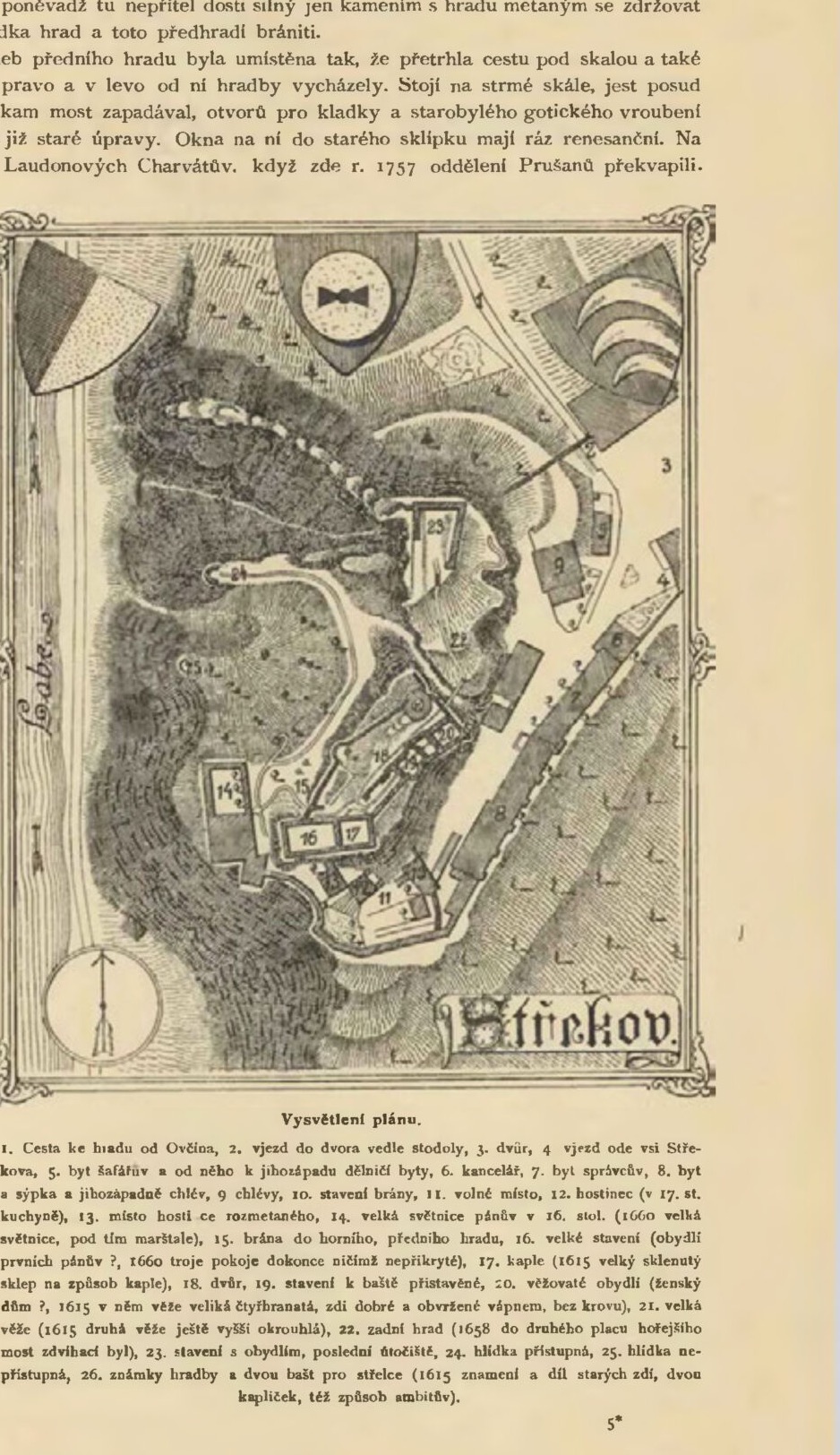
Vysvětlení plánu., Střekov Castle

Vysvětlení plánu.

1890s · A. Sedláček, Hrady, zámky a tvrze Království českého, díl 14 (1882–1927)

Public domain

Questions about Střekov Castle

What is the history of Střekov Castle?

Střekov Castle was built in the 14th century to protect navigation on the Elbe and collect duties on transported goods. It was acquired by the Lobkowicz family in 1563 and rebuilt and expanded around 1570. During the Thirty Years’ War it was occupied by Imperial, Saxon and Swedish forces, and it later fell into disrepair after losing its military role.

What is inside Střekov Castle?

Inside Střekov Castle are the domestic courtyard and the former service range. The surviving layout also includes a palas, a former residential block, and the remains of a castle chapel built into the eastern bastion. Much of the interior is ruined, with the castle’s buildings and roofs heavily damaged over time.

Why was Střekov Castle built, and what was it used for?

Střekov Castle was built as a defensive fortress controlling the Elbe waterway and collecting duties on transported goods. It also guarded an important trade route to Germany. Later, its owners maintained parts of it for habitation, but it was no longer permanently inhabited at the beginning of the 17th century and eventually became a ruin.

Where is Střekov Castle?

Střekov Castle stands above the Elbe River at Ústí nad Labem in northern Bohemia. It is in the Střekov district, on a steep monolithic clinkstone rock rising 100 metres above the river. The castle is a prominent landmark above the right bank of the Elbe.

When was Střekov Castle built?

Střekov Castle was built in the 14th century. The supplied dates place its construction between 1310 and 1319: the site record gives 1310, while the English article says it was built in 1316 and first mentioned in 1319. It was therefore raised in the early 14th century, with later rebuilding and expansion around 1570.

Was Střekov Castle ever attacked or besieged?

Střekov Castle was attacked and occupied during the Thirty Years’ War and the Seven Years’ War. Saxon forces occupied it in 1631, and Swedish forces occupied it several times between 1634 and 1648. In 1757, during the Seven Years’ War, a Prussian garrison surrendered to Croatian troops after they besieged the castle with 200 men inside.

Which family or clan held Střekov Castle?

The Bohemian House of Wartenberg held Střekov Castle shortly after its 14th-century construction. The Lobkowicz family acquired it in 1563 and held it until its confiscation in 1948; it was returned to the family in 1990. The family’s ownership was interrupted by state possession after the confiscation.

What did Střekov Castle look like in its prime?

In its prime, Střekov Castle was a two-part Gothic stone castle astride a steep dark clinkstone rock 100 metres above the Elbe. An arched bridge crossed a natural moat between the sections, while a tall cylindrical bergfried, an oblong palas, low curtain walls and semi-circular bastions formed its silhouette. The masonry was pale-grey weathered stone.

Is Střekov Castle still standing, or is it a ruin?

Střekov Castle is a ruin, although the bergfried, palas and castle walls survive or have been rebuilt. War damage, the loss of roofs and later collapse left much of the complex in poor condition. Preservation work began at the end of the 19th century and continued in 1911–1912, but it remains a ruined castle.

Can you visit Střekov Castle?

Střekov Castle is open to visitors. The castle is accessible to visitors during the usual visiting season from April to October, and it contains an exhibition of drawings and photographs of the castle and replicas of historical weapons. Cultural events are also held there, and a restaurant operates in the former forge.
All castles of Czechia · Castles of Europe · the best castles in Europe · explore the finished reconstructions.