
Czechia · Restored
Orlík Castle
Orlík Castle (Zámek Orlík) is a château on a rocky promontory above the Vltava River in Orlík nad Vltavou, South Bohemia, Czechia. Originally a medieval royal spur castle, it was rebuilt and remodelled over centuries and gained its Romantic Gothic exterior in the mid-19th century; the interiors preserve Empire-period furnishings and a collection of family artworks. The château is set beside a large English-style park and is accessed by a stone bridge across a defensive moat.
First raised
1300
Its prime
1860
Today
Restored
As it stood in 1860
What Orlík Castle looked like in its prime.
Large, pale plastered château with three prominent round towers rising above the main façade, each tower topped by crenellations and a narrow red decorative band; long steep dark slate roofs punctured by many white chimneys; a high stone retaining wall and gate cut into the rock lead to a stone bridge across a moat; a trapezoidal open courtyard with arcades on the ground floor is enclosed by rectangular wings; the château sits on a wooded river promontory at water level with an extensive park behind it.
Its story
The story of Orlík Castle.
A Royal Toll Castle Above the Vltava
King Přemysl Otakar II probably founded Orlík late in his reign, on a rock spur sixty metres above the Vltava, as a guard post on the road from Milevsko to Mirovice where toll was taken from river traffic. The name comes from the Czech for a young eagle.
Charles IV granted the castle in fief on 4 July 1357 to Dětřich of Portic, bishop of Minden, and on its transfer three years later to the bishop's nephew reserved the right to install his own garrison in war. The Prague burgher Zikmund Huler, who held it from 1395, was allowed to double the raft toll in 1400 and was executed for fraud on 23 June 1405.
Žižka's Letter to Domažlice, 1407–1508
Huler's brother Ondřej sold Orlík in 1407 to Petr Zmrzlík of Svojšín, master of the mint, who took the Utraquist side and probably rebuilt much of it. His son Petr, a Hussite captain, entertained Jan Žižka of Trocnov here in 1422; Žižka had a letter written at Orlík calling on Domažlice to resist the second crusade. Orlík was then the Utraquist counterweight to Catholic Zvíkov.
The Zmrzlík brothers went over to Sigismund of Luxembourg in 1427. Jaroslav Zmrzlík held for George of Poděbrady, and therefore fought a small war with the Rožmberks from 1469 to 1472 and with the Švamberks of Zvíkov, backers of Matthias Corvinus, from 1475. The castle burned down in 1508.
The Švamberks and the Surrender of 5 April 1621
Václav Zmrzlík had Orlík released from feudal tenure in 1513 and sold it on 2 February 1514 to Kryštof of Švamberk, whose rebuilding enlarged the living quarters without weakening the defences. Kryštof II made Orlík his principal seat and had it remodelled in Renaissance style by Italian architects, dying in 1582 before it was finished.
Petr II of Švamberk was a director for the lords in the revolt of 1618–20, and Ferdinand II confiscated his property before he died in 1620. An Estates garrison held the castle when four thousand men under Baltasar Marradas and Martin de Hoeff-Huerta besieged it, and surrendered on 5 April 1621 after a morning's exchange of fire. At the end of that August a hundred Estates musketeers from Zvíkov stormed Orlík and took it, but were intercepted near Nevězice as they withdrew with their plunder, and the imperial troops recovered the castle, leaving thirty musketeers in it.
Eggenberg Garrison and the Turkish Alarm, 1622–1717
Imperial commissioners reached the confiscated estate on 15 October 1622 and found the château nearly empty: two horses, a cow and six pigs in the farmyard, a third of its villages deserted. Prince Jan Oldřich of Eggenberg bought it on 13 November 1623 and repaired it. The war left the estate alone until 1632, when the Saxon invasion brought a garrison that stayed to the end of the fighting.
The garrison marched out in 1650. When a Turkish invasion was feared in 1683 Orlík was judged strong enough to be armed again, its inventory listing fourteen one-pounder guns and 1,150 roundshot. The Eggenbergs never lived there; their last heir died in 1717 aged thirteen, and Orlík came by Marie Arnoštka's bequest to her nephew Adam František of Schwarzenberg.
The Orlík Schwarzenbergs, 1717–2023
Český Krumlov was the Schwarzenbergs' chosen seat, and Orlík stood outside the family's main interest until the division into two lines in 1802; Karel Filip founded the junior line and was the first lord in a long time to live at Orlík permanently. He was the field marshal who beat Napoleon at Leipzig in 1813. A fire interrupted the rebuilding of 1802; the battlements put on the walls and towers of the front during the repairs are reckoned the oldest Romantic remodelling of a feudal seat in Bohemia. The neo-Gothic work of 1849–1860 followed designs by the Prague architect Bernhard Grueber; Karel III built the family tomb between 1861 and 1864.
Karel VI's part in the Declarations of the Czech nobility of 1938–39 cost him the property under the German occupation; it was returned after he joined the anti-Nazi rising at Čimelice in 1945. The Communists confiscated it in 1948 and the family went into exile in Austria. Orlík was placed in the first category of monuments, escaping devastation, and opened to the public with its interiors left as they stood in 1948. The Orlík Reservoir, filled between 1954 and 1962, drowned the valley the castle had stood sixty metres above.
Restored in 1992, the estate has been managed since 2006 by Jan Nepomuk Schwarzenberg. The château is held by the Schwarzenberg family foundation, was listed a national cultural monument on 1 July 2008, and opens from April to October. Karel Schwarzenberg's cremated remains were buried in the family tomb on 9 December 2023, on what would have been his 86th birthday.
Step inside
12 places to explore in 1860.
The record describes 12 distinct spots at Orlík Castle, including 6 interiors: lovecký sál (hunter's hall), chapel with net vault, greater and lesser knight's halls and more. Create your own photoreal reconstruction and explore every one, more scenes means more rooms, more angles, and more of the place to stand in.
Build Your Own Castle
Recreate Orlík Castle with AI to explore it.
The artist rebuilds it as it stood in 1860, a photoreal reconstruction that belongs to you alone. Pay with coins, no subscription needed.
Recreate this castle →Defend this castle →Whose castle
Clans who held Orlík Castle.
The families that held Orlík Castle for a decade or more across its history, follow a name to its clan.
Zmrzlík
The Zmrzlík of Svojšín family owned Orlík from 1408; the Hussite general Jan Žižka stayed at the castle in their time.
Švamberk
The Lords of Švamberk rebuilt Orlík as a Renaissance château after the fire of 1508.
Eggenberg
The Eggenbergs acquired Orlík in 1623 and held it until the Schwarzenberg inheritance of 1717.
Schwarzenberg
Inherited by the Schwarzenbergs in 1717; their main residence from the early 19th century, with the family tomb still at Orlík.
From the archive
Orlík Castle on paper: the measured plan and period views.
The survey plan and photographs below are the ground truth this page's reconstructions are checked against, drawn and photographed while the castle was still a working garrison. Every image is public-domain or openly licensed, with its source named.
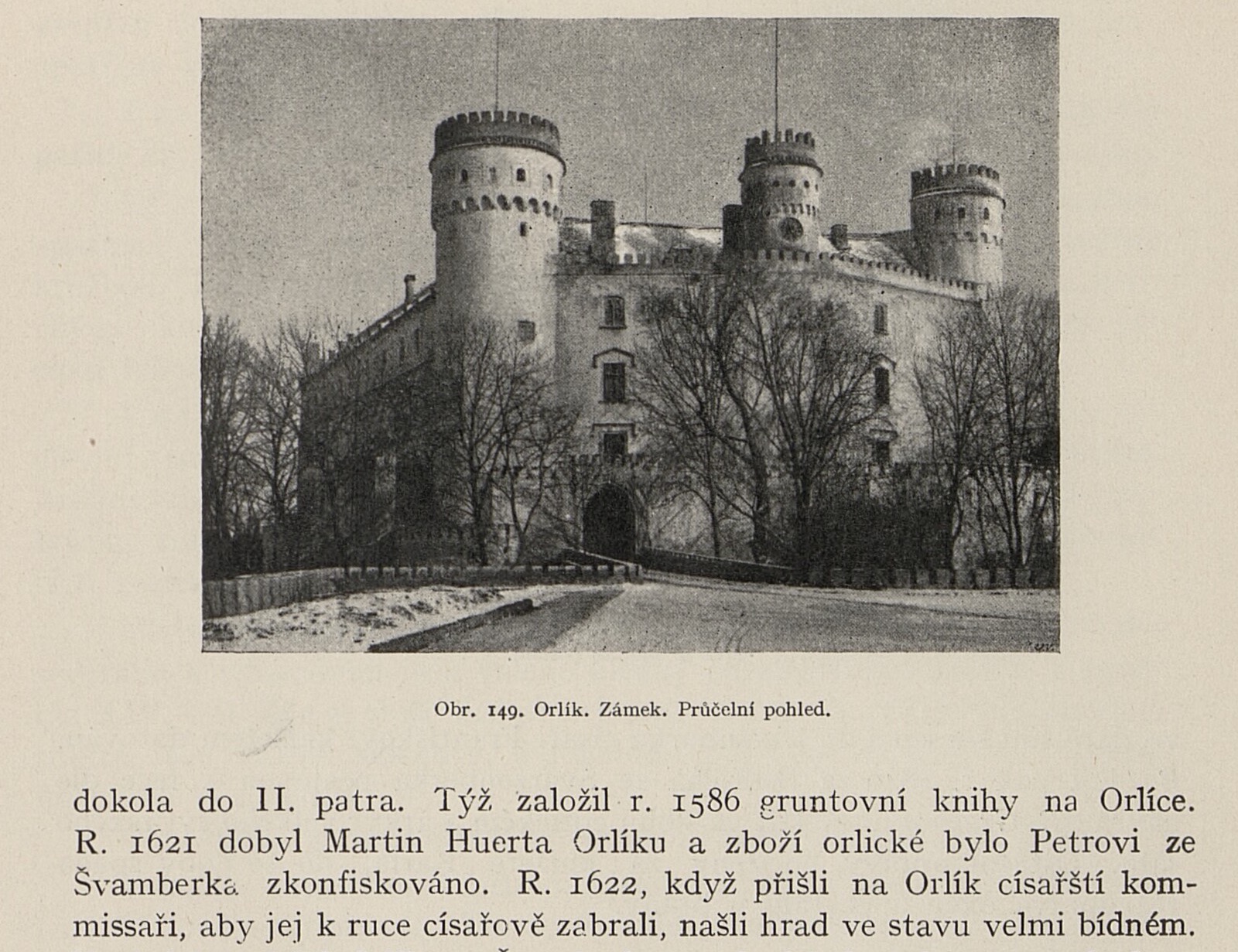
Obr. 149. Orlík. Zámek. Průčelní pohled.
1910 · Soupis památek historických a uměleckých v království Českém od pravěku do počátku XIX. st
Public domain (Moravian Library)
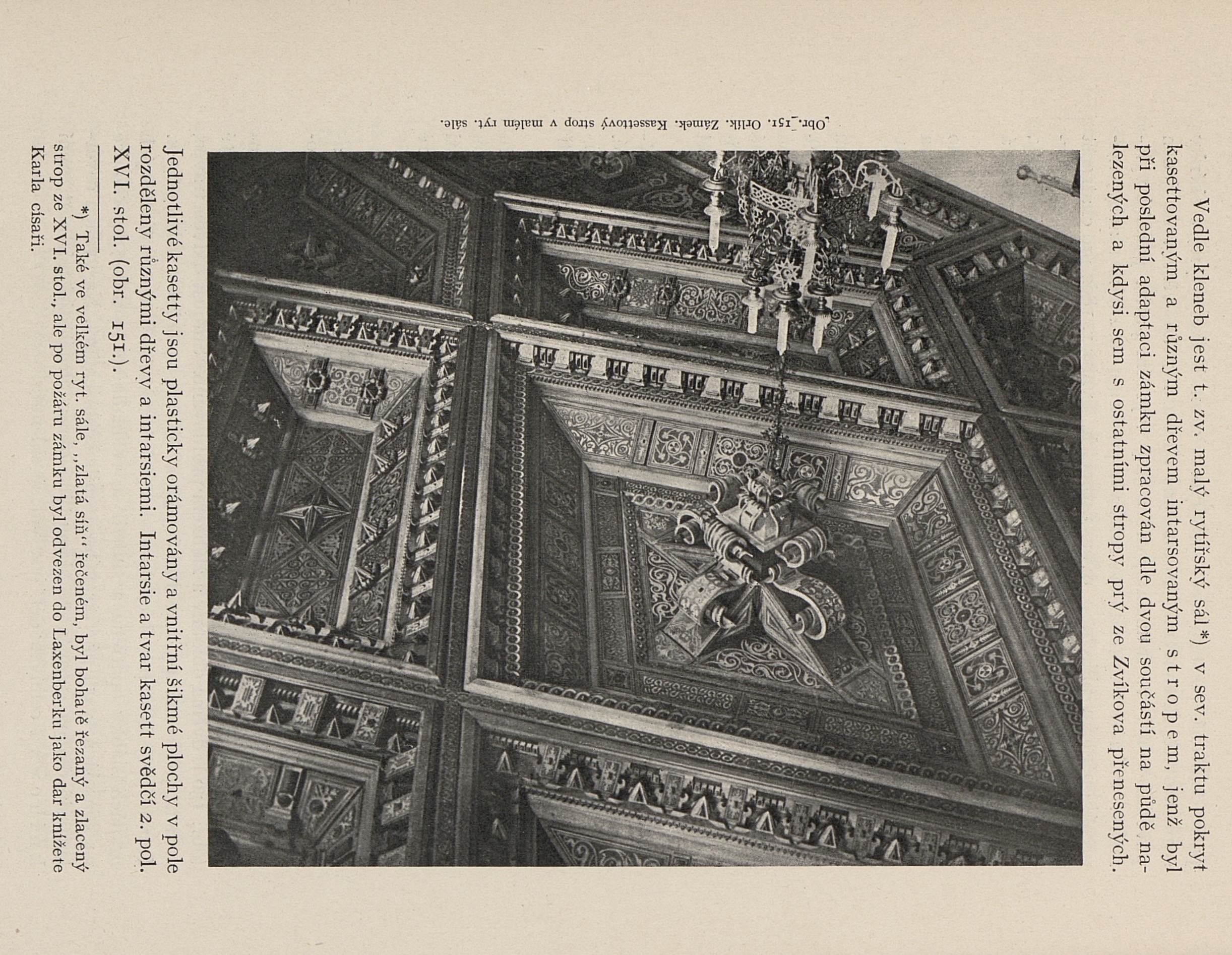
Obr. 151. Orlík. Zámek. Kassetový strop v malém ryt. sále. Jednotlivé kasetty jsou plasticky orámovány a vnitřní šikmé plochy v pole rozděleny různými dřevy a intarsiemi. Intarsie a tvar kasett svědčí 2. pol. XVI. stol. (obr. 151.).
1910 · Soupis památek historických a uměleckých v království Českém od pravěku do počátku XIX. st
Public domain (Moravian Library)
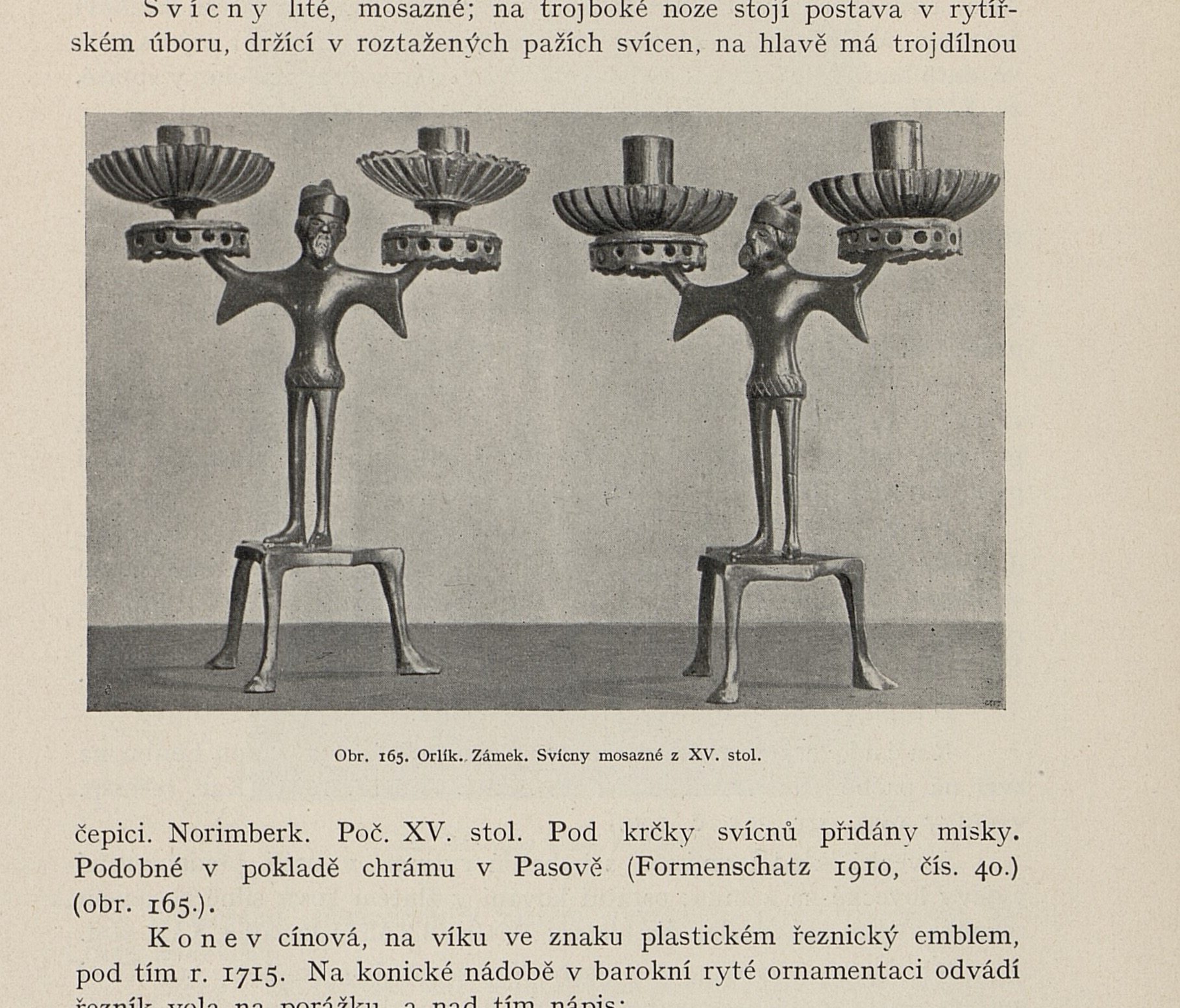
Obr. 165. Orlík. Zámek. Svícny mosazné z XV. stol.
1910 · Soupis památek historických a uměleckých v království Českém od pravěku do počátku XIX. st
Public domain (Moravian Library)


