
Denmark · Ruin
Vordingborg Castle
Vordingborg Slotsruin
Vordingborg Castle is a medieval Danish fortress whose ruins lie in the town of Vordingborg. Built from the late 12th century and much enlarged by the 14th century, most of the complex has been demolished, but the round brick Goose Tower (Gåsetårnet) survives as the site's best-preserved structure and symbol of the town.
First raised
1175
Its prime
1360
Today
Ruin
As it stood in 1360
What Vordingborg Castle looked like in its prime.
A massive circular red-brick keep rising from a low grassy mound, its cylindrical shaft pierced by narrow vertical arrow-slits and small windows and decorated with repeating dark-brick diamond patterns; a crenellated parapet crowns the wall head and above this a steep conical metal-clad spire rises to a finial. The tower stands beside long stretches of fourteenth-century brick curtain wall and a defended bailey, set within a mixed park and town landscape.
Its story
The story of Vordingborg Castle.
Valdemar the Great, Absalon and the Baltic Expansion, c. 1160–1241
Vordingborg was founded by King Valdemar the Great, about 1160 by one account and in 1175 by another, on ground where a magnate's farm had stood before him. Of Valdemar's own stronghold little is known: a ring rampart with an encircling moat around a castle yard of thirty by forty metres, and no trace yet of any permanent building inside it.
The castle was raised as a defensive work and as a base from which to launch raids against the German coast, and it became the centre of the expansive policy Valdemar and Archbishop Absalon pursued on the southern Baltic shore. In the same period a net of castles went up along the south-facing coasts of the Danish islands, among them Nyborg, the castle on Sprogø and Tårnborg by Korsør. The king would take up residence at Vordingborg when the fleet gathered in Grønsund, in Fanefjord or in the bay below the castle before a voyage. The culmination was the fall of Arkona and the conquest of Rügen in 1169, and it was at Vordingborg that Valdemar died in 1182.
The castle was rebuilt within a generation. Oak piles from a substantial dam, cut from trees felled in the summer of 1189, show that work went on under Valdemar's successor Knud VI, who reigned from 1182 to 1202, and recent research holds that Knud extended the place far more heavily than was once assumed, with further building in 1195 and in 1198–1199. The old rampart was levelled in favour of a ring wall of monk's brick, and along the southern side a stone house thirty metres long was raised, the so-called palatium, probably the king's own lodging. Valdemar II used the castle in the same way, for expansion into the Baltic, and in 1241 it was where he made the reformed legal code, the Code of Jutland.
Erik Menved, Christoffer II and the Pawned Crown, 1286–1346
After the murder of Erik Klipping in 1286, Erik Menved became king and set out to recover Denmark's former greatness. The castle came back to the centre of Danish ambitions in the Baltic, and documents issued at Vordingborg show that the king stayed there often. He was duke of Estonia, took the protectorate over Lübeck in 1307 and Rostock in fief in 1311–12, and could therefore govern a large part of the trade between Europe and the North; the expansive policy, with the many wars and revolts of the reign, carried the kingdom into poverty and misfortune.
Erik died in 1319. His brother Christoffer II was crowned king in the castle church by Archbishop Esger Juul in 1324, and in the same year Christoffer's daughter Margrethe was married to the Margrave of Brandenburg. In 1326 the castle was the scene of a great defeat. In the same year Christoffer had to flee Vordingborg and go into exile; the greater part of the crown's castles and tenant farms stood pawned to the counts of Holstein. Valdemar Atterdag, who took the throne in 1340, was far from master of the whole of Denmark: large parts of the realm stood pawned, and he spent the first years of his reign paying off the various pawn-holders. Vordingborg was redeemed in 1346 with the money Valdemar received for letting the knights of the Teutonic Order take over Estonia.
Valdemar Atterdag's Enlargement and the Peace of Vordingborg, 1358–1435
The castle was enlarged several times in the century after Valdemar the Victorious, most markedly under Valdemar Atterdag. Dendrochronological dating of piles from the works puts the felling of the timber in the winter of 1358–59, and the enlargement must have followed shortly after. By the end of the 1300s Vordingborg probably showed nine fortress towers and twelve half-towers, joined by almost 800 metres of wall standing eight metres high. It was one of the country's largest medieval castles.
In 1365, after some years of dispute, Valdemar Atterdag concluded the Peace of Vordingborg at the castle with a group of Hanseatic towns led by Lübeck. The agreement was signed on 22 November, but its terms were unfavourable to the Hanseatic League, and war broke out again in 1367. Seventy years later the castle hosted a second settlement: on 15–17 July 1435 Erik of Pomerania made peace there with Adolf VIII of Holstein, who was granted the duchy of Schleswig.
Taken Without a Fight, 1658–1774
Vordingborg was never rebuilt with bastions capable of standing up to cannon, and it gradually lost its military importance; the various alterations and additions made to it changed nothing fundamental, and the present ruins reflect Valdemar Atterdag's castle. The last real military reckoning at the walls had been in Valdemar Atterdag's time, and as the crown established itself permanently in Copenhagen the place served mainly as the seat of successive captains who administered the len of Vordingborg from it. The final break came in the Second Karl Gustav War of 1658–60: the garrison had been drawn off to Copenhagen by the time the Swedes arrived, so the Swedish army was able to take the castle without a fight. After the war it was so wrecked that it was pulled down.
Large parts of the castle were demolished once the Swedish wars had ended in order to build a palace for Prince Jørgen, son of King Frederick III, raised on the old castle ground in 1671–73. Jørgen married Anne Stuart in 1683, the later Queen Anne of Great Britain, and by all accounts never lived at Vordingborg. The empty palace was sold and pulled down in 1750, and parts of the castle were probably used for the nearby manor of Iselingen, its building elements in all likelihood going into the palaces of Frederiksstaden in Copenhagen. All the royal house's possessions in South Zealand were sold at auction in 1774.
The Goose Tower and the Danish Castle Centre, 1808 to the Present
One staff wing of the palace was left standing, and it housed Sydsjællands Museum until 2013. The Goose Tower, Gåsetårnet, twenty-six metres tall, is the only fully preserved part of the castle and the symbol of the town; legend has it that Valdemar Atterdag used the golden goose on its spire to taunt the Hanseatic League, but the bird was first put up there in 1871. The tower was transferred into the national trust on 24 December 1808, making it the first protected historic monument in Denmark; the site is a protected ancient monument.
The National Museum dug at Vordingborg at intervals between 1889 and 1946, and the work was taken up again in 1995 by Sydsjællands Museum, now Museum Sydøstdanmark, with further digging in 2012–13. In April 2014 the Danish Castle Centre, Danmarks Borgcenter, opened beside the four-hectare ruin, the whole of the old ruin being revitalised at the same time with extensive excavation and water put back into the moats. Those excavations turned up a whole castle tower, ten to fifteen metres high, thought to have toppled into the moat some time before 1600. The castle ruins are the town's most famous attraction.
Step inside
6 places to explore in 1360.
The record describes 6 distinct spots at Vordingborg Castle, including the full exterior approach. Create your own photoreal reconstruction and explore every one, more scenes means more rooms, more angles, and more of the place to stand in.
Build Your Own Castle
Recreate Vordingborg Castle with AI to explore it.
The artist rebuilds it as it stood in 1360, a photoreal reconstruction that belongs to you alone. Pay with coins, no subscription needed.
Recreate this castle →Defend this castle →From the archive
Vordingborg Castle on paper: the measured plan and period views.
The survey plan and photographs below are the ground truth this page's reconstructions are checked against, drawn and photographed while the castle was still a working garrison. Every image is public-domain or openly licensed, with its source named.
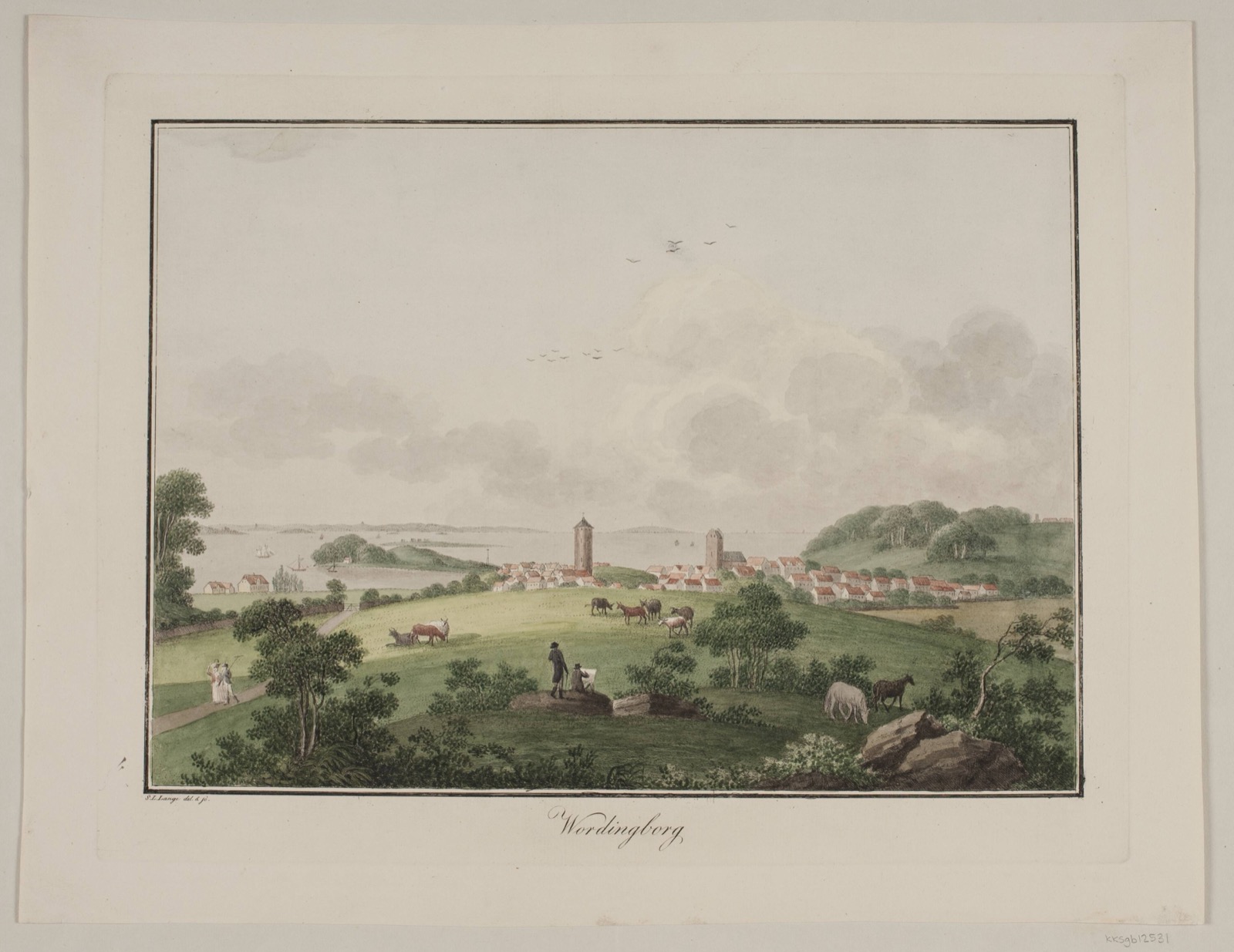
Vordingborg
· National Gallery of Denmark (via Europeana)
Public domain
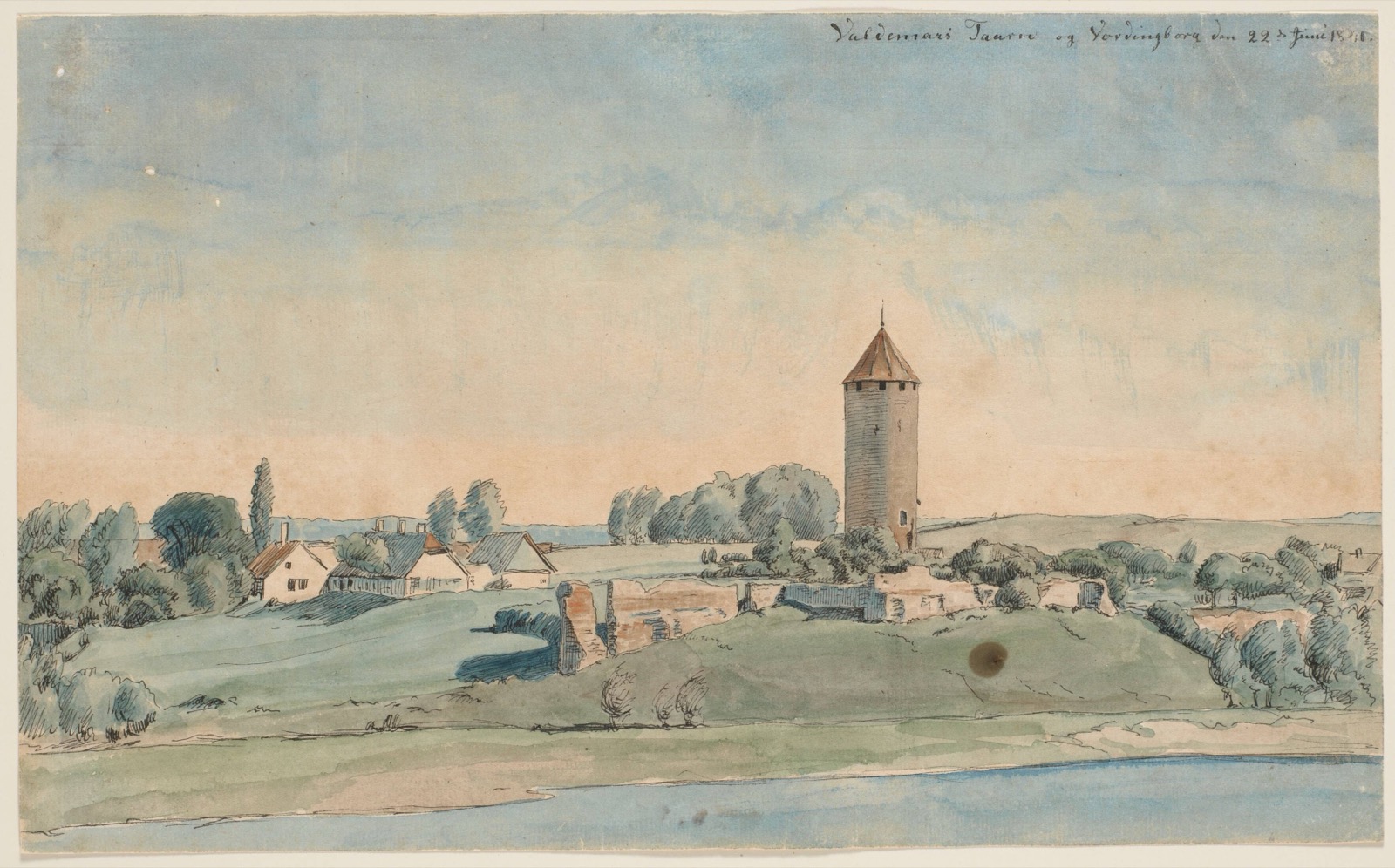
Gaasetaarnet, Vordingborg
1841 · National Gallery of Denmark (via Europeana)
Public domain


