Clan Rising
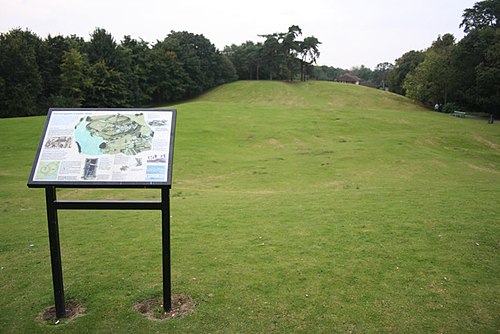
Bampton Castle today

England · Partial ruin

Bampton Castle

Bampton Castle stood in the village of Bampton, Oxfordshire; sources differ on its foundation (accounts name c.1142 or 1314–15). The medieval fortress was four-sided with a tower at each corner and fortified gatehouses on the eastern and western sides. The castle was demolished before 1789, and substantial fragments were incorporated into the later house Ham Court, which survives as a Grade II* listed building.

Photograph via Wikimedia Commons

Its prime

1360

Today

Partial ruin

As it stood in 1360

What Bampton Castle looked like in its prime.

A compact four-sided stone castle built of local pale limestone, with a tower at each corner linked by continuous curtain walls and fortified gatehouses on the east and west sides. Corbelled-out turrets project from some wall sections; steep stone-tiled rooflines rise above ranges against the curtain walls. Windows are narrow and recessed; one end features a rounded tower with a small conical cap now incorporated into a domestic range. At prime the fabric was complete and enclosed a central service courtyard.

Its story

The story of Bampton Castle.

Accounts of Bampton Castle's origin differ. One holds that Matilda built a motte castle here in about 1142, during the reign of Stephen; others date it to 1314–15, when Aymer de Valence, Earl of Pembroke obtained a licence from Edward II to "make a castle of his house at Bampton". Skelton's Antiquities of Oxfordshire describes a four-sided castle with a tower at each corner, fortified gatehouses on the eastern and western sides, and corbelled-out turrets.

The last known account of the castle intact comes from Wood's manuscript, preserved at the Ashmolean Museum: visiting on 7 September 1664, he found nearly the whole western side still standing. The castle was demolished before 1789, but parts of its structure were incorporated into a later house, Ham Court, which survives as a Grade II* listed building.

Step inside

6 places to explore in 1360.

The record describes 6 distinct spots at Bampton Castle, including the full exterior approach. Create your own photoreal reconstruction and explore every one, more scenes means more rooms, more angles, and more of the place to stand in.

Approach across the forecourt toward the western rangeWestern gatehouse exteriorEastern gatehouse exterior and approachCorner rounded turret (now incorporated)Curtain wall and parapet walk between towersCentral service courtyard enclosed by ranges

Build Your Own Castle

Recreate Bampton Castle with AI to explore it.

The artist rebuilds it as it stood in 1360, a photoreal reconstruction that belongs to you alone. Pay with coins, no subscription needed.

Recreate this castle →Defend this castle →

Whose castle

Clans who held Bampton Castle.

The families that held Bampton Castle for a decade or more across its history, follow a name to its clan.

  • Valence

    Built in 1314–15 by Aymer de Valence, Earl of Pembroke, licensed by Edward II to make a castle of his house at Bampton.

Questions about Bampton Castle

What is the history of Bampton Castle?

Bampton Castle’s history begins either in the 12th century, when Matilda built a motte castle about 1142, or in the 14th century, when Aymer de Valence obtained a licence to make a castle of his house. It was four-sided and fortified by corner towers and eastern and western gatehouses. Nearly the whole western side stood in 1664, but the castle was demolished before 1789.

What is inside Bampton Castle?

Inside the former Bampton Castle was a central service courtyard enclosed by ranges against the curtain walls. The surviving description identifies the castle’s interior arrangement through this courtyard and the surrounding ranges, rather than naming individual rooms. Substantial fragments were incorporated into the later house Ham Court.

Where is Bampton Castle?

Bampton Castle is in Bampton, Oxfordshire, in England. It stood in the village of Bampton, and the surviving fragments are incorporated into Ham Court. Bampton is the location associated with the castle, while Oxfordshire identifies its region.

When was Bampton Castle built?

Bampton Castle was built either in the 12th century or the 14th century. One account dates a motte castle at the site to about 1142, while other accounts date the castle to 1314–15, when Aymer de Valence obtained a licence from Edward II. The supplied accounts therefore do not establish one exact construction date.

Which family or clan held Bampton Castle?

Bampton Castle was held by the Valence family. Aymer de Valence, Earl of Pembroke, built it in 1314–15 after Edward II licensed him to make a castle of his house at Bampton. This claim concerns the castle’s early construction and association with the Valence family.

What did Bampton Castle look like in its prime?

In its prime, Bampton Castle was a compact, four-sided stone castle built of local pale limestone. A tower stood at each corner, with continuous curtain walls and fortified gatehouses on the eastern and western sides. Corbelled-out turrets, narrow recessed windows, steep stone-tiled rooflines and a central service courtyard completed the enclosed medieval form.

Is Bampton Castle still standing or is it a ruin?

Bampton Castle is no longer standing as a complete castle; it survives in partial ruin. It was demolished before 1789, although substantial fragments of its structure were incorporated into Ham Court. Ham Court survives as a Grade II* listed building, and one rounded tower is incorporated into a domestic range.
All castles of England · Castles of Europe · the best castles in Europe · explore the finished reconstructions.