England · Ruin
Castle Acre Castle
Castle Acre Castle is a ruined medieval motte-and-bailey castle in Castle Acre, Norfolk, built soon after the Norman Conquest by William de Warenne. It comprises a large motte with an inner bailey, a substantial rectangular outer bailey, and a northeast barbican; substantial earthwork ramparts survive alongside fragments of 12th-century stone curtain walls and gatehouses. The site is a scheduled monument and is managed by English Heritage as a visitor attraction.
First raised
1140
Its prime
1165
Today
Ruin
As it stood in 1165
What Castle Acre Castle looked like in its prime.
A large circular earthen motte topped by a tall square stone keep sits north of a broad rectangular outer bailey; both inner and outer baileys are defined by high earth banks and deep ditches with stretches of pale grey flint-and-rubble curtain wall rising from the slopes. Three substantial stone gatehouses guard approaches, and a barbican and bridge protect the north‑east flank; service ranges and a stone double-hall occupy the inner bailey. At prime the defences read as a continuous ring of earth and stone.
Its story
The story of Castle Acre Castle.
William de Warenne Takes the Manor of Acre, 1070s–1090
Acre was an Anglo-Saxon estate centre, held at the time of the invasion by a wealthy man called Toki. He was quickly replaced by Frederick, a Flemish lord and brother-in-law to William de Warenne, and when Frederick died around 1070 Warenne took the manor himself. During the 1070s he raised a castle where the River Nar met the Peddars Way, at the centre of his Norfolk estates and possibly on top of Toki's former house.
The castle was motte-and-bailey, and at its centre stood no conventional Norman keep but a grand unfortified double-hall of stone, closer to a country house. William gave St Mary's, the former parish church now enclosed by the outer bailey, to the Cluniac order with 110 hectares of farmland, and by 1088 monks had arrived from Lewes. His son, the second Earl William, granted them more spacious ground to the west, probably in 1090, where they built Castle Acre Priory.
Disseised for Duke Robert, then Rebuilt in Stone, 1101–1148
When Robert Curthose, Duke of Normandy, invaded England in 1101, the second earl backed him; he was exiled and disseised of his English estates, Castle Acre among them, until 1103, when the duke persuaded Henry I to let him reclaim them.
Civil war broke out after 1135 between the supporters of King Stephen and the Empress Matilda. William backed Stephen, as did his son the third Earl William de Warenne on inheriting in 1138. Norfolk saw less fighting than much of the country, but the third earl faced challenges to his preeminence from the growing d'Albini and de Vere families, and remodelled the castle in response. Around 1140 the earthworks were raised considerably, the double-hall strengthened and then begun to be converted into a very tall square keep, and the timber ramparts replaced with stone walls.
A fortified planned settlement went up alongside, effectively dependent on the castle. The Peddars Way was redirected so that travellers from the south left the main road and passed west around the priory and the castle fishpond before regaining the route north, designed to display the symbols of de Warenne lordship. William died in 1148 while taking part in the Second Crusade.
Hamelin de Warenne Cuts the Keep Back
The castle passed to William's daughter Isabel, then married to King Stephen's son William of Blois. In 1153 Stephen, facing military stalemate, agreed that Matilda's son should inherit the throne instead; Henry II took power the next year and seized castles across England, Castle Acre included. In 1164 he married Isabel to his illegitimate brother, Hamelin de Warenne, who took the castle with the rest of the de Warenne lands and changed the plan for it, cutting back the keep's intended height and demolishing its southern half; whether even that lesser building was completed is unclear. Hamelin probably also built the two gatehouses in the town and the outer bailey's western gate, and the town's bailey gate still stands, roofless but largely intact.
The Seventh Earl, Maud Nereford and Ruin by 1397
The de Warennes held castle and settlement until 1347, and royalty came often, Henry III at least four times, Edward I five. The seventh earl, John de Warenne, married Joan, a niece of Edward II; the marriage failed and he chose to live instead with his mistress, Maud Nereford, a situation that led to threats of excommunication. In 1316 John gave Castle Acre to Aymer de Valence, Earl of Pembroke and England's ambassador to Rome, probably to encourage him to put a petition to annul the marriage before the Pope the following year. John reacquired it but died in 1347 with no legitimate heirs. Richard Fitzalan, Earl of Arundel, inherited the estate; by 1397 the castle was in ruins.
The Cokes, the Stone Robbers and State Guardianship
After 1537 Thomas Howard, Duke of Norfolk, leased the ruined castle with the priory next door, closed in the Dissolution. His grandson sold both to Sir Thomas Gresham in 1558; they passed to Thomas Cecil, Earl of Exeter, and in 1615 to the lawyer Sir Edward Coke, who repaired the castle at a cost of £60.
The site descended in Coke's family, later earls of Leicester, while the walls were robbed of their stone and the ground grazed. The antiquarian Henry Harrod noted in 1857 that "every house in the neighbourhood has some of the stone-work of the castle...in its walls". In 1971 Thomas Coke, fifth Earl of Leicester, placed the castle into the guardianship of the state, and major excavations concentrated on the inner bailey between 1972 and 1983. English Heritage manages the castle and the bailey gate, both open to visitors; the castle and the settlement defences are protected as a scheduled monument, and the bailey gate further as a Grade I listed building.
Step inside
9 places to explore in 1165.
The record describes 9 distinct spots at Castle Acre Castle, including 2 interiors: great double-hall / keep interior, castle kitchen and service range. Create your own photoreal reconstruction and explore every one, more scenes means more rooms, more angles, and more of the place to stand in.
Build Your Own Castle
Recreate Castle Acre Castle with AI to explore it.
The artist rebuilds it as it stood in 1165, a photoreal reconstruction that belongs to you alone. Pay with coins, no subscription needed.
Recreate this castle →Defend this castle →Whose castle
Clans who held Castle Acre Castle.
The families that held Castle Acre Castle for a decade or more across its history, follow a name to its clan.
Warenne
Built by William de Warenne, Earl of Surrey, in the 1070s and held by the de Warenne earls until 1347, when it passed to Richard Fitzalan, Earl of Arundel.
Coke
Sir Edward Coke restored the castle in the early 17th century; the Cokes, Earls of Leicester, held it until Thomas Coke placed it in state guardianship in 1971.
From the archive
Castle Acre Castle on paper: the measured plan and period views.
The survey plan and photographs below are the ground truth this page's reconstructions are checked against, drawn and photographed while the castle was still a working garrison. Every image is public-domain or openly licensed, with its source named.
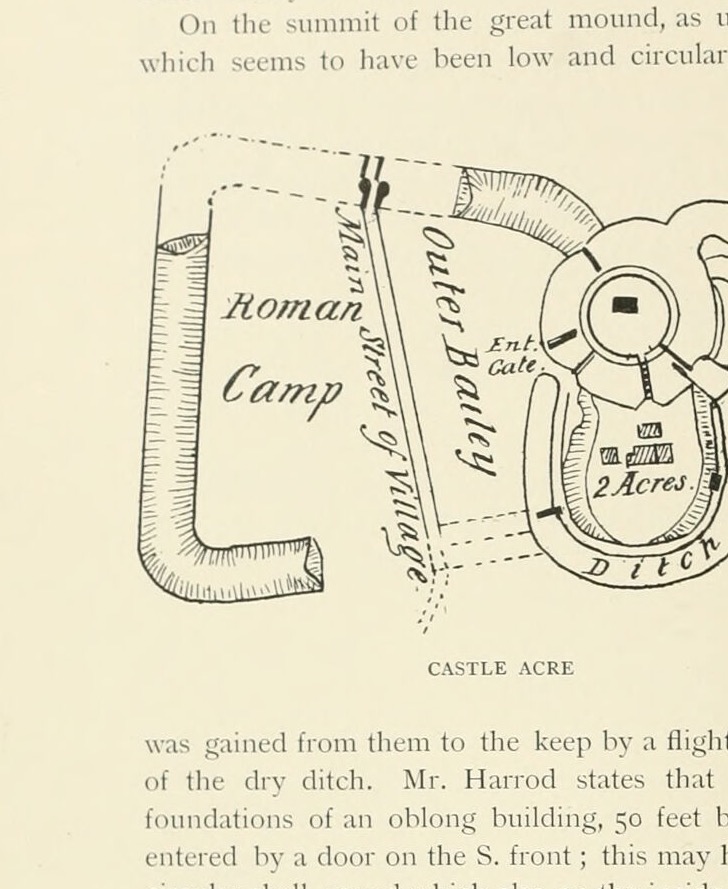
CASTLE ACRE
1897 · J. D. Mackenzie, The Castles of England, vol. 1 (1897)
Public domain
Nearby