England · Partial ruin
Haggerston Castle
Haggerston Castle was a Northumberland castle and later country house at Haggerston, south of Berwick-upon-Tweed. By the 20th century only the medieval tower and a stone rotunda survived; the main house was rebuilt in the 1890s and later demolished after a fire. Today the freestanding tower and rotunda survive as listed structures within a holiday park.
Its prime
1900
Today
Partial ruin
As it stood in 1900
What Haggerston Castle looked like in its prime.
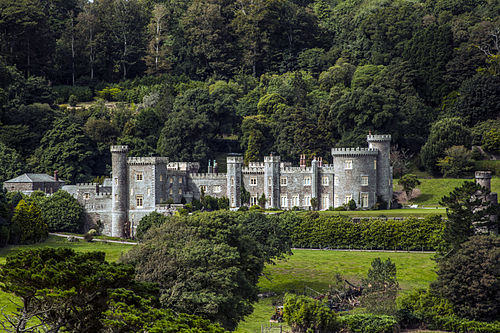
At its prime c.1900 the site read as a paired composition: a tall, rectangular medieval tower of pale sandstone with narrow vertical slit windows, a projecting stone oriel and a crenellated parapet; and a separate cylindrical stone rotunda with large round oculus windows and a low parapet. Between them stood a large late‑Victorian country house and service ranges set within parkland, formal beds (including an Italian garden) and estate lawns, all on otherwise flat Northumberland ground.
Its story
The story of Haggerston Castle.
From de Hagardeston to Haggerston, 11th Century to 1458
The family who held the boggy ground at Haggerston, some five miles south of Berwick-upon-Tweed, are believed to have come north with William the Conqueror's invading force, which pushed as far as Berwick in the 11th century; the lake still on the site is a remnant of that wet ground. John de Hagardeston lived at the castle in the late 12th and early 13th century (his death is documented as around 1210), and married into the Manners family of Cheswick. Little else is known of the early centuries, because fires destroyed much of the castle along with its documents.
The castle itself first enters the record in 1311, when Edward II visited. In 1345 it was described as a 'strong tower' and granted a licence to crenellate by Edward III, an entry recorded in the Calendar of Patent Rolls for 1343–45. By the time of Thomas Haggerston, born around 1458, the family name appears to have settled into its anglicised spelling.
Baronets, Marriages and the Debts of 1839
Sir Thomas Haggerston was created first baronet of Haggerston in the Baronetage of England in 1642. The family married into many great houses, among them the Cheswick family, gaining large amounts of land. In 1785 Haggerston belonged to Sir Carnaby Haggerston, who married Francis Smyth; their daughter Mary married Sir Thomas-Massey Stanley of Hooton Hall in Cheshire in 1805, and ownership of Haggerston devolved to him. The baronetcy took a different road, passing to Sir Carnaby's nephew, Thomas Haggerston of Sandoe and Ellingham.
Sir William Thomas Stanley-Massey-Stanley, 10th Baronet (1806–1863), of Hooton amassed considerable gambling debts, and around 1839 both Hooton Hall and Haggerston Castle came into the ownership of the Naylor/Leyland family.
C. J. Leyland's House and the Fire of 1911
By the 1880s the castle and its estates formed part of the Leyland Entailed Estates, built up by the Liverpool banker Thomas Naylor. On Naylor's death in 1891 they were inherited by his nephew Christopher John Naylor (1849–1926), who gave up his family home at Leighton Hall in Powys to his brother, moved to Haggerston and changed his name to Leyland. By 1893 he had rebuilt the main house and begun his own gardens, overseeing the landscaping of the 23,000-acre estate and laying out a 1.4-acre Italian garden.
Local legend held the castle cursed by a witch, the curse blamed for destructive fires on three occasions. The reason for it and the year of the first fire are now unknown; later fires came in 1618 and in 1911. The last of them left only the tower and the rotunda, and Leyland never again lived in the house he had built in 1893.
The Haggerston Grey and the Rise of the Leylandii
While Leyland was landscaping the gardens, his brother John sent him six specimens of Cupressocyparis × leylandii, a hybrid produced by a spontaneous cross at Leighton Hall in 1888, when the cones of a Nootka cypress were fertilised by pollen from a Monterey cypress. In 1925 a firm of nurserymen specialising in conifers went looking for a fast-growing tree that would take to windy, salty ground such as Cornwall's; they found Leyland's six trees and began propagating them, naming them 'Haggerston Grey' in respect of their origins. A freak tornado blew one down in 1953 and the Forestry Commission began developing hybrids from the five survivors; by the late 20th century the leylandii was among the biggest-selling items in British garden centres.
Demolition, the 1933 Auction and the Holiday Park
C. J. Leyland died in 1926. In 1933, in an attempt to recoup some of the family fortune, the ruins of the house he had built were demolished and the estate was auctioned off in 2,000 lots. The tower and the rotunda came through, both Grade II listed; Haven Holidays owns them today and operates a holiday park on 256 acres of the surrounding land.
Step inside
10 places to explore in 1900.
The record describes 10 distinct spots at Haggerston Castle, including 1 interior: cellars and service basement. Create your own photoreal reconstruction and explore every one, more scenes means more rooms, more angles, and more of the place to stand in.
Build Your Own Castle
Recreate Haggerston Castle with AI to explore it.
The artist rebuilds it as it stood in 1900, a photoreal reconstruction that belongs to you alone. Pay with coins, no subscription needed.
Recreate this castle →Defend this castle →Whose castle
Clans who held Haggerston Castle.
The families that held Haggerston Castle for a decade or more across its history, follow a name to its clan.
Haggerston
The de Hagardestons, later Haggerstons, held the castle from at least the late 12th century until gambling debts brought the estate to new owners around 1839.
Leyland
The Naylor/Leyland family owned Haggerston from around 1839; C. J. Leyland (né Naylor) inherited in 1891, and after his death in 1926 the estate was auctioned off in 1933.