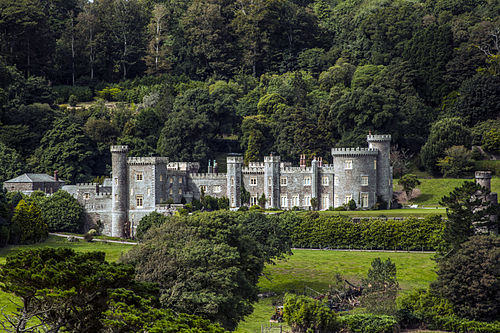
England · Ruin
Sheriff Hutton Castle
Sheriff Hutton Castle is an irregular quadrangular stone castle in the village of Sheriff Hutton, North Yorkshire, built in the late 14th century and long associated with the Neville family and the Crown. Tall fragments of its rectangular corner towers and its gatehouse survive today as ruins; the ranges and curtain walls between them have largely gone.
First raised
1382
Its prime
1484
Today
Ruin
As it stood in 1484
What Sheriff Hutton Castle looked like in its prime.
An irregular quadrangular plan with four massive rectangular corner towers linked by ranges of buildings around an inner courtyard; the northern and western sides are straight while the south and east have obtuse outward-pointing angles. The entrance is in the east wall, defended by a gatehouse. Built of rubble mudstone dressed with sandstone, the castle would have had stepped parapets forming small turrets on the tower tops and continuous curtain walls enclosing the yard.
Its story
The story of Sheriff Hutton Castle.
From the Sheriff's Motte to Lord Neville's Quadrangle, c.1135–1382
The first castle here was a motte and bailey raised in the Forest of Galtres by Bertram de Bulmer, Sheriff of York in the reign of King Stephen (c. 1135–1154); its remains lie south of the churchyard. The stone castle stands apart from it, at the western end of the village, and was built by John, Lord Neville in the late fourteenth century. Neville had obtained a charter in 1377 for a Monday market and an annual fair, and in 1382 Richard II granted him a licence to crenellate, though whether building had already begun by that date is unknown.
The design has been credited, on stylistic and documentary grounds, to John Lewyn, who built nearby Bolton Castle in 1378. The two share tower parapets that step up to form turrets, and the same plan of a quadrangle with massive rectangular corner towers, an arrangement popular in the north of England in the late fourteenth century. At Sheriff Hutton the quadrangle is irregular, its fabric largely rubble mudstone dressed with sandstone quarried at Terrington.
The Neville Partition of 1425 and the Fall at Barnet, 1471
The castle passed to John's son Ralph Neville, 1st Earl of Westmorland. On Ralph's death in 1425 the Neville estates were partitioned: his grandson Ralph, 2nd Earl of Westmorland, kept the title and the Durham lands, while the Yorkshire estates, Sheriff Hutton among them, went to Richard Neville, 5th Earl of Salisbury. When Salisbury's son Richard Neville, 16th Earl of Warwick, was killed at the Battle of Barnet in 1471, his lands were given to Richard, Duke of Gloucester, brother of Edward IV, by right of his wife Anne Neville.
Richard of Gloucester, Lord of the North, 1471–1485
Richard stayed often at Sheriff Hutton during his tenure as Lord of the North, its closeness to York making it convenient to him. By the middle of October 1480 he was at the castle when word came from the Earl of Northumberland that the Scots might retaliate for a raiding party Richard had led across the border; Northumberland wrote to the magistrates of York ordering them to raise an armed force, and the men of York sent an alderman out to Sheriff Hutton to seek Richard's advice.
In 1484 Richard established a royal household at the castle for the young Edward, Earl of Warwick, son of George Plantagenet, 1st Duke of Clarence, and for John de la Pole, 1st Earl of Lincoln. That July he founded the Council of the North, with its chief headquarters at Sheriff Hutton and Sandal Castle; the council would last a century and a half. In 1485, waiting at Nottingham for Henry Tudor's invasion, he sent his niece Elizabeth of York and her sisters north to Sheriff Hutton, along with the Earls of Warwick and Lincoln, Lord Morley and John of Gloucester. After Richard's death at Bosworth that year the castle became the property of Henry VII.
Crown Constables, the Howards and the Council's Move to York, 1485–1572
John Skelton visited in 1495 and wrote 'The Garlande of Laurell' about Elizabeth Tilney, Countess of Surrey. The Howards lived at the castle while it still belonged to the crown: her husband Thomas Howard, later 2nd Duke of Norfolk, was King's Lieutenant in the North from 1489 to 1499 and possibly constable of Sheriff Hutton. Sir Thomas Darcy replaced him as constable and steward in 1499/1500, and was himself replaced by Sir Richard Cholmondeley in 1509. Henry VIII is said to have sent Henry Fitzroy here to be raised in 1525, and a survey of that date found the castle in need of repair.
In 1536 the castle was sold to the Howard family, and Thomas Howard, 3rd Duke of Norfolk, made repairs in 1537. After the council moved its seat to York in the mid-sixteenth century the castle went into decline. Henry, Earl of Huntingdon, mounted a further campaign of repairs in 1572 in the hope that the council's President would take it as a residence, and described it as an 'olde Castell aamoste ruinated'.
Ruinous by 1618: the Ingrams and Private Hands to 2019
The castle was described as ruinous again in 1618. The Ingram family acquired it in 1622, and stone from the site went into various buildings in Sheriff Hutton village. The Ingrams held it until the early twentieth century, by which time the ruins were being used as a farmyard.
Tall fragments of the corner towers and gatehouse still stand to their original height, while the ranges and curtain walls between them have largely gone and the middle and outer wards lie beneath the neighbouring farm. The ruin is a scheduled monument, Grade II* listed since 1954 and recognised as an internationally important structure. It remains in private hands: the Howarth family held it from the 1940s until its sale to another private owner in 2019.
Step inside
8 places to explore in 1484.
The record describes 8 distinct spots at Sheriff Hutton Castle, including 3 interiors: gatehouse passage (interior), southwest tower (interior level), south range (external and internal). Create your own photoreal reconstruction and explore every one, more scenes means more rooms, more angles, and more of the place to stand in.
Build Your Own Castle
Recreate Sheriff Hutton Castle with AI to explore it.
The artist rebuilds it as it stood in 1484, a photoreal reconstruction that belongs to you alone. Pay with coins, no subscription needed.
Recreate this castle →Defend this castle →Whose castle
Clans who held Sheriff Hutton Castle.
The families that held Sheriff Hutton Castle for a decade or more across its history, follow a name to its clan.
Neville
Built by John, Lord Neville, under a 1382 licence to crenellate; held by the Nevilles until Warwick's death at Barnet in 1471.
Nearby