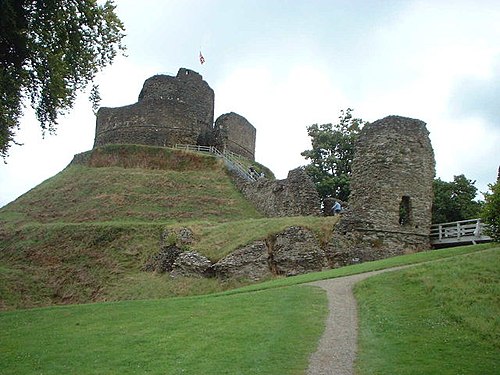
England · Partial ruin
Helmsley Castle
Helmsley Castle is a medieval stone castle in the market town of Helmsley, North Yorkshire, England. The site preserves a tall rectangular tower, stretches of curtain wall and extensive earthworks around a rectangular inner bailey; it is now cared for by English Heritage.
First raised
1120
Its prime
1334
Today
Partial ruin
As it stood in 1334
What Helmsley Castle looked like in its prime.
A tall, rectangular stone tower of pale grey–buff coursed rubble rises above lower curtain walls, capped by a crenellated parapet with short projecting corner turrets and narrow slit and arched windows. The castle stands on a grassy, rocky outcrop with visible foundation-ruins and earthworks of a rectangular inner bailey and double ditches. Masonry shows irregular coursing with larger dressed stones at corners; at its prime the tower, gatehouse, barbican and curtain walls were continuous and roofed.
Its story
The story of Helmsley Castle.
Walter l'Espec's Timber Castle, c.1120–1153
The estate of Helmsley was granted to Robert, Count of Mortain, after the Norman Conquest, but there is no evidence he built anything here. The castle was raised in timber around 1120 by Walter l'Espec, on a rocky outcrop above the River Rye, and its plan owed little to the motte-and-bailey work of the period: a rectangular inner bailey ringed by double ditches, unlike nearby Pickering.
L'Espec also granted the land for Rievaulx Abbey, 1.9 miles away; Aelred, the abbey's first novice master, was involved in l'Espec's affairs both military and personal, and Helmsley served as a place of safety in unstable years. Walter left no surviving children, tradition giving him a son killed young in a fall from his horse, and on his death in 1153 the castle went to his sister Adelina, wife of Peter de Roos.
Rebuilding in Stone under the de Ros Lords, 1186-1316
In 1186 Robert de Ros, son of Everard de Ros, began converting the castle to stone, raising two main towers, the round corner towers and the main gateway on the south side. He died in 1227, leaving Helmsley to his elder son William, who lived there until 1258 and added only a chapel in the courtyard.
William's son Robert held the lordship from 1258 to 1285, and his marriage to Isabel d'Aubigny, heiress to Belvoir Castle, paid for a new hall and kitchen and for strengthening the defences, possibly including the south barbican, built at some point between 1227 and 1285. He also drove a wall across the site, dividing it in two: the southern half private to the lord's family in the new hall and east tower, the northern half, with the old hall, left to the steward and the castle officials. The strengthening carried on into the lifetime of his son, William de Ros II, who died in 1316.
Edward III, Richard of Gloucester and the Manners Earls, 1334-1632
The east tower may have been heightened for the visit of Edward III, who stayed about five days in 1334. The de Roos kept Helmsley until 1478, when Edmund de Roos sold it to Richard, Duke of Gloucester, the future Richard III, who did nothing with it and lodged instead at Middleham. After Richard fell at Bosworth, Henry VII restored the castle to Edmund.
Edmund died childless in 1508 and Helmsley passed to his cousin Sir George Manners of Etal, then in 1513 to George's son Thomas, created Earl of Rutland in 1525. The next real alteration came under Thomas's grandson Edward, who turned the old hall into a Tudor mansion, converted the 13th-century chapel into a kitchen linked to it by a covered gallery, pulled the new hall down, and made the south barbican a more comfortable residence. A letter of April 1578 records the mason's slow progress, his payment of £10, and timber standing ready for a gallery in the attic. Edward died in 1587; the castle passed through his brother John, John's son Roger and Roger's younger brother Francis, and on Francis's death in 1632 to his young grandson George Villiers, 2nd Duke of Buckingham.
Fairfax's Siege and the Slighting, 1644
In 1644 Sir Thomas Fairfax laid siege to Helmsley. Sir Jordan Crosland held it for the king for three months before surrendering, and Parliament ordered the place slighted: much of the walls and gates and part of the east tower were destroyed, though the mansion was spared.
A Ruin by Design: Duncombe Park to English Heritage
In 1657 Villiers married Mary Fairfax, daughter of the same Sir Thomas Fairfax who had besieged Helmsley. He died without heirs in 1687 and Helmsley was sold in 1695 to Charles Duncombe, a banker and politician knighted in 1699 and Lord Mayor of London in 1708; the 40,000-acre estate cost him £90,000. On his death in 1711 it went to his sister Mary's husband Thomas Brown, who took the Duncombe name, hired William Wakefield, a protégé of Sir John Vanbrugh, to build a country house at Duncombe Park overlooking the ruins, and left the castle to decay as a “picturesque backdrop” to the new seat. J. M. W. Turner sketched it.
The town made its own use of the ruin, holding fêtes, pageants and agricultural shows there; Charles Norris Gray, vicar of All Saints', ran events in it through the later 19th century. The Office of Works took the castle in 1923 under the guardianship of Sir Charles Peers and began clearing debris and trees, and in the Second World War the earthworks were planned into an anti-tank defence. Still owned by Lord Feversham's family of Duncombe Park, the castle is a scheduled monument and a Grade I listed building, and is in the care of English Heritage.
Step inside
10 places to explore in 1334.
The record describes 10 distinct spots at Helmsley Castle, including 3 interiors: chapel in the courtyard, new hall (interior), kitchen / service area. Create your own photoreal reconstruction and explore every one, more scenes means more rooms, more angles, and more of the place to stand in.
Build Your Own Castle
Recreate Helmsley Castle with AI to explore it.
The artist rebuilds it as it stood in 1334, a photoreal reconstruction that belongs to you alone. Pay with coins, no subscription needed.
Recreate this castle →Defend this castle →Whose castle
Clans who held Helmsley Castle.
The families that held Helmsley Castle for a decade or more across its history, follow a name to its clan.
l'Espec
Built in wood c.1120 by Walter l'Espec, who held it until his death in 1153.
de Roos
Held by the de Roos family from 1153 until Edmund de Roos sold it in 1478.
Manners
Passed to Sir George Manners in 1508; his son Thomas was created Earl of Rutland in 1525.
From the archive
Helmsley Castle on paper: the measured plan and period views.
The survey plan and photographs below are the ground truth this page's reconstructions are checked against, drawn and photographed while the castle was still a working garrison. Every image is public-domain or openly licensed, with its source named.
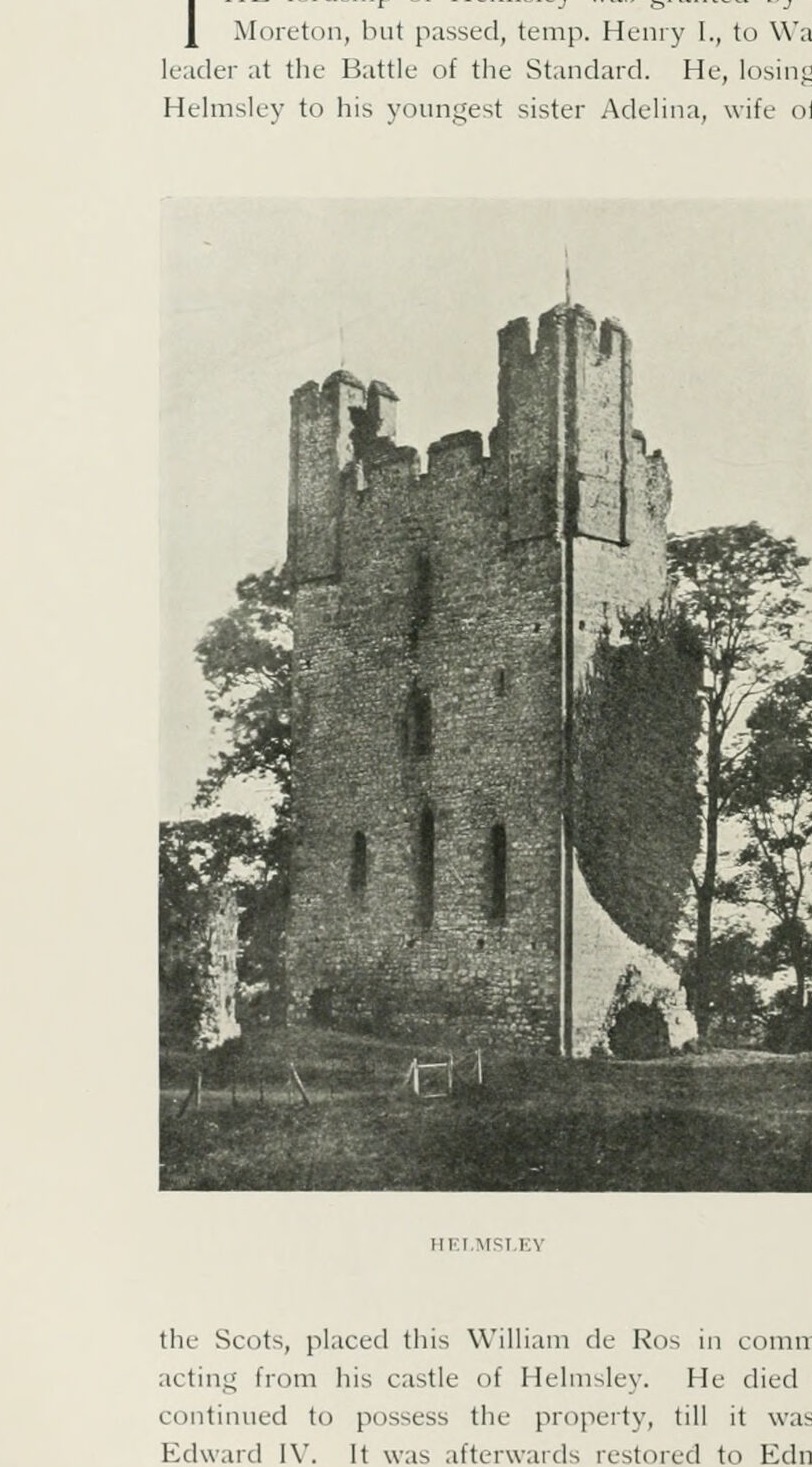
HELMSLEY
1897 · J. D. Mackenzie, The Castles of England, vol. 2 (1897)
Public domain
Nearby