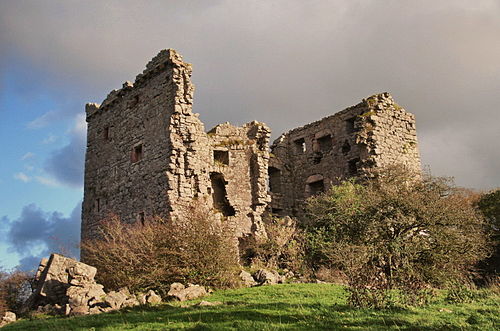
England · Partial ruin
Hornby Castle
Hornby Castle is a Grade I listed fortified manor house in Hornby, North Yorkshire. The surviving building is the south range of a larger complex that was remodelled several times and largely demolished in the 20th century; the property remains a private residence with surrounding parkland.
Its prime
1811
Today
Partial ruin
As it stood in 1811
What Hornby Castle looked like in its prime.
A continuous fortified-manor silhouette of coursed sandstone rubble with lead and stone-slate roofs: a tall, square, battlemented tower rises above a crenellated south range, low linked ranges with regular rectangular windows and stone chimneys, and a crenellated curtain wall partly covered in ivy. The complex sits on a gentle rise above parkland and orchard, with a broad lawn and fields in the foreground; roofs are pitched with stone slates and low parapets at the skyline.
Its story
The story of Hornby Castle.
The St Quintin Tower and William Conyers's Rebuilding, 14th Century to 1557
At the end of the fourteenth century the fortified manor house at Hornby, on the edge of Wensleydale between Bedale and Leyburn in North Yorkshire, belonged to the St Quintin family, and passed out of it when the heiress Margaret Quintin married John Conyers, who died in 1422. William Conyers, 1st Baron Conyers, largely rebuilt the place in the fifteenth century, keeping the fourteenth-century tower that carried the older family's name, St Quintin's tower. On the death of John Conyers, 3rd Baron Conyers, in 1557, the estate went to his daughter Elizabeth, wife of Thomas Darcy.
The Darcys of Holderness and Colonel Assheton, 1557-1778
The estate descended in the Darcy family, made Earls of Holderness in 1682. Conyers Darcy, 2nd Earl of Holderness, was elected MP for Boroughbridge in 1660 and for Yorkshire in 1661.
During the English Civil War the castle was taken by Colonel Ralph Assheton, commander-in-chief of the Parliamentary forces in North Lancashire. An order to slight it was not carried out. The line ran on to Robert Darcy, 4th Earl of Holderness, who died in 1778.
John Carr's South Range and the Dukes of Leeds
In the 1760s the house was largely rebuilt for the 4th Earl of Holderness by John Carr of York, who was responsible for the surviving south range, the east range and outbuildings.
The 4th Earl's daughter and heir Amelia, Baroness Darcy and Baroness Conyers, married Francis Osborne, Marquess of Carmarthen, afterwards 5th Duke of Leeds. He assembled at Hornby rich early eighteenth-century furniture drawn from several houses, illustrated in the books of Percy Macquoid. On Amelia's death in 1784 the estate passed to her son George Osborne, 6th Duke of Leeds (1775-1838). After Kiveton Hall was demolished in 1811, Hornby became the main seat of the Dukes of Leeds, and remained so until George Osborne, 9th Duke of Leeds.
Demolition and the Clutterbuck Purchase, 1927-1967
St Quintin's tower was demolished in 1927. In 1930 the estate was broken up and most of the house demolished; Carr's east range came down in the 1930s. A sixteenth-century main doorway from the house is preserved in the Burrell Collection in Glasgow.
What remained, the south range, was bought in 1936 by Major-General Walter E. Clutterbuck and passed down to his grandson Roger Clutterbuck. The grounds include a deer park and a working farm. Listed Grade I on 13 February 1967, the range is a private residence and not open to the public, though the gardens are open at certain times of the year.
Step inside
8 places to explore in 1811.
The record describes 8 distinct spots at Hornby Castle, including the full exterior approach. Create your own photoreal reconstruction and explore every one, more scenes means more rooms, more angles, and more of the place to stand in.
Build Your Own Castle
Recreate Hornby Castle with AI to explore it.
The artist rebuilds it as it stood in 1811, a photoreal reconstruction that belongs to you alone. Pay with coins, no subscription needed.
Recreate this castle →Defend this castle →Whose castle
Clans who held Hornby Castle.
The families that held Hornby Castle for a decade or more across its history, follow a name to its clan.
St Quintin
Owners of Hornby at the end of the 14th century, until heiress Margaret Quintin married John Conyers (died 1422); their tower stood until 1927.
Conyers
Held by the Conyers from Margaret Quintin's marriage until the death of John, 3rd Baron Conyers, in 1557; the 1st Baron largely rebuilt the castle.
Darcy
Descended in the Darcy family, Earls of Holderness from 1682, from 1557 until the death of Robert Darcy, 4th Earl of Holderness, in 1778.
Osborne
Passed by marriage to the Osbornes, Dukes of Leeds, in 1784; from 1811 Hornby was their main seat until the time of the 9th Duke.
Nearby