Clan Rising
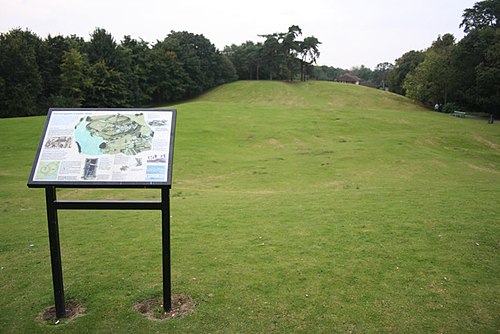
Wareham Castle today

England · Partial ruin

Wareham Castle

Wareham Castle was a motte-and-bailey castle sited in the south-west corner of the older Anglo-Saxon town defences at Wareham, Dorset. A small square stone keep stood on the motte with inner and outer baileys guarded by a stone curtain wall and surrounding ditch; much of the site survives today as earthworks integrated into the town.

Photograph via Wikimedia Commons

Its prime

1137

Today

Partial ruin

As it stood in 1137

What Wareham Castle looked like in its prime.

A large grass-covered circular motte occupies the south-west corner of rectangular town earthworks, its summit dominated by a compact square stone keep built of rubble with pilaster buttresses at the corners. Below the motte lie the traces of inner and outer baileys enclosed by a stone curtain wall roughly 1.5 metres thick in places and protected by a surrounding ditch; the town’s long earthen ramparts form a rectangular perimeter with four entrances and streets running beside them.

Its story

The story of Wareham Castle.

Robert Beaumont controlled Wareham Castle in 1118, when he passed it to Robert, Earl of Gloucester, who carried out work on it in 1137. The motte-and-bailey stood in the south-west corner of the older Anglo-Saxon town defences, known locally as the Walls, with a small square stone keep on the motte and inner and outer baileys behind a stone curtain wall and ditch.

After King John, Wareham passed to the Earls of Clare, who paid it little attention, and the outer bailey ditch was filled in early in the 13th century. In the Civil War the Royalists under Ralph Hopton, 1st Baron Hopton, took the town in 1643; Parliament retook it in 1644, when soldiers led by Sir Ashley Cooper forced their way through the West Gate in the walls. Much of the site survives as earthworks within the town.

Step inside

7 places to explore in 1137.

The record describes 7 distinct spots at Wareham Castle, including the full exterior approach. Create your own photoreal reconstruction and explore every one, more scenes means more rooms, more angles, and more of the place to stand in.

Approach along the motte crest (exterior)Motte summit with square keep (exterior)Inner bailey (courtyard)Curtain wall and surrounding ditch (exterior)West Gate and adjacent town walls (exterior)Outer bailey line (exterior)Anglo-Saxon town ramparts (exterior)

Build Your Own Castle

Recreate Wareham Castle with AI to explore it.

The artist rebuilds it as it stood in 1137, a photoreal reconstruction that belongs to you alone. Pay with coins, no subscription needed.

Recreate this castle →Defend this castle →

Whose castle

Clans who held Wareham Castle.

The families that held Wareham Castle for a decade or more across its history, follow a name to its clan.

  • Clare

    The Earls of Clare held Wareham after King John's reign, though they paid the castle little attention.

From the archive

Wareham Castle on paper: the measured plan and period views.

The survey plan and photographs below are the ground truth this page's reconstructions are checked against, drawn and photographed while the castle was still a working garrison. Every image is public-domain or openly licensed, with its source named.
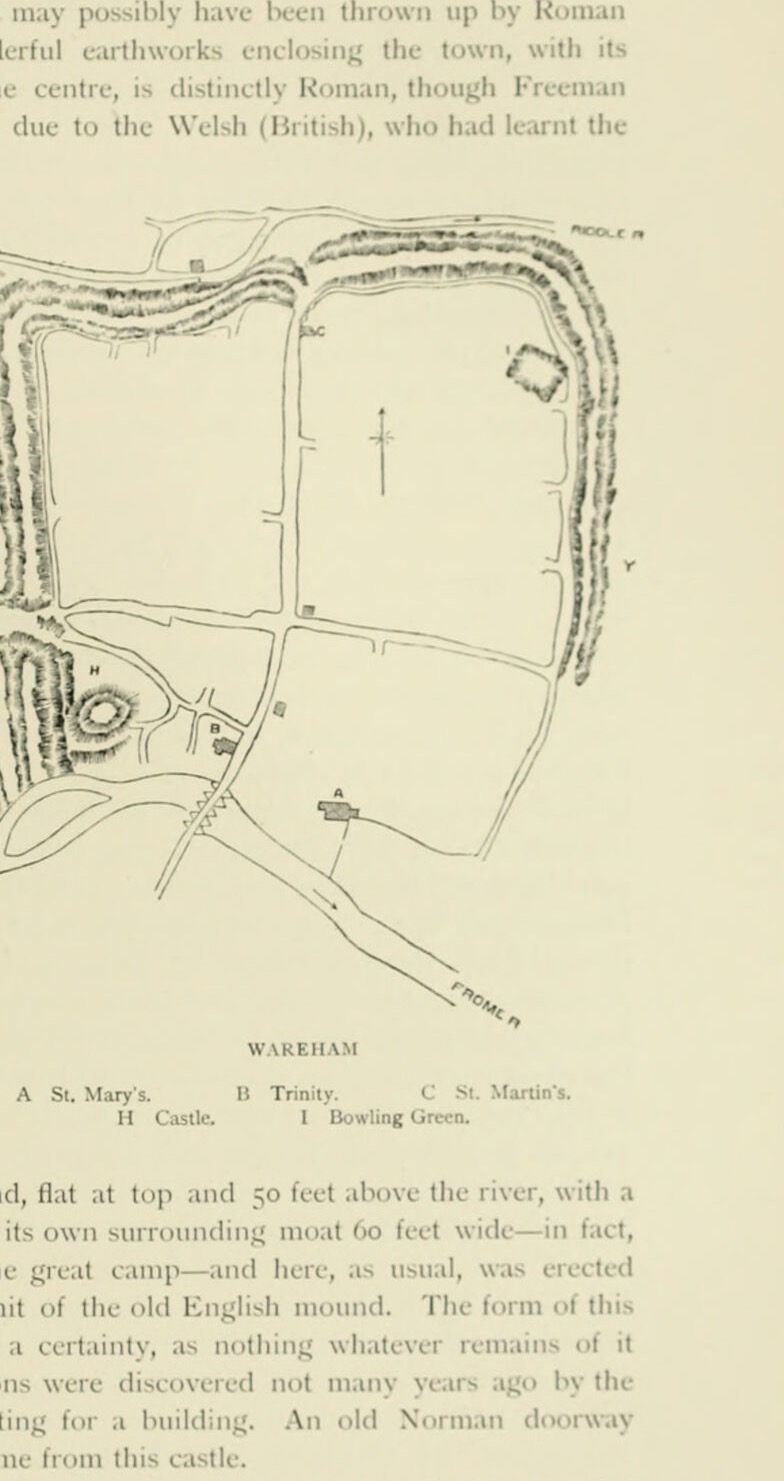
WAREHAM
A St. Mary's.    B Trinity.    C St. Martin's.    H Castle.    I Bowling Green., Wareham Castle

WAREHAM A St. Mary's. B Trinity. C St. Martin's. H Castle. I Bowling Green.

1897 · J. D. Mackenzie, The Castles of England, vol. 1 (1897)

Public domain

Questions about Wareham Castle

What is the history of Wareham Castle?

Wareham Castle began as a motte-and-bailey fortress in the 11th or 12th century, built in the south-west corner of older Anglo-Saxon town defences. Robert Beaumont controlled it in 1118 and passed it to Robert, Earl of Gloucester, who carried out work in 1137. During the Anarchy it changed hands between supporters of King Stephen and the Empress Matilda.

Why was Wareham Castle built, and what was it used for?

Wareham Castle was built for defence, using a motte, inner and outer baileys, timber defences and a ditch within the older fortified town. A stone keep and curtain wall were later added. After the 12th-century civil war, nearby Corfe Castle became the region’s more important military fortification, and Wareham Castle later received little attention under the Earls of Clare.

What is inside Wareham Castle, and what can you see in it?

Inside Wareham Castle, the visible remains include the motte summit, the foundations of the small square keep, the inner bailey and traces of the outer bailey. The baileys were enclosed by a stone curtain wall and protected by a ditch. The lines of the baileys are traced by Pound Lane and Trinity Lane.

Where is Wareham Castle?

Wareham Castle is in Wareham, Dorset, in south-west England. It occupies the south-west corner of the older Anglo-Saxon town defences, known locally as the Walls. The castle site lies within the town, alongside the surviving town ramparts and entrances.

Was Wareham Castle ever attacked or besieged?

Wareham Castle was attacked and changed hands during the Anarchy in the 1140s, when it stood between the territories of King Stephen and the Empress Matilda. During the English Civil War, Royalists under Ralph Hopton took the town in 1643. Parliament retook it in 1644, when soldiers led by Sir Ashley Cooper forced their way through the West Gate.

Which family or clan held Wareham Castle?

The Earls of Clare held Wareham Castle after King John’s reign, although they paid the castle little attention. During their tenure, the outer bailey ditch was filled in early in the 13th century. Their control followed an earlier period when the castle had been controlled by the Earls of Gloucester.

What did Wareham Castle look like in its prime?

In its prime, Wareham Castle had a large circular motte crowned by a compact square stone keep. The keep was built of rubble and had pilaster buttresses at its corners. Inner and outer baileys lay below it, enclosed by a stone curtain wall roughly 1.5 metres thick in places and protected by a surrounding ditch.

Is Wareham Castle still standing, or is it a ruin?

Wareham Castle is a partial ruin, with much of the site surviving as earthworks within the town. The foundations of the keep remain inside the motte, while the lines of the inner and outer baileys can still be traced. Most of the castle ditch was filled in, although some surviving sections remain.
All castles of England · Castles of Europe · the best castles in Europe · explore the finished reconstructions.