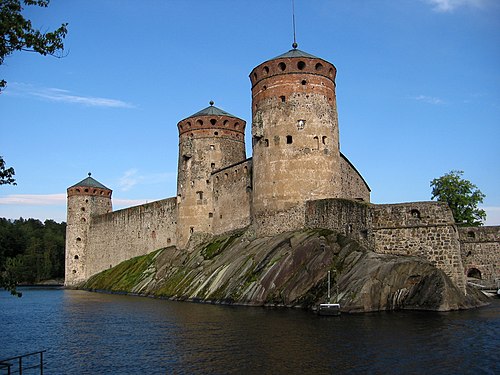
Finland · Ruin
Kajaani Castle
Kajaanin linna
Kajaani Castle is an early 17th-century granite fortress built on a small islet in the Kajaani River in present-day Finland. Constructed from 1604 and substantially completed under Per Brahe in the 1650s–1660s, it was destroyed by explosives in 1716 and today survives as roofless ruins on Linnansaari island.
First raised
1604
Its prime
1666
Today
Ruin
As it stood in 1666
What Kajaani Castle looked like in its prime.
A compact rectangular granite fortress set on a small river islet, its thick curtain walls rising directly from the rapids; the plan is terminated by a half‑rounded (round) turret at each short end. By its prime the inner yard walls had been raised to the same height as the outer walls, enclosing stone service buildings within. The masonry is coarse local granite, with arched openings and passageways piercing the walls, and the whole sits amid fast-flowing water and riverside trees.
Its story
The story of Kajaani Castle.
Charles IX's Castle on the Rapids, 1604–1619
Kainuu passed to Sweden under the Treaty of Teusina in 1595, and in 1604 Charles IX ordered a castle raised on an islet in the Kajaani River, between the Ämmäkoski and Koivukoski rapids. Clemens Eriksson began the foundations that year, building proper started in 1605, and the islet, far too small to carry a castle, had to be enlarged by piling and embankment. The king meant it to hold Sweden's position in Kainuu and shield settlers from Russian raids; on completion it was the northernmost stone castle in Europe, and the last built in Sweden in the medieval manner.
Work went slowly for want of labour and materials, and peasants of the district had to give six working days a year to the work. Admiral Isak Behm was detained in 1610 for refusing an order to attack the Russian border outpost of Soma; his successor Erich Persson Hare took over, and the work slowed again. After the Treaty of Stolbovo in 1617 the region began to lose its strategic value, and in 1619 Gustav II Adolf ordered construction interrupted, the castle still unfinished.
A Prison in the Wasteland: Messenius and Wivallius
Unfinished, the castle served in its first years as an administrative centre, a military strongpoint and a prison, thought a good place to deport men to because it lay in far-off wasteland. The best known of its prisoners was Johannes Messenius, professor at Uppsala University, sentenced over his contacts with the Jesuits and the Pope and held here from 1616 to 1635 before his transfer to Oulu in 1636. There he wrote Scondia Illustrata, a history of Scandinavia in fifteen parts, published at Stockholm in 1700–1705. The Swedish author and adventurer Lars Wivallius was imprisoned at Kajaani from 1634 to 1641.
Per Brahe's Freiherrdom, 1650–1681
Count Per Brahe the Younger received the Freiherrdom of Kajaani as his fief in 1650 and founded the town of Kajaani beside the castle the next year. He had the castle rebuilt as a seat for the nobility between 1661 and 1666, its wooden ranges replaced with stone; Samuel Lång finished the work in 1665, raising the inner-yard walls to the height of the outer ones. Kajaani remained the chief seat of the freiherrdom until 1681, when the Great Reduction cancelled the fief and the castle passed back to the fogd, whose duties included the defence of the district.
Chekin's Siege and the Blast, 1712–1716
In 1712, during the Great Northern War, Kajaani and the villages around it were burned to the ground. The castle's commander, Lieutenant Colonel Johan von Meurman, then set about strengthening it: the tower tops were adapted for cannon, three metres of peat laid over the walls, doors and windows covered and obstacles set along the shores. After Olavinlinna fell in 1714, Kajaani was Sweden's last line of defence in Finland. Russian troops appeared before it in March 1715 and demanded immediate surrender; the defence held, and they stayed away for more than half a year.
They returned in December 1715, General Fyodor Chekin bringing about four thousand men against a garrison of some fifty. After five weeks of siege the commander, Johan Henrik Fieandt, agreed to surrender on 24 February 1716 for lack of food, firewood and ammunition. The Russians had promised the defenders their liberty and their property; instead they carried off nearly everything and deported soldiers and civilians alike as prisoners to Turku and to Russia. Chekin blew the castle up in March 1716.
Ruin, Restoration and the Metsähallitus Years, 1721–2014
Kajaani returned to Sweden at the Treaty of Nystad in 1721, and rebuilding was proposed several times. A small garrison remained until the 1790s while the walls decayed and the castle's stone was carted off for house foundations; when Finland became part of the Russian Empire in 1809 its military significance was gone. Linnasaari remained an important river crossing, and in 1845 a wooden bridge was built over the ruins, the middle of the ruin lowered to take its foundations.
Repairs began in 1890 on a Senate grant, to plans by the restoration architect Johan Jacob Ahrenberg, but the work of 1890–1892 was poorly done: fallen sections were patched with brick and the ruins lowered further. Finds made while digging for a new concrete bridge in 1936 prompted demands to restore the ruins; excavation began in July 1937 on a parliamentary grant, the walls repaired and raised, the brickwork replaced with granite and about 1,800 objects recovered. From 2001 to 2008 the Finnish Heritage Agency repaired the walls while the city built a footbridge to the island, and in 2014 the castle passed to the nature services of Metsähallitus; it is a registered archaeological site.
Step inside
7 places to explore in 1666.
The record describes 7 distinct spots at Kajaani Castle, including 2 interiors: inner courtyard / ward, vaulted rooms and prison spaces within the curtain. Create your own photoreal reconstruction and explore every one, more scenes means more rooms, more angles, and more of the place to stand in.
Build Your Own Castle
Recreate Kajaani Castle with AI to explore it.
The artist rebuilds it as it stood in 1666, a photoreal reconstruction that belongs to you alone. Pay with coins, no subscription needed.
Recreate this castle →Defend this castle →Whose castle
Clans who held Kajaani Castle.
The families that held Kajaani Castle for a decade or more across its history, follow a name to its clan.
Brahe
Fief of Count Per Brahe the Younger from 1650 until the Great Reduction of 1681; his rebuilding was completed in 1666.
From the archive
Kajaani Castle on paper: the measured plan and period views.
The survey plan and photographs below are the ground truth this page's reconstructions are checked against, drawn and photographed while the castle was still a working garrison. Every image is public-domain or openly licensed, with its source named.
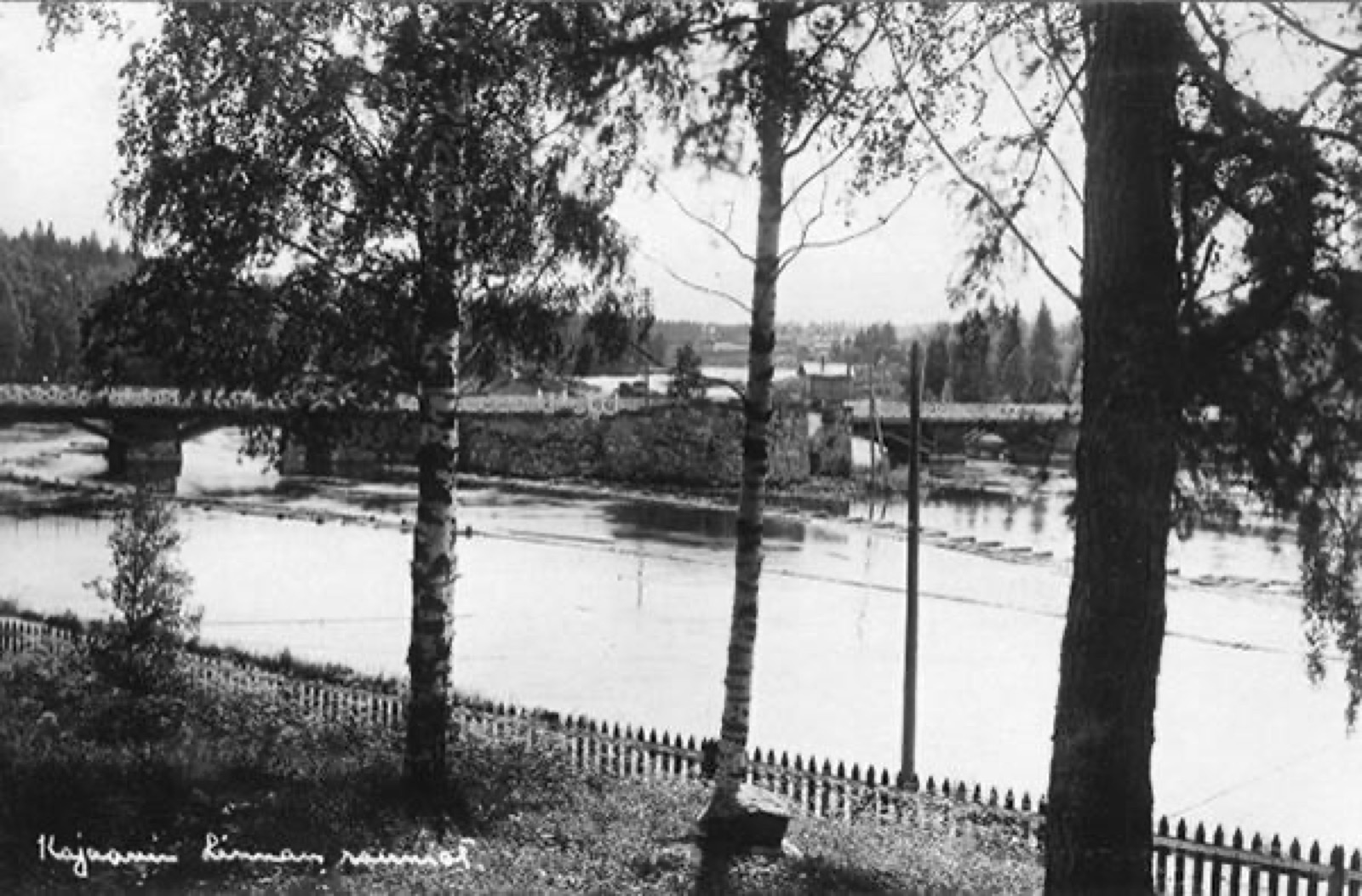
Kajaaninjoen yli vievä silta ja linnan rauniot. Kuvan oikeassa alakulmassa teksti:Kajaanin linnan rauniot
· Lusto - The Finnish Forest Museum (via Europeana)
CC BY
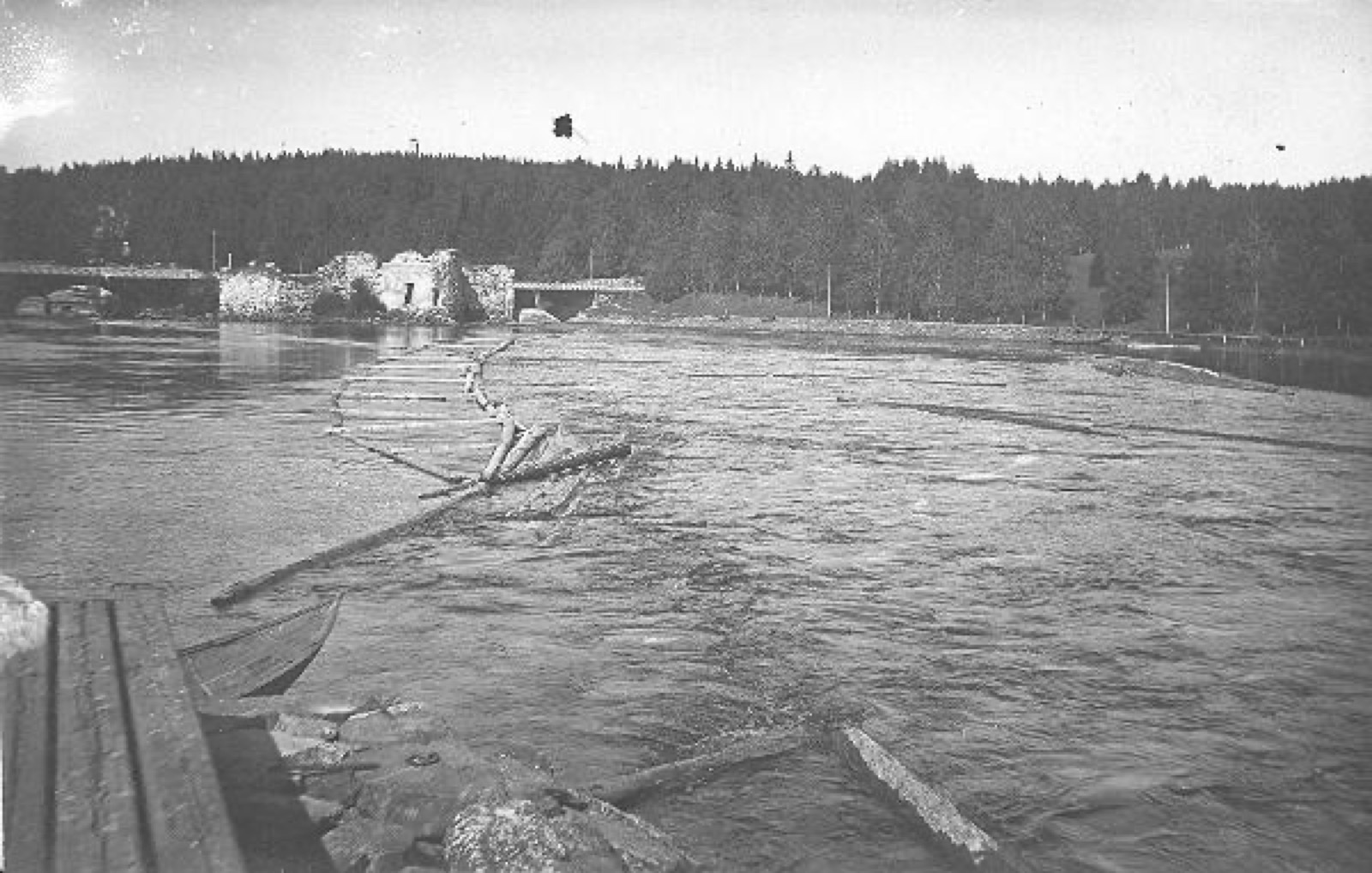
Uittorakenteita Ämmänkoskessa. Kauempana Kajaanin linnan rauniot ja silta.
· Lusto - The Finnish Forest Museum (via Europeana)
CC BY