France · Restored
Castle of Fougères
Château de Fougères
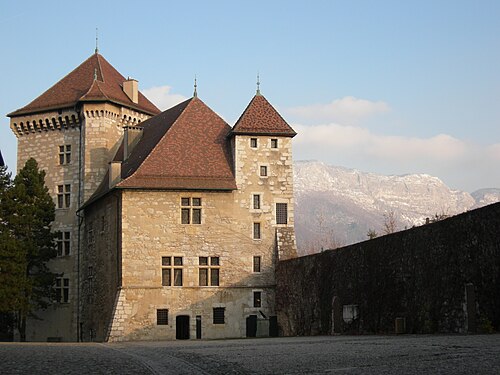
The Château de Fougères is a medieval fortress in Fougères, Ille-et-Vilaine, France, built on a rocky spur surrounded by a loop of the Nançon river. It comprises three concentric enclosures with extensive curtain walls and thirteen towers and today belongs to the municipality. The site was a major fortified place through the Middle Ages and retains its full sequence of ramparts and towers.
First raised
1200
Its prime
1488
Today
Restored
Ranked among Europe’s castles
As it stood in 1488
What Castle of Fougères looked like in its prime.
A multi-tiered medieval fortress of grey granite set on a rocky spur encircled by the Nançon river; three concentric curtain walls step up the slope, pierced by roughly a dozen cylindrical towers and several larger round keeps, many topped with conical stone or slate roofs and crenellated parapets. Ramparts link the towers with visible walkways and arrow slits; the lower walls face a dense cluster of town roofs below. At prime condition all enclosures, towers and walkways are complete and continuous.
Its story
The story of Castle of Fougères.
The Rock of La Couarde, Henry II's Siege and the Stone Rebuilding, 11th–13th Centuries
The castle stands at the bottom of the valley, in the western part of the walled town, on the rock of La Couarde, which emerges from a marshy hollow ringed by a meander of the Nançon. The meander made a natural moat, and diverting the river turned the hollow into an island. It was built to defend the north-eastern edge of the frontier zone of the duchy of Brittany, the marches of Brittany, and the position has been much discussed by castellologists: the marsh protected the site and gave the advantage of concealment and surprise, but the fortress sits below a town perched on a promontory, and the position offered no answer to artillery when that arrived in the fifteenth century. Schist quarries surround the site, among them La Vigne to the south-west, which shortened the haul for building stone.
The earliest work was a timber keep on the highest point of the rock, held in the eleventh century by Main II de Fougères, of the family that carried the name of the place. In 1166 Henry II of England besieged the castle and left it in ruins, dismantled with its keep razed. Raoul II rebuilt it around 1176. He kept his donkeys there, and their successors can still be seen grazing in the courtyard. From the thirteenth century the wooden enclosure was replaced by a stone wall, and the town was girdled with a rampart in the same period.
Pierre de Dreux, Louis IX and the Lusignan Inheritance, 1231–1428
Raoul III did homage for Fougères to Louis IX. In 1231 Pierre de Dreux took the place by surprise, and Louis IX came at the head of his army to recover the town. Raoul's only daughter, Jeanne I of Fougères, married Hugues XII de Lusignan in January 1253 and became owner of the land of Fougères. Philip the Fair afterwards granted it to his son, the future Charles IV. Jean de Montfort, duke of Brittany, installed himself in the castle; Du Guesclin took it from him, and in 1373 it passed to Pierre II d'Alençon. In 1428 Jean II d'Alençon sold Fougères to the duke of Brittany to raise his ransom.
Surienne's Night Attack and the Fall to La Trémoille, 1449–1491
In March 1449, in the middle of a truce between France and England, François de Surienne, a Spanish mercenary in English pay, attacked at night with 600 men. The inhabitants were massacred and the town pillaged. Surienne settled into the castle in 1450 and entrenched himself there, and surrendered only after a two-month siege by François I, duke of Brittany, helped by an outbreak of plague.
Pierre II raised the defences further in the fifteenth century, and the castle gained the two squat towers known as the Françoise and the Tourasse. The Amboise postern tower came in the same century, then the Raoul and Surienne towers, the last two reworked in 1481. By the Treaty of Verger in 1488 Duke François II acknowledged himself a vassal of Charles VIII and left the place in the king's hands as security. The treaty was broken that same year, and La Trémoille, lieutenant general of the royal armies, took the castle in a week against a defence of 3,000 men. The king left a garrison there once Fougères was attached to the kingdom of France in 1491.
Governors, the League and the Chouans, 1547–1810
Henri II gave the castle to Diane de Poitiers in 1547, and it became the lodging of the governors of Fougères. On 28 March 1588 the duc de Mercœur, governor of Brittany and a Leaguer in rebellion against Henri III, seized the castle and took refuge in it. The abbé Déric, appointed by Louis XV on 22 August 1773, was its last prior before the Revolution, and in 1793 the castle was taken by the Chouans and the Vendéens. The fourteenth-century lordly lodging was destroyed around 1810.
Balzac, Hugo and the Town's Castle, 1820 Onwards
The Pommereul family owned the castle from 1820. Honoré de Balzac stayed several weeks at Fougères with Gilbert de Pommereul in October 1828, visiting the castle and the surrounding country for his novel Les Chouans, published the following year. Victor Hugo took the Mélusine tower for the Tourgue of Quatrevingt-treize (1879), describing a high broad tower of six storeys pierced here and there with loopholes, its only way in or out an iron door onto a bridge-châtelet, with the oubliette visible through a grille in the floor.
The Pommereuls sold the castle to the town in 1892 for 80,000 gold francs. It had been classified a historical monument in 1862; an order of 4 July 1928 added the ground beside the western barbican, and one of 26 February 1953 the moats and the buildings immediately around them. The town owns it still, the ramparts survive in good condition while the seigneurial lodging remains a ruin, and the castle is open to visitors.
Step inside
8 places to explore in 1488.
The record describes 8 distinct spots at Castle of Fougères, including 2 interiors: outer court and outer enceinte, middle bailey and peacetime courtyard. Create your own photoreal reconstruction and explore every one, more scenes means more rooms, more angles, and more of the place to stand in.
Build Your Own Castle
Recreate Castle of Fougères with AI to explore it.
The artist rebuilds it as it stood in 1488, a photoreal reconstruction that belongs to you alone. Pay with coins, no subscription needed.
Recreate this castle →Defend this castle →Whose castle
Clans who held Castle of Fougères.
The families that held Castle of Fougères for a decade or more across its history, follow a name to its clan.
Amboise
The House of Amboise built the first wooden fort on the site in the eleventh century.
Fougères
Rebuilt by Raoul II, Baron de Fougères, whose barony gave the castle and town their name.