
France · Restored
Château de Vincennes
The Château de Vincennes is a medieval royal fortress and residence on the eastern edge of Paris, noted for its very large 14th-century keep and its Sainte-Chapelle. Built and expanded from the 14th century onward, the complex later received large 17th-century royal additions and was used as a military base and prison. Today much of the château, including the keep and chapel, survives and is open to the public.
First raised
1340
Its prime
1660
Today
Restored
Ranked among Europe’s castles
As it stood in 1660
What Château de Vincennes looked like in its prime.
A massive pale-dressed limestone keep with four large rounded projecting turrets dominates a lower rectangular curtain of rougher stone with a continuous machicolated cornice and slate-covered wall-walk. Conical slate roofs cap the curtain’s corner tourelles. The keep rises in smooth cylindrical volumes with narrow vertical slit and pointed-arched windows and pronounced stringcourses; a deep surrounding moat and grassy bank sit between the wall and the outer approach.
Its story
The story of Château de Vincennes.
From Louis VII's Hunting Lodge to Charles V's Keep
An act of Louis VII created the first royal residence in the forest of Vincennes in 1178, and in 1183 a wall was raised around the wood to enclose a hunting reserve of nearly 770 hectares. Louis IX used it more than any residence but the Palais de la Cité; tradition, following his contemporary Jean de Joinville, set him under an oak at Vincennes giving judgement, and it was here that he said farewell to his family before the crusade from which he did not return.
Around 1337 Philip VI resolved to fortify the site with a keep west of the old manor. The disasters of the century made the work urgent (French defeats in the Hundred Years' War, the capture of the king, the rising of the Parisian merchants under Étienne Marcel in 1357–58, the Jacquerie in the countryside), and John II and his son, the future Charles V, wanted a secure residence close to Paris but not inside it. Charles V, born there on 21 January 1338, made the fortress his home and the seat of his government: three lower levels of the keep stood by 1364, he moved into it in 1367 or 1368 with building still under way, and when the tower was finished in 1369–70 it rose 52 metres above the courtyard, the tallest fortified structure in Europe. More than two and a half kilometres of iron bars were built into it, framing doorways and windows and belting the tower at three of its levels, one of the first known uses of such reinforcement.
Henry V's Garrison and the Treaty of Troyes
Vincennes was the regular residence of Charles VI until his madness. When Henry V of England defeated the French at Agincourt in 1415, the Treaty of Troyes that followed in 1420 granted the château and the Île-de-France to the English; Henry repaired the fortress and installed his troops in it, fell ill shortly after the siege of Meaux, was brought here to recover and died in the castle on 31 August 1422, aged 35. An alliance between the Burgundians and Charles VII eventually allowed the king to force the English out of the Île-de-France and reoccupy the château.
The Sainte-Chapelle and the Last Valois, 1378–1574
In 1378 Charles V decided to build a new chapel for the relics held at Vincennes. Raymond du Temple began work in 1379, the king died the following year with the foundations barely laid, and the building was interrupted again and again. Francis I resolved in 1520 to finish it to mark the birth of his son and heir, and after his death in 1547 Henry II completed the vaults and added the stained glass; the Sainte-Chapelle de Vincennes was inaugurated in 1552. In February 1574 the court took refuge at the château, where Charles IX, gravely ill, died on 30 May in the apartments of the keep. Marie de' Medici began a new lodging whose first stone was laid in 1610 by her ten-year-old son Louis XIII; Louis XIV enlarged it to designs by the royal architect Louis Le Vau, then moved the court to Versailles in 1682.
The State Prison in the Keep, to 1784
The keep had been fitted out as a state prison for well-born captives from the seventeenth century, with room for no more than fourteen at a time. The Duke of Beaufort, chief of the cabal of the Importants, was shut up there on the orders of Anne of Austria and escaped in 1648; Catherine Deshayes Monvoisin, known as La Voisin, was imprisoned and interrogated during the Affair of the Poisons in 1680. Voltaire, the Marquis de Sade and Mirabeau were all detained here in the eighteenth century. From 1752 the upper floors were given over mainly to cells, and in 1784, after Mirabeau published articles exposing the abuses of the royal judicial system and the practice of holding prisoners without trial, use of the keep as a prison was discontinued.
Arsenal, Moat Executions and August 1944
In 1796 the château was converted into an arsenal. Under Napoleon it was remade for military use: a wooden floor divided the Sainte-Chapelle into two levels and turned it into a munitions store, and the pavilions of the King and Queen became barracks for the garrison. On 21 March 1804 the Duc d'Enghien, accused of trying to restore the royal government, was shot in the moat on Napoleon's order. In 1814, with the armies of the Sixth Coalition closing on Paris, the fortress was held by General Pierre Daumesnil, who had lost a leg at Wagram; asked to surrender, he answered that he would give up Vincennes when he got his leg back. He held out again in 1815 against Russian and Prussian troops who wanted the arsenal, and yielded only on the order of the restored Louis XVIII.
Commune soldiers took the château without a fight on 20 March 1871, and when the army had retaken Paris it was the last place where the red flag still flew; the remaining Communards surrendered on 27 May, and officers who had joined the Commune were arrested, tried and shot in the moat. The Dutch-born German spy Mata Hari was executed by firing squad at Vincennes on 15 October 1917.
From 1936 a large underground bunker was dug beneath the Pavilion of the Queen as the headquarters of the chief of staff, and Generals Maurice Gamelin and then Maxime Weygand directed the defence of France from it until the German offensive of 1940 overwhelmed them. The Germans then used the fortress as a base and as a prison for members of the French Resistance: Jacques Bonsergent, one of the first taken, was tried and executed there in November 1940, and on 20 August 1944 policemen and Resistance members arrested by the Waffen-SS were shot in the eastern moat and their bodies thrown into a common grave. On the evening of 24 August, the day General Leclerc's 2nd Armoured Division reached the centre of Paris, the German troops blew up the château's three munitions stores before withdrawing, and the fire burned for close to eight days, leaving the Pavilion of the King in ruins. In 1948 the château became the headquarters of France's Defence Historical Service, which keeps a museum in the keep.
Step inside
11 places to explore in 1660.
The record describes 11 distinct spots at Château de Vincennes, including 3 interiors: keep prison cell (dungeon), sainte-chapelle de vincennes interior, bâtiment du roi state room. Create your own photoreal reconstruction and explore every one, more scenes means more rooms, more angles, and more of the place to stand in.
Build Your Own Castle
Recreate Château de Vincennes with AI to explore it.
The artist rebuilds it as it stood in 1660, a photoreal reconstruction that belongs to you alone. Pay with coins, no subscription needed.
Recreate this castle →Defend this castle →From the archive
Château de Vincennes on paper: the measured plan and period views.
The survey plan and photographs below are the ground truth this page's reconstructions are checked against, drawn and photographed while the castle was still a working garrison. Every image is public-domain or openly licensed, with its source named.
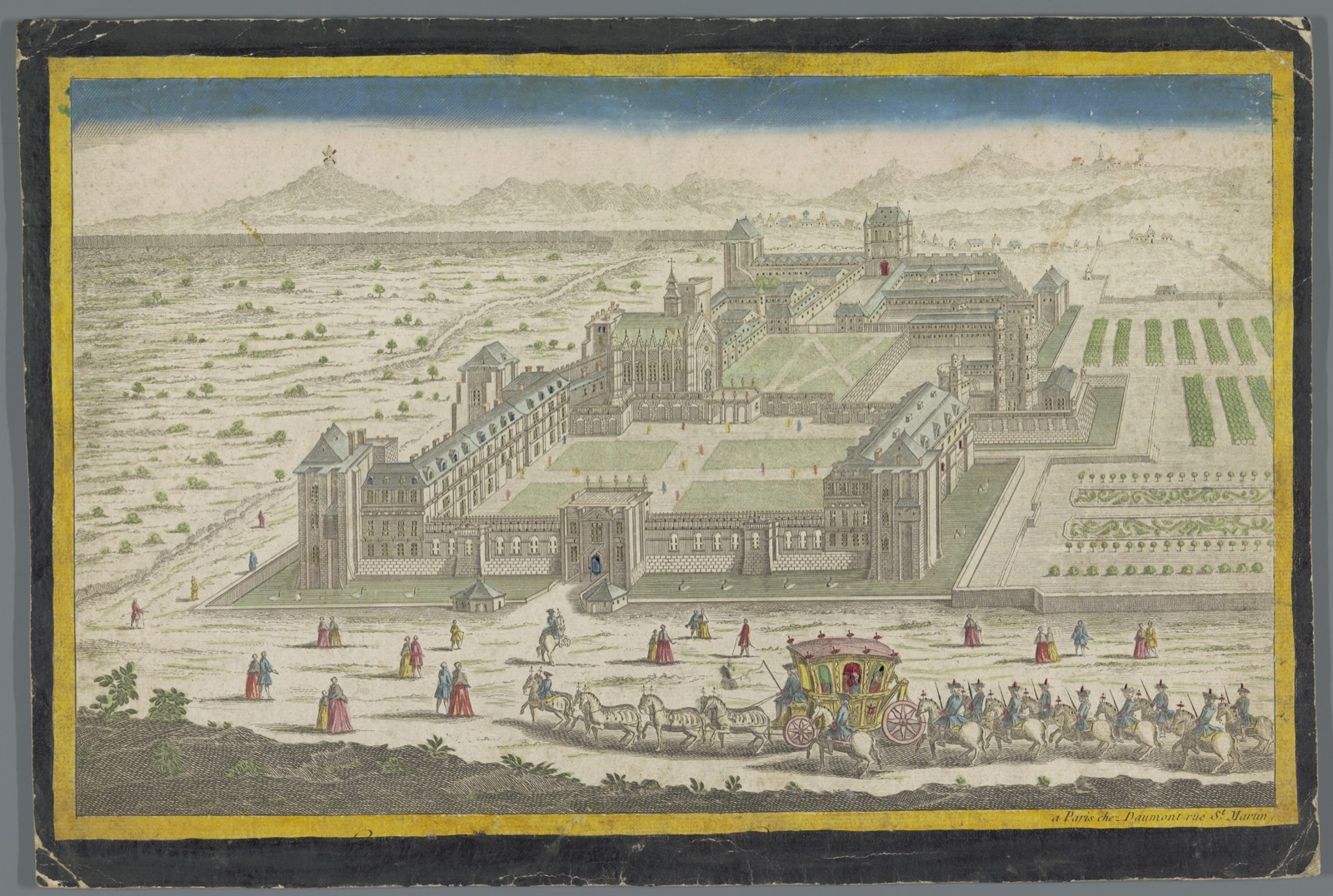
Gezicht op het Château de Vincennes
· Rijksmuseum (via Europeana)
Public domain
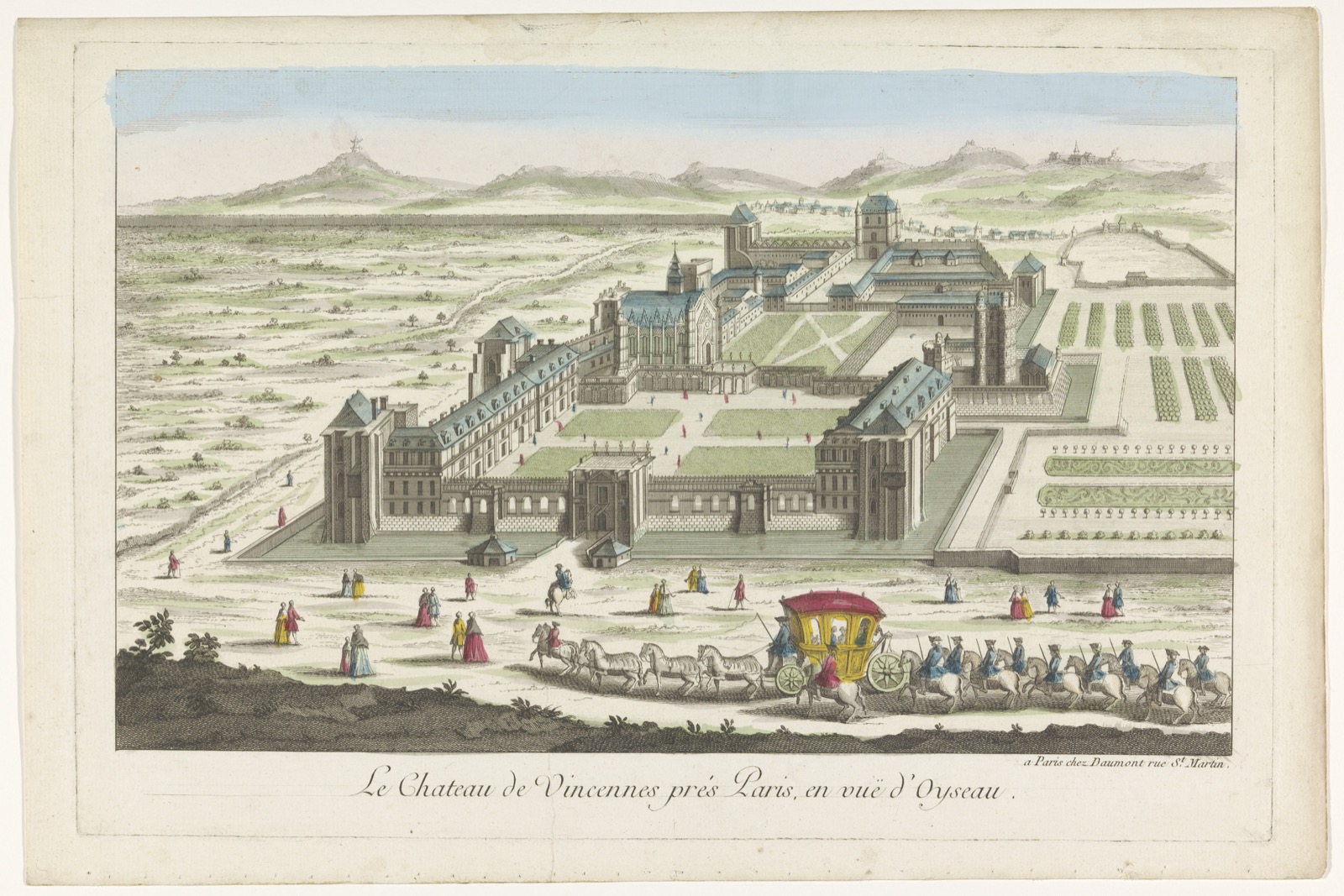
Gezicht op het Château de Vincennes
· Rijksmuseum (via Europeana)
Public domain
Nearby
Landmarks within reach of Château de Vincennes.


Questions about Château de Vincennes
What is the history of Château de Vincennes?
What is inside Château de Vincennes?
Who owns Château de Vincennes now?
Why was Château de Vincennes built, and what was it used for?
Where is Château de Vincennes?
When was Château de Vincennes built?
Was Château de Vincennes ever attacked or besieged?
What did Château de Vincennes look like in its prime?
Is Château de Vincennes still standing or is it a ruin?
Can you visit Château de Vincennes?
More castles of France


Explore the city


