
France · Ruin
Château Gaillard
Château Gaillard is a medieval fortress ruin perched on a limestone promontory above the River Seine beside Les Andelys in Normandy. Built for Richard I at the end of the 12th century, it originally comprised three concentric enclosures with a keep in the inner ward and advanced outworks defending a bend in the river.
First raised
1197
Its prime
1198
Today
Ruin
Ranked among Europe’s castles
As it stood in 1198
What Château Gaillard looked like in its prime.
Perched on a high pale limestone promontory above a bend in the Seine, the castle forms an oval of thick curtain walls enclosing successive baileys cut by dry moats. A massive central keep rises above the inner enclosure; lower ranges of buildings and timbered fittings filled the courtyards. The outer and inner walls show regular crenellations and early machicolations, linked by defended gateworks and haulable/movable wooden bridges; at prime the whole complex is roofed and continuous, dominating the river and town below.
Its story
The story of Château Gaillard.
Richard the Lionheart Seizes the Manor of Andeli, 1196
Richard the Lionheart inherited Normandy from Henry II in 1189. While he was on crusade and then a prisoner until 1194, Philip II took the Norman Vexin, leaving Gaillon as a French post blocking the Seine valley and Rouen exposed behind it. Richard's answer was the manor of Andeli, a limestone promontory 90 metres above a bend in the river: land held by Walter de Coutances, Archbishop of Rouen, which the Treaty of Louviers of January 1196 barred either king from fortifying. Richard seized it anyway, and the archbishop's interdict on Normandy was lifted in 1197 only after the king handed the diocese the port of Dieppe.
It cost an estimated £12,000 between 1196 and 1198, more than Richard spent on all his castles in England, and went up in two years where large stone castles usually took the better part of a decade. Its pipe rolls are the earliest detailed record of how castle-building was organised, down to the diggers who cut the ditches and the soldiers set to guard the workmen; no master mason appears, which led Allen Brown to suggest Richard was his own architect. The king boasted he could hold the place were the walls made of butter.
The Works That Locked the Seine Above Rouen
Château Gaillard was the centre of a barrier rather than a lone strongpoint: Richard founded the fortified town of Petit Andely at its foot, bridged the Seine to a mid-river island carrying its own small castle, and drove a triple row of stakes into the river upstream to stop ships descending. Its three baileys, separated by ditches quarried out of the rock, were ranged in depth against the plateau to the south-east, the quarter from which an attack had to come, and it was one of the first castles in Europe to carry machicolations. Obstacle behind obstacle was meant to exhaust an assault and let fewer men hold the rock, but the design had costs: the baileys strung along 200 metres of ridge were awkward to reinforce from one another, and the plateau behind rose 50 metres above them.
Philip II's Siege, September 1203 to March 1204
Richard died in Limousin on 6 April 1199 of an arrow wound taken at the siege of Châlus, and John could not hold Normandy. In August 1203 Philip took the island fort and destroyed the river boom, and the road to Rouen was open before he invested the castle in September. He ringed it with a double line of circumvallation ditches set with fourteen siege belfries and settled down to starve it out. Between 1,400 and 2,200 townspeople had taken refuge inside; the castellan Roger de Lacy put out 500 of them, then a second group of the same size, before Philip forbade further passage through the lines. The rest, at least 400 and perhaps 1,200, were driven out, turned back by French fire and found the gates locked behind them. They sheltered under the walls for three months, more than half dying of cold and hunger before Philip returned to the lines in February 1204 and released the survivors.
The castle fell to engineering rather than hunger. The French undermined the great tower of the advanced work, and its collapse pushed the defenders back into the castle proper; a party hunting for a weak point climbed in through a low window of the chapel John had added, fired the buildings and lowered the bridge for the army. The garrison retreated to the keep, but a fixed bridge let the miners reach its door and a stone-throwing engine broke it in. Roger de Lacy surrendered on 6 March 1204; Rouen followed on 23 June, and Normandy passed under direct French rule for the first time since the duchy was granted to Rollo in 911.
A State Prison, and Henry V's Last Norman Obstacle
Under French kings the rock became a prison: in 1314 Margaret and Blanche of Burgundy, condemned in the Tour de Nesle affair, were shut up here, Margaret dying the following year and Blanche allowed after ten years to withdraw to the convent of Maubuisson, where she died in 1326. After Halidon Hill in 1333 Philip VI granted the castle to the exiled nine-year-old David II of Scotland, who stayed until he went home in 1341. In the Hundred Years' War it was one of only four Norman castles still resisting Henry V after Rouen capitulated, surrendering on 9 December 1419 when the last rope for drawing water from the well broke. Étienne de Vignolles, the captain known as La Hire, retook it by escalade; months later it was English again under Lord Talbot, until Charles VII came in person in September 1449 and took it after five weeks.
Henry IV's Demolition Order of 1599
Ruinous by 1573, Château Gaillard was still strong enough for Leaguers under Nicolas II de La Barre de Nanteuil to hold during the Wars of Religion, and Henry IV's troops took it in 1591 after nearly two years of siege. The States-General of Normandy then asked the king to pull it down so no other armed band could lodge there; he ordered the demolition in 1599, Capuchin monks were granted its stone, and the work ran until 1611. Classified as a monument historique in 1862, the ruin belongs to the French State; excavations in the 1990s found an addition on its north side built to mount guns, dated to the 16th century.
Step inside
10 places to explore in 1198.
The record describes 10 distinct spots at Château Gaillard, including 2 interiors: chapel, keep interior. Create your own photoreal reconstruction and explore every one, more scenes means more rooms, more angles, and more of the place to stand in.
Build Your Own Castle
Recreate Château Gaillard with AI to explore it.
The artist rebuilds it as it stood in 1198, a photoreal reconstruction that belongs to you alone. Pay with coins, no subscription needed.
Recreate this castle →Defend this castle →From the archive
Château Gaillard on paper: the measured plan and period views.
The survey plan and photographs below are the ground truth this page's reconstructions are checked against, drawn and photographed while the castle was still a working garrison. Every image is public-domain or openly licensed, with its source named.
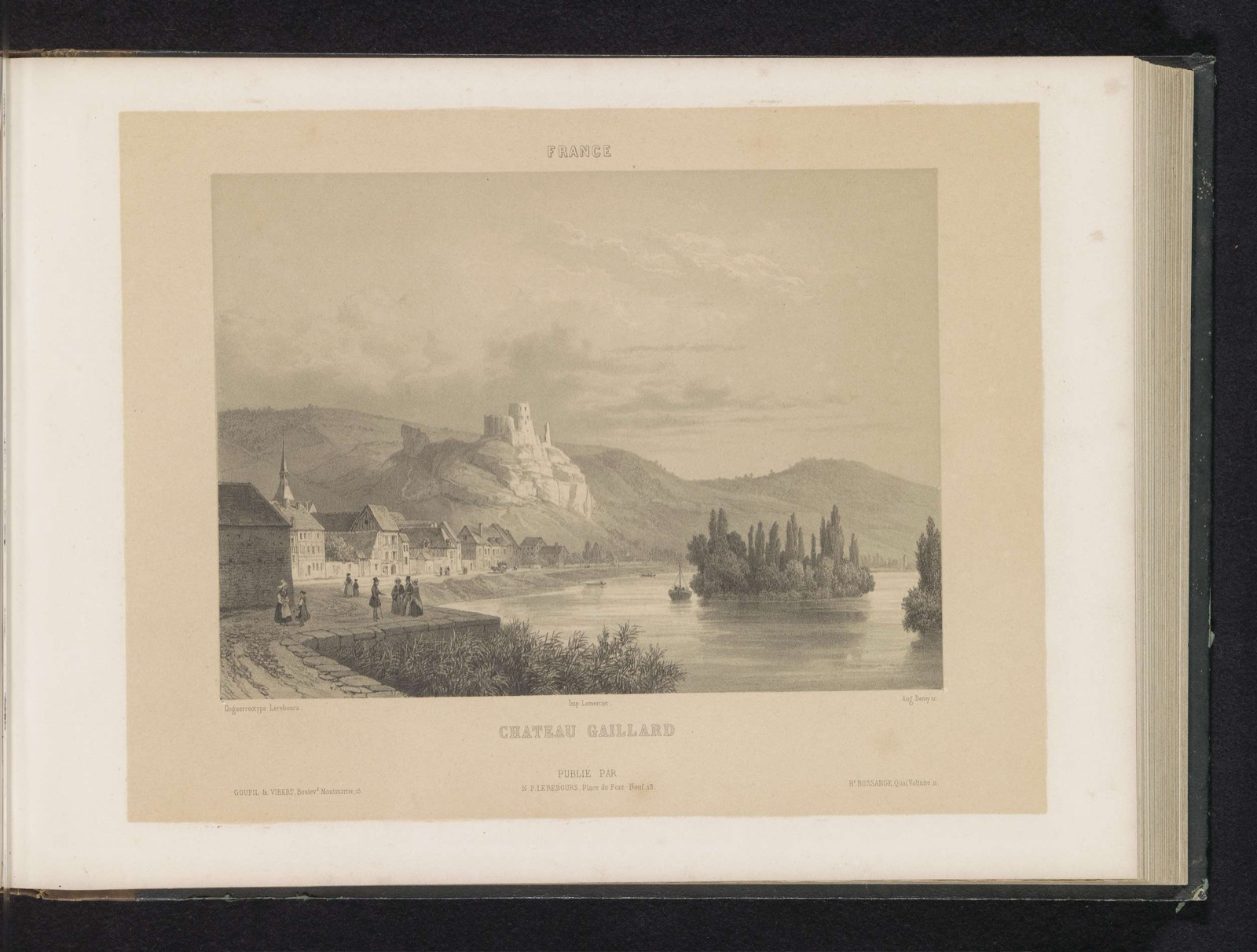
Gezicht op Château Gaillard
· Rijksmuseum (via Europeana)
Public domain
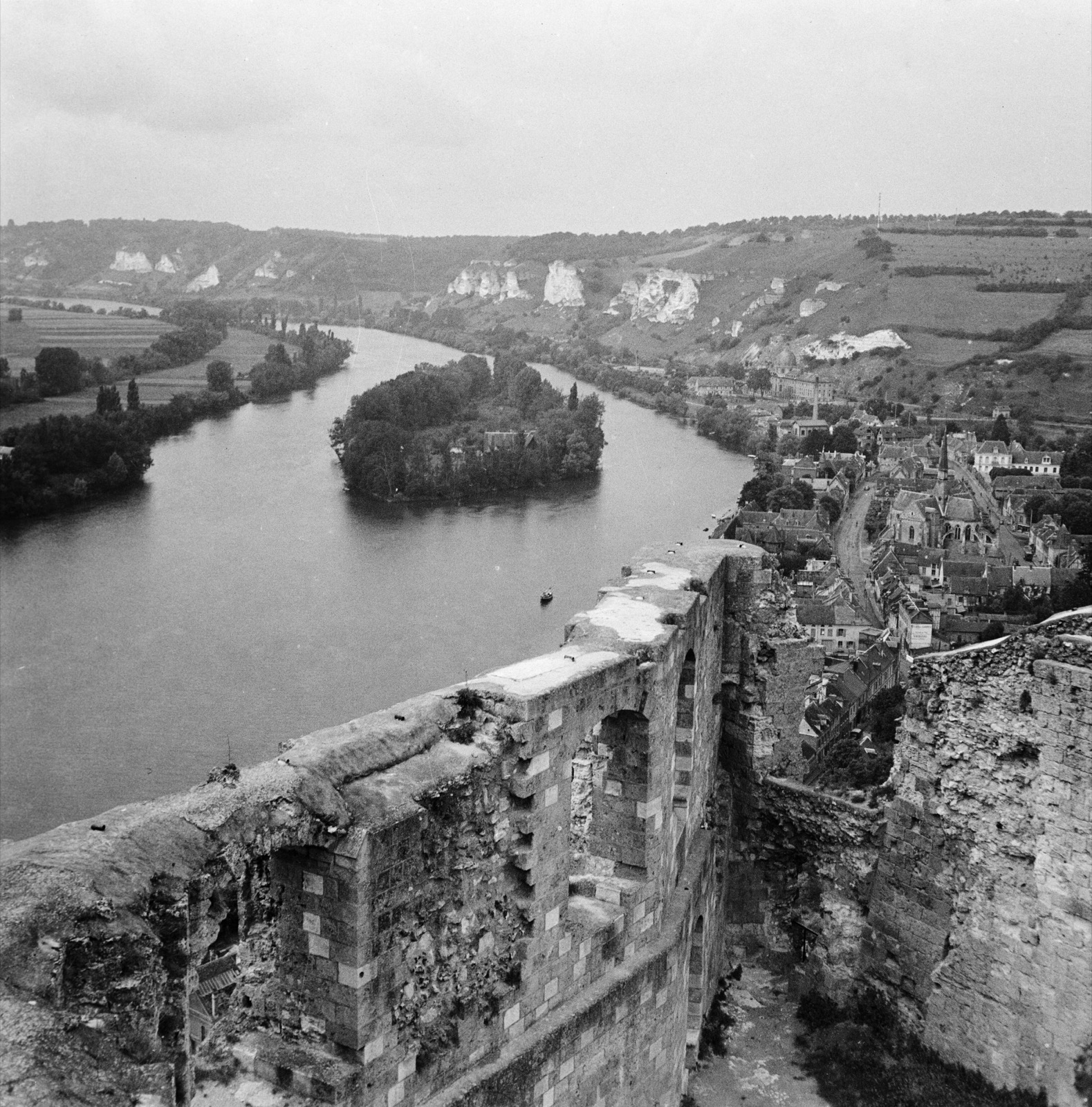
Borgen Château Gaillard i staden Les Andelys.
1948 · Society of Swedish Literature in Finland (via Europeana)
CC BY


