Clan Rising
Château de Bonaguil today

France · Restored

Château de Bonaguil

Château de Bonaguil is a medieval fortress in Saint-Front-sur-Lémance, Lot-et-Garonne, France, rebuilt at the end of the 15th and start of the 16th centuries with extensive artillery-era defences. It occupies a steep rocky promontory and incorporates an outer enceinte, deep rock-cut ditch and a compact inner stronghold around a tall keep. The castle has been a listed Monument historique since 1862 and has undergone multiple restorations.

Photograph via Wikimedia Commons

First raised

1600

Its prime

1520

Today

Restored

As it stood in 1520

What Château de Bonaguil looked like in its prime.

Perched on a steep rocky spur, the fortress is built of pale beige limestone with a compact, crenellated curtain and an outer low earth-retaining wall; multiple round towers and at least one pronounced rectangular/square tower puncture the curtain. A tall central keep rises above the complex with a machicolated parapet and an artillery platform; the approach is guarded by a barbican, rock-cut ditch and fixed bridges, and many embrasures and gun-ports are visible in the walls.

Its story

The story of Château de Bonaguil.

The Château de Bonaguil at Saint-Front-sur-Lémance takes its name from bonne aiguille, 'good needle', the steep rocky promontory it commands. First built in the 13th century, it belonged to the Fumel family through the Hundred Years War, in which the lords of Bonaguil fought on the side of the King of England; the castle was taken several times, burnt and abandoned, yet always remained Fumel property.

On 11 November 1380 Jean de Fumel-Pujols, baron of Blanquefort, married the heiress Jeanne Catherine de Roquefeuil and dropped his name for hers. Jean de Roquefeuil rebuilt the keep in 1470–82 with a streamlined shape to better resist artillery, and Bérenger de Roquefeuil, whose troubles began with Charles VII condemning his violence against serfs and vassals, restructured the whole castle at the turn of the 16th century, financed by Roquefeuil lands in the Gironde and on the Golfe du Lion.

The result covered 7,500 square metres and incorporated the latest developments in artillery defence, yet it was obsolete when completed and was never attacked. An indebted Antoine had to cede the fortress to the lord of Pardhaillan in 1618 before buying it back years later. Classified a monument historique since 1862, Bonaguil is today owned by the neighbouring commune of Fumel.

Step inside

11 places to explore in 1520.

The record describes 11 distinct spots at Château de Bonaguil, including 2 interiors: east dwelling apartments (dwelling p), rock-cut well shaft. Create your own photoreal reconstruction and explore every one, more scenes means more rooms, more angles, and more of the place to stand in.

Exterior approach from the valleyBarbican and outer ditchMain gate and bridge crossingCurtain wall walkway and towersTop of the keep - artillery platformBase of the keep and access rampInner bailey and courtyardEast dwelling apartments (dwelling P)Rock-cut well shaftCaponier and ditch defencesBoulevards and service routes in the north ditch

Build Your Own Castle

Recreate Château de Bonaguil with AI to explore it.

The artist rebuilds it as it stood in 1520, a photoreal reconstruction that belongs to you alone. Pay with coins, no subscription needed.

Recreate this castle →

Castle Siege

Play Castle Siege at Château de Bonaguil.

A strategy game played on Château de Bonaguil’s real ground plan: the same surveyed walls shown in the archive below. Post your finite garrison on the battlements between assaults, then hold out as rams, siege towers, trebuchets and sappers arrive in ever-worse waves.

Sign in free to see the garrison muster. One castle costs 150 Clan Coins and is yours forever.

Sign in to take command →

See every castle’s leaderboard →

Whose castle

Clans who held Château de Bonaguil.

The families that held Château de Bonaguil for a decade or more across its history, follow a name to its clan.

  • Fumel

    Held by the Fumel family through the Hundred Years War; though taken and burnt, the castle always remained their property.

  • Roquefeuil

    Held by the Roquefeuils from 1380, when Jean de Fumel-Pujols married heiress Jeanne Catherine de Roquefeuil and took her name; Bérenger de Roquefeuil rebuilt the castle at the turn of the 16th century.

From the archive

Château de Bonaguil on paper: the measured plan and period views.

The survey plan and photographs below are the ground truth this page's reconstructions are checked against, drawn and photographed while the castle was still a working garrison. Every image is public-domain or openly licensed, with its source named.
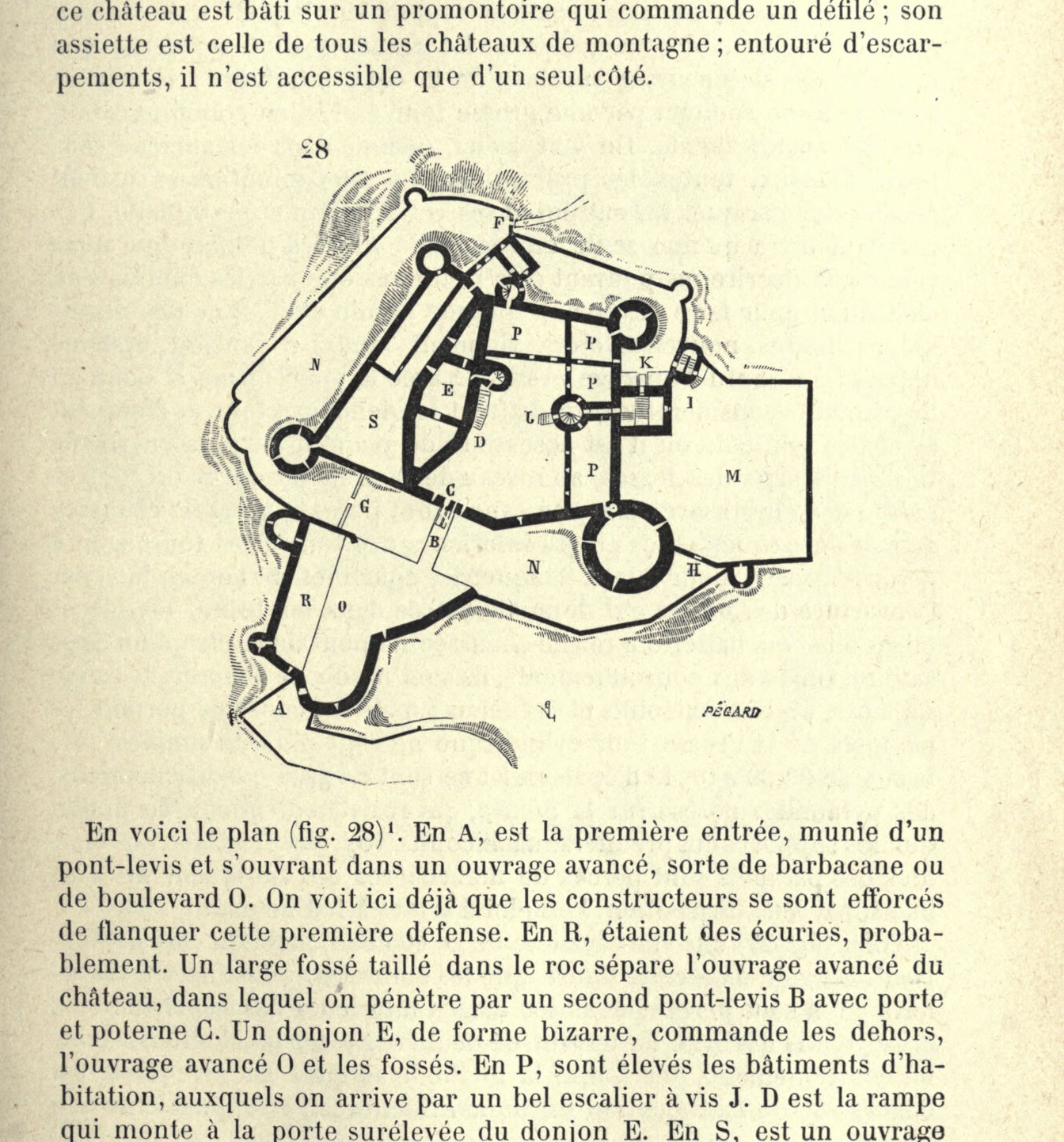
En voici le plan (fig. 28), Château de Bonaguil

En voici le plan (fig. 28)

1858 · Viollet-le-Duc, Dictionnaire raisonné, t. 3 (1858)

Public domain

Questions about Château de Bonaguil

Where is Château de Bonaguil?

Château de Bonaguil is in the commune of Saint-Front-sur-Lémance, in Lot-et-Garonne, in Nouvelle-Aquitaine. It stands on a limestone spur above the meeting point of two narrow valleys. The castle is owned by the neighbouring commune of Fumel.

What is the history of Château de Bonaguil?

Château de Bonaguil was first built in the 13th century as a fortified castle. Jean de Roquefeuil rebuilt the keep in 1470–82, and Bérenger de Roquefeuil restructured the whole castle at the turn of the 16th century with extensive artillery defences. It was taken several times, burnt and abandoned during the Hundred Years War, but remained Fumel property.

Why was Château de Bonaguil built, and what was it used for?

Château de Bonaguil was built as a fortified stronghold on a steep rocky promontory. Its later rebuilding added layered defences against artillery, including an outer enceinte, a barbican, gun-ports, casemates and a deep rock-cut ditch. Bérenger de Roquefeuil later made it his principal residence, around 1495.

When was Château de Bonaguil built?

Château de Bonaguil was first built in the 13th century, before 1271. It was extensively rebuilt from the end of the 15th century into the beginning of the 16th century, with the work completed around 1510. The site record places its principal phase in the early 16th century.

Which family or clan held Château de Bonaguil?

Château de Bonaguil was held by the Fumel family through the Hundred Years War and remained their property despite being taken and burnt. From 1380, it was held by the Roquefeuils after Jean de Fumel-Pujols married Jeanne Catherine de Roquefeuil and took her name. Bérenger de Roquefeuil rebuilt it at the turn of the 16th century.

What did Château de Bonaguil look like in its prime?

In its prime, Château de Bonaguil was a pale beige limestone fortress on a steep rocky spur. Its compact crenellated curtain was pierced by round towers and a pronounced square tower, while a tall central keep rose above it with a machicolated parapet and artillery platform. Barbicans, bridges, a rock-cut ditch and numerous gun-ports completed its defensive appearance.

Is Château de Bonaguil still standing, or is it a ruin?

Château de Bonaguil is still standing and has been restored. It is described as being in a good state of conservation, although its roof structures were lost during the French Revolution. The fortress was classified as a Monument historique in 1862.

What is inside Château de Bonaguil, and what can you see there?

Château de Bonaguil contains the east dwelling apartments and a deep rock-cut well shaft. The well was formed by enlarging and deepening a natural vertical fissure in the limestone, reaching 48 metres deep with a diameter of 2 metres. Other documented spaces include the inner bailey and courtyard, the keep, and defensive passages and platforms.

Was Château de Bonaguil ever attacked or besieged?

Château de Bonaguil was attacked and taken several times during the Hundred Years War, then burnt and abandoned. Despite these assaults, it remained the property of the Fumel family. After its later reconstruction, the completed fortress was never attacked.
All castles of France · Castles of Europe · the best castles in Europe · explore the finished reconstructions.