
France · Restored
Château de Combourg
Château de Combourg is a medieval castle in Combourg, Ille‑et‑Vilaine, Brittany, France, sited on a small hill beside Lac Tranquille. Built around 1025, it became famous as the childhood home of the writer François‑René de Chateaubriand and was restored in 1876 under Count Geoffroy de Chateaubriand with work overseen by Eugène Viollet‑le‑Duc. The privately owned château is listed as a monument historique.
First raised
1025
Its prime
1876
Today
Restored
As it stood in 1876
What Château de Combourg looked like in its prime.
Perched on a small wooded hill beside Lac Tranquille, the château presents a compact medieval stone silhouette dominated by a succession of towers and a continuous curtain wall rising directly from the slope. Pitched roofs and chimneys, crenellations and a restored 19th‑century roofline define its skyline; the exterior is stone masonry, set above the town with the lake at the foot of the hill, appearing as a lived‑in fortified residence in 1876.
Its story
The story of Château de Combourg.
Guiguené's Castle for the Fief of Comburnium
The first castle on the natural mound above the great pond was raised by Guiguené, archbishop of Dol, to protect his fief of Comburnium; that first work is dated as early as 1016 by some accounts, the foundation about 1025 by others. Early in the 11th century Guiguené had a keep built for his brother Rivallon, the first lord of Combourg and protector of the cathedral of Dol. In 1162 Combourg passed by marriage to Hasculf de Soligné, husband of Yseult, younger daughter of Jean de Dol.
Raoul de Fougères Against Henry II, Then Malestroit and Coëtquen
Yseult had been placed under the protection of her sister's husband, Raoul II de Fougères, who was in arms against Henry II of England and put both Combourg and the stronghold of Dol into a state of defence. Henry summoned the ban and arrière-ban of the Cotentin along with his constable, Richard I du Hommet, and led them into Brittany to join the Bretons of Conan, count of Richemont, the king's ally. The army made itself master of both places.
Combourg fell about the middle of the 14th century to the house of Châteaugiron-Malestroit, for whom it was partly rebuilt in the 15th century, with a drawbridge and machicolations on pyramidal corbels. In 1553 it passed by inheritance to the marquis de Coëtquen, and in the 18th century the last of that name gave it to his daughter, wife of the duc de Duras.
The Chateaubriands, 1761-1796
By a contract of 3 May 1761 the duc and duchesse de Duras sold Combourg to René-Auguste de Chateaubriand of Saint-Malo, who had gone to sea as a ship's boy and grown rich as a shipowner in the island trade and in privateering. His family settled in the castle in May 1777, and his younger son François-René passed twelve years of a bleak youth here. "I became what I am in the woods of Combourg", he wrote in his Memoirs from Beyond the Grave, and from his descriptions the place has come to be called the birthplace of Romanticism. René-Auguste died in 1786, alone and paralysed, in the East tower, and was buried in the town church.
The castle went to his eldest son Jean-Baptiste. In May 1791, on his way to Saint-Malo before sailing for America, François-René said he had to lodge with the steward, his father's house being so abandoned. On 22 April 1794 Jean-Baptiste, his wife and her grandfather Malesherbes were guillotined; the estate was confiscated, the castle pillaged and burnt. It was restored in 1796 to Jean-Baptiste's son Louis Geoffroy, then seven years old, who never came to it.
Eighty Years Derelict, Then Thrile's Rebuilding, 1848-1878
The house stayed in that state for eighty years. Gustave Flaubert, passing in 1848 with Maxime du Camp, left a striking description of it. That decay opened the way to its transformation in two campaigns of work, in 1866 and 1878, commissioned by Geoffroy de Chateaubriand, grandson of the writer's eldest brother, from the architect Ernest Thrile, a pupil of Eugène Viollet-le-Duc.
Thrile remodelled without regard for the original arrangement, in the troubadour style then in fashion, adding a monumental staircase. The near-reconstruction did away with the chapel in the Moor's tower, the guard room and the inner court. Some accounts date the restoration to 1876 and credit it directly to Viollet-le-Duc rather than to his pupil.
Wounded Men, the Ghost Cat and the La Tour du Pin Line
By 1915 the castle had been turned into a military hospital by Sybille de Chateaubriand, comtesse de Durfort. The Abbé Mugnier's journal for 13 February 1915 records what she told him: the white flag flying from the highest tower, the great rooms filled with lice-ridden wounded, thirty-four of them in the house, and the prefect's decision to send 150 German prisoners to clean out the pond, undredged for three centuries. General de Gaulle came at her invitation in 1949 and left his thanks in the visitors' book.
Chateaubriand wrote in his memoirs of the ghosts said to haunt the place: the country people held that a certain wooden-legged count of Combourg, dead three centuries, came back at certain seasons, a tale attached to Malo-Auguste de Coëtquen (1679-1727), said to have lost his right leg at Malplaquet in 1709 and to walk the stairs with a black cat. During the restoration workmen found the dried corpse of a cat walled up behind a 16th-century beam, and it is shown in a case in the boy Chateaubriand's room.
The estate descended from Sybille to the comtes de La Tour du Pin Verclause, and belongs to Sonia, the present countess, and her son Guy. The rest of the castle was inscribed as a monument historique in December 1926, and the façades and roofs, the guard room and the vestibule classified in August 1966; it also holds the Maisons des Illustres label.
Step inside
4 places to explore in 1876.
The record describes 4 distinct spots at Château de Combourg, including 1 interior: family apartments (chateaubriand period). Create your own photoreal reconstruction and explore every one, more scenes means more rooms, more angles, and more of the place to stand in.
Build Your Own Castle
Recreate Château de Combourg with AI to explore it.
The artist rebuilds it as it stood in 1876, a photoreal reconstruction that belongs to you alone. Pay with coins, no subscription needed.
Recreate this castle →Defend this castle →Whose castle
Clans who held Château de Combourg.
The families that held Château de Combourg for a decade or more across its history, follow a name to its clan.
Chateaubriand
Held by the Chateaubriand family from 1761; restored under Count Geoffroy de Chateaubriand in 1876 and still privately owned.
From the archive
Château de Combourg on paper: the measured plan and period views.
The survey plan and photographs below are the ground truth this page's reconstructions are checked against, drawn and photographed while the castle was still a working garrison. Every image is public-domain or openly licensed, with its source named.
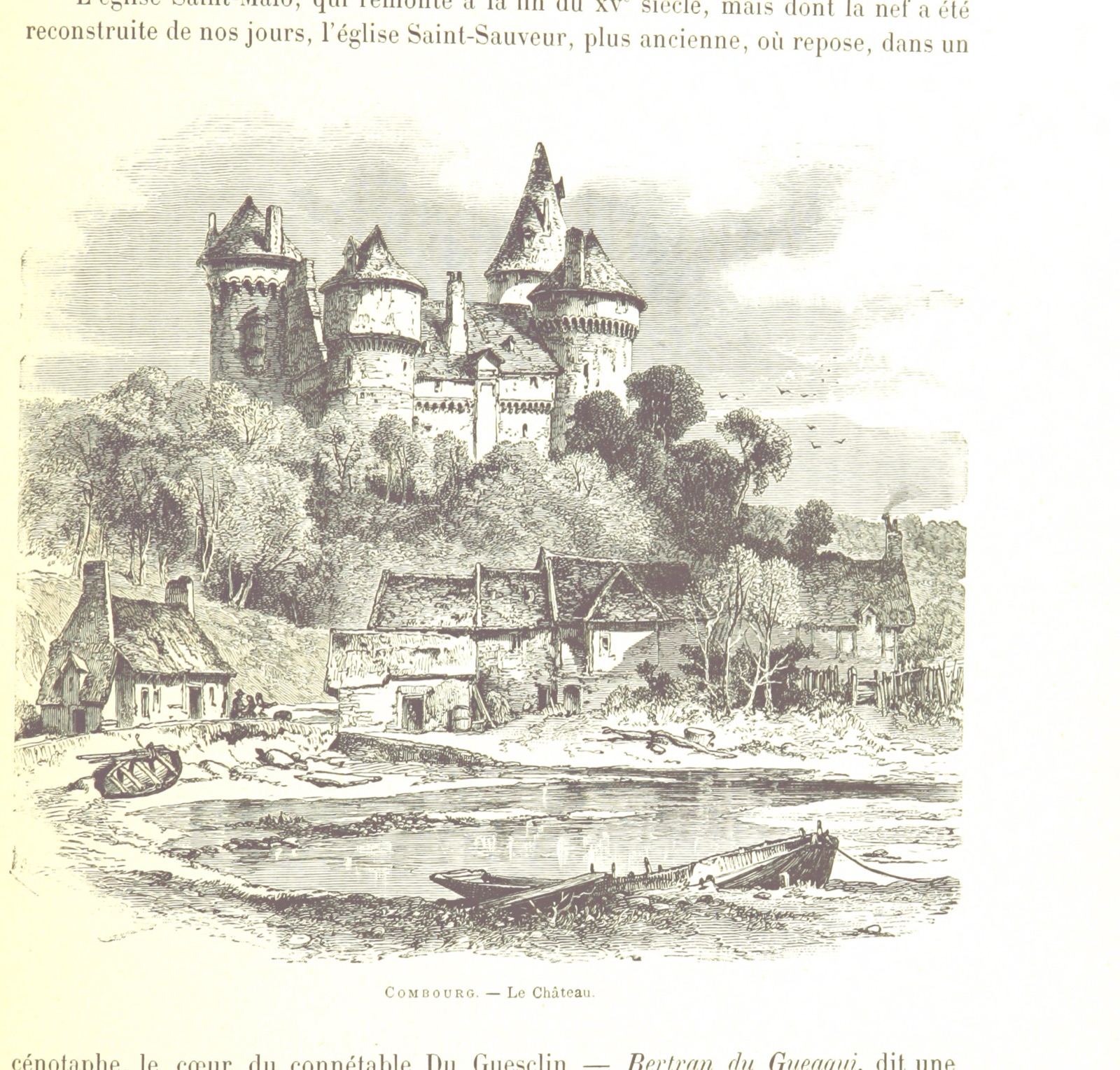
Château de Combourg from "La France pittoresque. Ouvrage illustré, etc".
1893 · The British Library (via Europeana)
Public domain


