
France · Restored
Château de Falaise
Château de Falaise is a 12th–13th century stone castle in Falaise, Normandy, occupying a high limestone crag above the town. Its surviving fabric includes a large rectangular grand donjon, a smaller keep, and a later cylindrical keep (Tour Talbot), all linked to curtain walls. The site is historically associated with the Dukes of Normandy and has been protected as a monument historique since the 19th century.
First raised
1000
Its prime
1207
Today
Restored
As it stood in 1207
What Château de Falaise looked like in its prime.
Perched on a steep limestone crag, the castle presents a compact silhouette of three main keeps: a massive rectangular grand donjon with vertical blind arcading, a smaller rectangular petit donjon, and a tall cylindrical tower (Tour Talbot) with corbelled machicolations. Pale grey-beige stone walls and narrow slit windows rise directly from the rock, linked by low curtain walls and ramparts; the rooflines are crenellated and the complex crowns the cliff above the town.
Its story
The story of Château de Falaise.
Herleva's Town and the Birth of the Conqueror
Falaise was fortified in stone remarkably early. Traces of 10th-century masonry survive on the east front, and carbon dating during excavations in 2009 placed a first masonry enceinte between 1019 and 1023, begun perhaps under Duke Richard I of Normandy, more probably under his son Richard II. The chronicler Robert de Torigni went further, crediting Richard I with towers and walls here as early as 960.
An early siege came from within the ducal family. On Richard II's death in August 1026, his younger son Robert, discontented with his inheritance of Exmes, rebelled against the new duke Richard III and shut himself inside Falaise. Richard besieged him (Guillaume de Jumièges wrote that he kept his battering rams and ballistas working without cease), until Robert submitted. The brothers were reconciled, but Richard died in 1027 and Robert became duke. At Falaise, Robert fathered a son by Herleva, a woman of the town and daughter of a chamberlain. The child, born about 1028, was William, the future Conqueror of England, which is why the castle is also called Château Guillaume-le-Conquérant. In 1042 the castle was held by the rebel vicomte Tustin Goz and successfully besieged by Raoul de Gacé, a loyalist of the young duke.
Henry Beauclerc's Palace-Keep, 1123
After the battle of Tinchebray in 1106, William's youngest son Henry I of England set about rebuilding Normandy's ducal castles. At Falaise he strengthened the walls of town and castle, founded the chapel of Saint-Nicolas in the bailey, and around 1123–1125 raised the great quadrangular donjon in the Anglo-Norman palace style. Its first floor held the traditional ducal apartments (great hall, private chamber and chapel), but no small rooms for a complicated household, making it kin to the towers at Corfe, Norwich and Portchester in England.
Henry's grandson Henry II spent heavily on the fortifications, giving the enceinte its first flanking towers and adding the smaller second keep, the petit donjon, against the great one in the later 12th century, more a residence than a work of war. Henry II kept Christmas 1159 at Falaise with his queen, Eleanor of Aquitaine, and his court.
A State Prison: William the Lion and Arthur of Brittany
Under Henry II the castle became a prison of state. In August 1173, at war with his rebellious sons, Henry took Breton allies of theirs captive at Dol and had them transferred to Falaise; in July 1174 they were joined by William the Lion, King of Scots, captured at Alnwick.
The darkest imprisonment came in 1202. Arthur, Duke of Brittany (King John of England's teenage nephew and rival claimant to his throne) was campaigning in Normandy with the backing of Philip II of France when John surprised and captured him at Mirebeau on 1 August. Arthur was conveyed to Falaise and held in the keep. According to the chronicler Ralph of Coggeshall, John ordered two of his servants to mutilate the duke; the keeper guarding Arthur refused to allow it, but announced his death to demoralise his supporters. The circumstances of Arthur's end remain unclear, though he probably died in 1203.
Philip Augustus, Henry V and the Talbot Tower
In 1204 Philip Augustus took Falaise after a siege of only eight days, following the defection of Louvrecaire, the Gascon mercenary captain holding it. Having annexed Normandy, the French king added a third keep about 1207: a tall cylindrical tower on the pattern of Gisors and the medieval Louvre, purely defensive. It was later named the Tour Talbot after the English commander who repaired it during the Hundred Years' War.
Henry V of England invested the place on 4 November 1417; Olivier de Mauny held the town for six weeks, and Gilbert de la Fayette held out in the fortress for a little over three months before capitulating in January 1418. The English strengthened the vulnerable east curtain around 1430–1440, and the castle was besieged a second time in 1450 during the French reconquest of Normandy. During the Wars of Religion it was disputed between Montgomery and Marshal Matignon, and fell to the Catholic Leaguers in 1590.
Quarry, College and the Falaise Pocket
Abandoned in the 17th century, the castle was used as a stone quarry and the upper storeys of the donjon were destroyed. From 1809 to 1944 the town's college occupied the enclosure. Classified as a monument historique in 1840, it had its keeps saved from ruin by the restoration campaign begun in 1864 under Victor Ruprich-Robert. In 1944 the Allied bombardment of the battle for the Falaise pocket razed the modern buildings and the Romanesque chapel of Saint-Nicolas, but the three keeps came through unscathed.
Step inside
9 places to explore in 1207.
The record describes 9 distinct spots at Château de Falaise, including 4 interiors: great hall inside the 12th-century keep, keep chapel, lord's private chamber and more. Create your own photoreal reconstruction and explore every one, more scenes means more rooms, more angles, and more of the place to stand in.
Build Your Own Castle
Recreate Château de Falaise with AI to explore it.
The artist rebuilds it as it stood in 1207, a photoreal reconstruction that belongs to you alone. Pay with coins, no subscription needed.
Recreate this castle →Defend this castle →From the archive
Château de Falaise on paper: the measured plan and period views.
The survey plan and photographs below are the ground truth this page's reconstructions are checked against, drawn and photographed while the castle was still a working garrison. Every image is public-domain or openly licensed, with its source named.
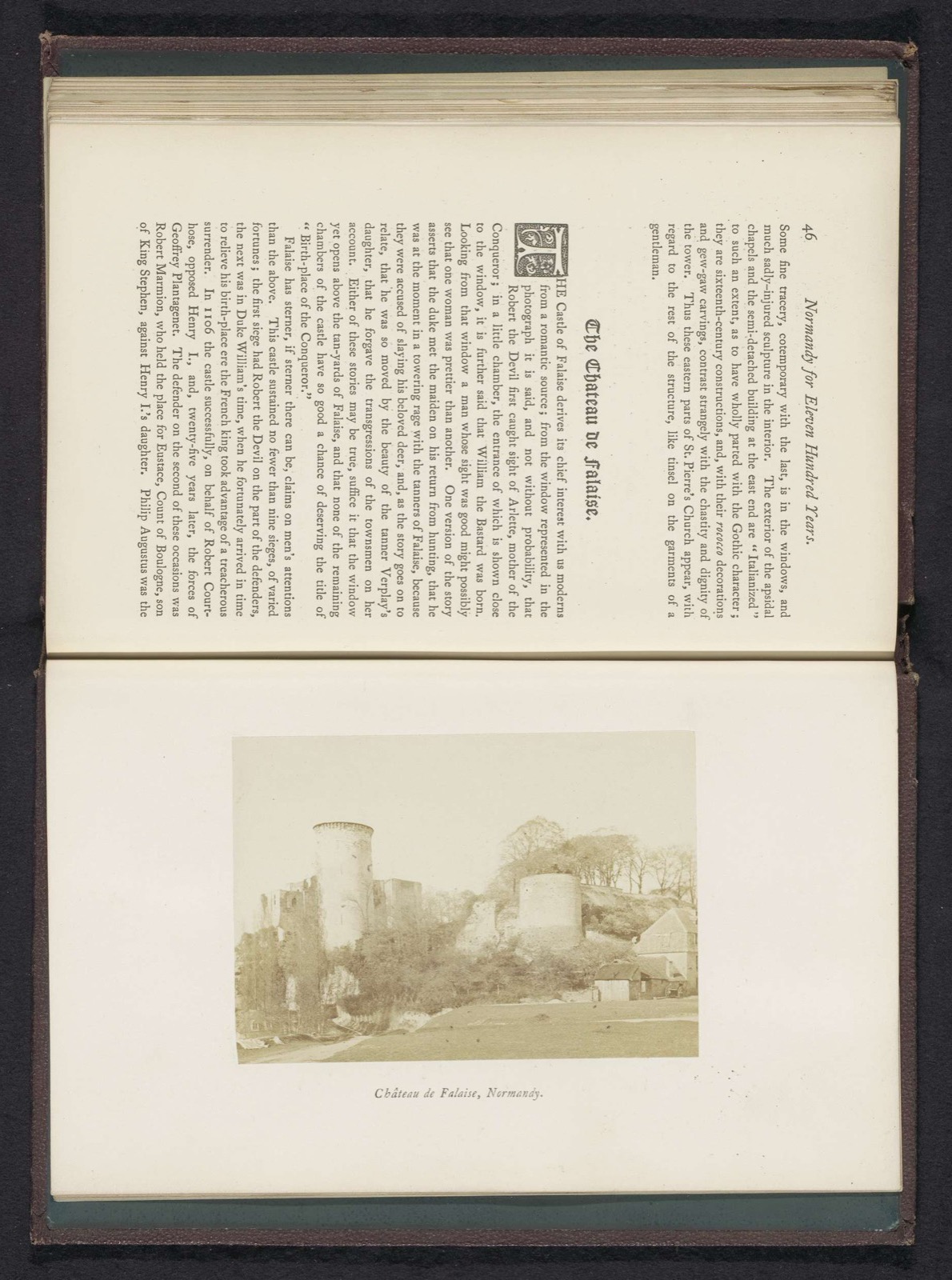
Château de Falaise, Normandy
· Rijksmuseum (via Europeana)
Public domain
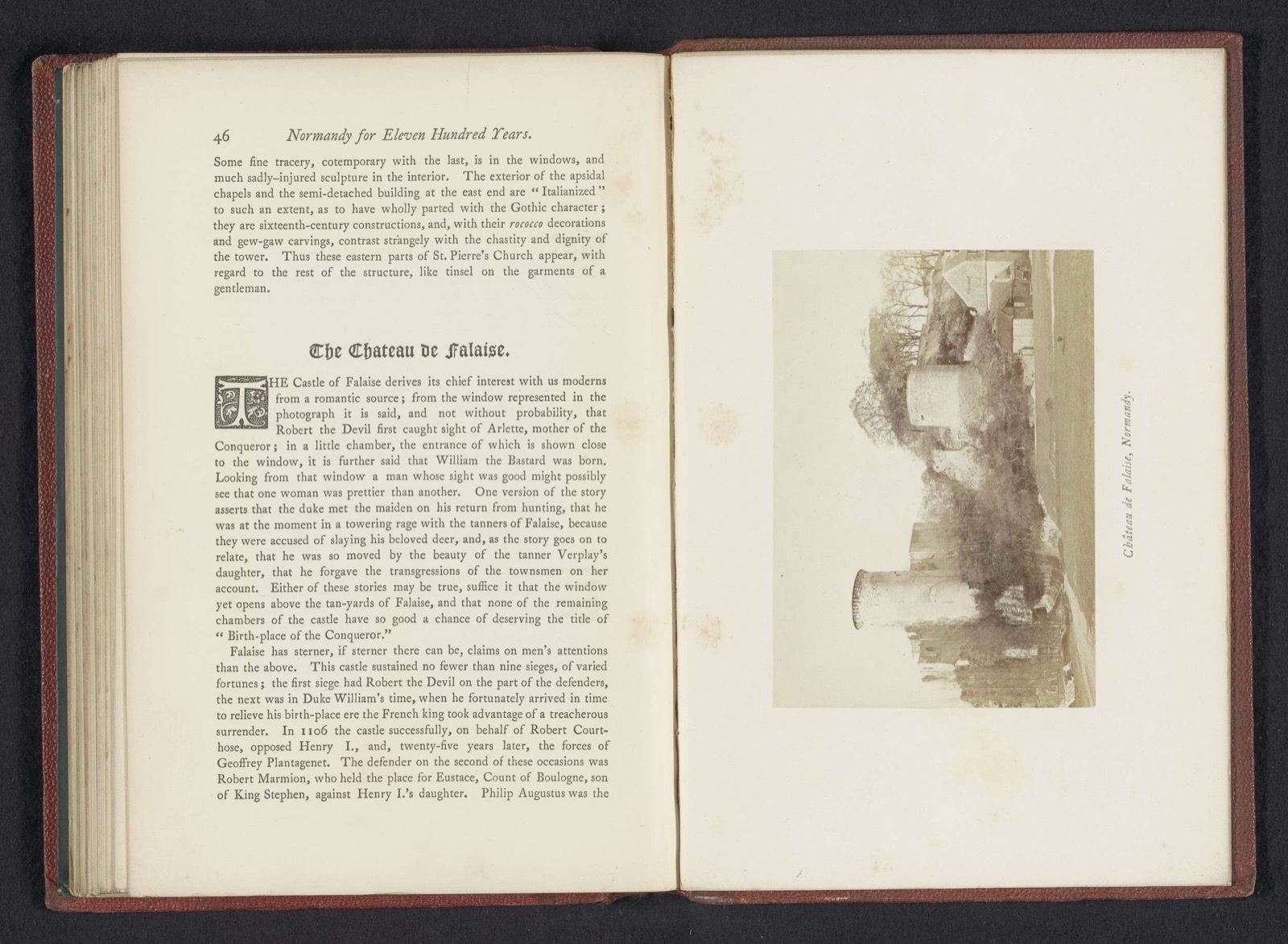
Château de Falaise, Normandy
· Rijksmuseum (via Europeana)
Public domain
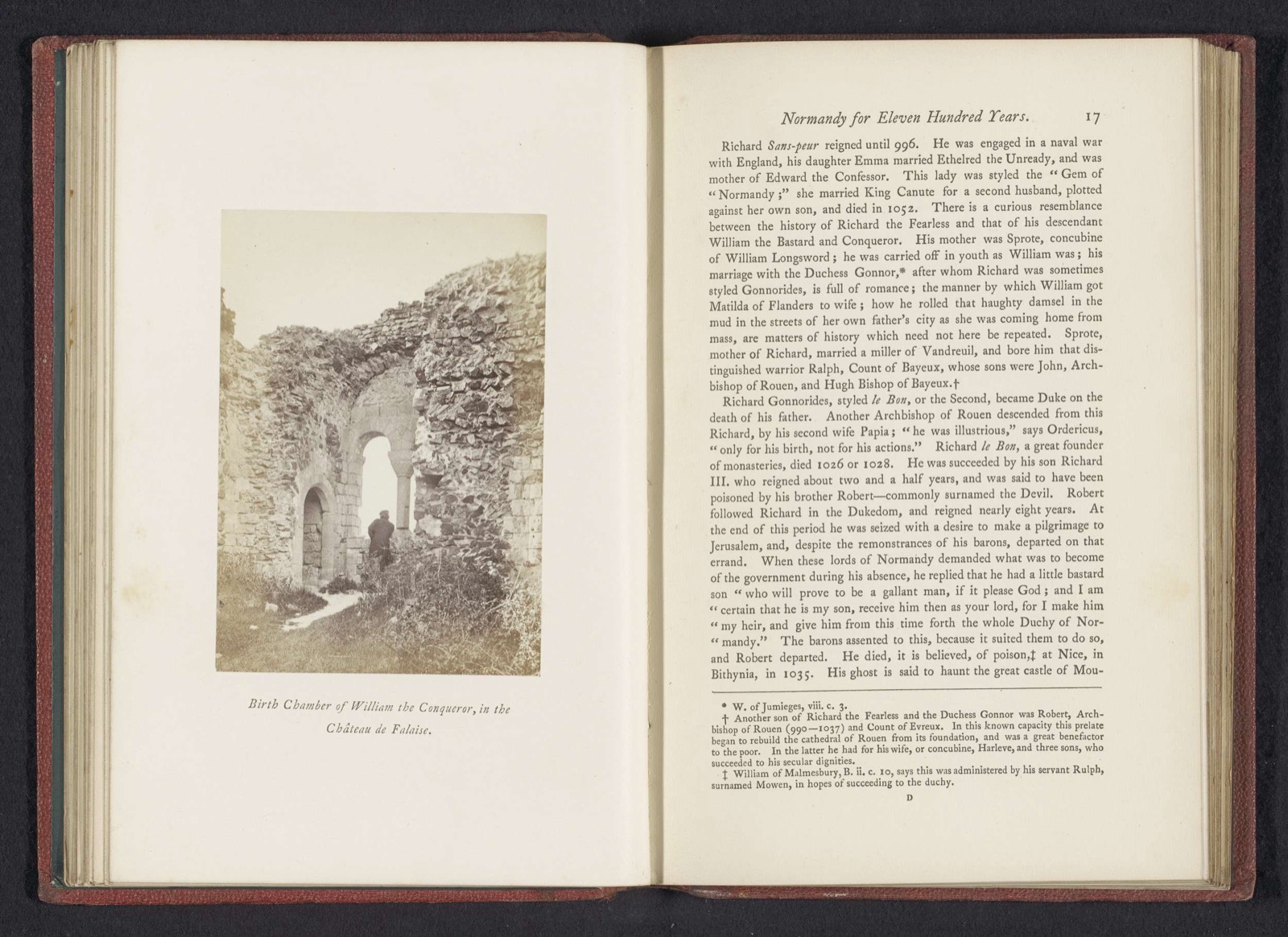
Birth chamber of William the Conqueror, in the Château de Falaise
· Rijksmuseum (via Europeana)
Public domain


