
France · Partial ruin
Château de Gisors
Château de Gisors is a medieval fortress in Gisors, Eure, in northern France. Begun in the late 11th century and altered through the 12th–13th centuries, the site is dominated by an octagonal stone shell keep atop a motte and a circular curtain (chemise) with attached towers including the cylindrical Prisoner's Tower.
First raised
1100
Its prime
1210
Today
Partial ruin
As it stood in 1210
What Château de Gisors looked like in its prime.
Perched on a steep, grassy motte, a tall circular stone chemise/curtain wall encircles the summit with a large round-arched entrance visible on the slope side. Rising from the motte above the ring is an eight-sided (octagonal) stone shell keep with vertical faceted faces and a low parapet; a separate cylindrical tower projects from the outer wall. The masonry is pale grey limestone; trimmed hedges, paths and trees occupy the slope and foreground.
Its story
The story of Château de Gisors.
Rufus's Motte, the Siege of 1120 and the Stone Keep
Gisors stands at the end of a plateau above the Epte, the key to a line of river castles holding the duchy of Normandy against the pretensions of the king of France. William II Rufus, regent of the duchy, ordered Robert de Bellême to raise the first castle here in the 1090s: a motte inside a spacious bailey, completed a year later by a timber keep, probably ringed by a palisade.
Louis VI and Henry I of England met on the site in 1113. Gisors saw its first siege in 1120, when the Norman lords rose for William Clito against his uncle Henry I; the governor Robert de Chandos held the place, but the scare persuaded the king to rethink the defences, and rebuilding was taken in hand from 1123. The motte received an octagonal keep of ashlar inside a chemise of heavy masonry; the keep is considered one of the best-preserved examples of a shell keep.
A Six-Month-Old Bride and the Templars, 1135-1180
Henry I died in 1135 leaving no male heir. His daughter Matilda was kept from the throne; her Angevin husband Geoffrey Plantagenet became duke of Normandy in 1144, and on 19 January that year did homage to Louis VII and handed him Gisors and the Norman Vexin. At a meeting here in 1158 the Capetian sealed a reconciliation by granting his six-month-old daughter Margaret of France to Henry II's son Henry the Young King, with the fortress and the Vexin as her dowry; pending the wedding, Gisors was entrusted to the Order of the Temple. In 1160 Henry ordered the marriage celebrated at once, and Gisors became Norman again.
Henry II raised the keep by two timbered storeys. A campaign begun in 1170 ran for ten years, widening the ditches and enclosing the site in a lower enceinte 800 metres long and flanked by eight towers.
Philip Augustus Takes the Vexin, 1188-1199
In 1188, on the eve of the Third Crusade, Henry II and Philip Augustus met at Gisors, agreed a truce and promised together to take the cross and win Jerusalem back from Saladin. Henry died the next year, and it was his successor Richard the Lionheart who went east with the Capetian. When Richard was held prisoner on his return by the Emperor Henry VI, Philip took the fortress in 1193 from its commander Gilbert de Vascœuil.
Philip remodelled what he had seized, adding a barbican facing the town and a cylindrical second keep on the outer curtain, the Prisoner's Tower, dated 1197–1200. Freed in 1194, Richard took up arms to recover his fief, but both sides settled: the treaties of Le Vaudreuil and Issoudun in 1195 and of Gaillon the year after placed the Norman Vexin, Gisors with it, under the French crown, and Richard built Château-Gaillard in two years to cover the loss. After his death in 1199 Philip conquered most of the rest of Normandy, and Gisors lost a good part of its importance as a frontier castle.
Jacques de Molay's Cell to Decommissioning, 1310-1591
Deprived of strategic weight, the castle was turned into a prison. From March 1310 to March 1314, during the trial of the Order of the Temple, it held the order's Grand Master Jacques de Molay, joined in its gaols by three other dignitaries: Hugues de Pairaud, Geoffroy de Gonneville and Geoffroy de Charnay, preceptor of Normandy.
A campaign by the Duke of Clarence carried Gisors for the English in 1419, and they were not dislodged until 1449. The bailey has been reckoned capable of holding a thousand soldiers; the English garrison numbered 90 in 1438 and 43 by 1448. Back with the French crown and of no further use once the war ended, the castle was gradually let go. Around 1575 Nicolas Poullain, a lieutenant of the Prévôté de Paris, was shut in the ground-floor cell that gave the Prisoner's Tower its name. The fortress was decommissioned in 1591.
Roger Lhomoy's Shaft and the Monument Historique
Gisors has been a classified monument historique since the list of 1862, and the esplanade and castle walks were classified as a site on 24 February 1940. The castle belongs to the town of Gisors; the park is open to visitors all year and the Vexin Normand tourist office runs guided tours. Substantial restoration work began in 2021.
Legend made Gisors the hiding place of the Templars' treasure, though the order never built the castle. In the 1950s the caretaker Roger Lhomoy sank a shaft and explored the cavities he opened, which destabilised the motte and cracked the keep; he claimed to have found underground rooms and a chapel holding thirty medieval chests, nineteen stone sarcophagi and several statues. He was ordered to fill the cavities in, and the courtyard was concreted over. His tale reached Gérard de Sède, who retold it in a magazine and a 1962 book; excavations by the Ministry of Culture in 1964 turned up nothing.
Step inside
8 places to explore in 1210.
The record describes 8 distinct spots at Château de Gisors, including 2 interiors: interior of the octagonal shell keep (central platform), inside the prisoner's tower (prison cell). Create your own photoreal reconstruction and explore every one, more scenes means more rooms, more angles, and more of the place to stand in.
Build Your Own Castle
Recreate Château de Gisors with AI to explore it.
The artist rebuilds it as it stood in 1210, a photoreal reconstruction that belongs to you alone. Pay with coins, no subscription needed.
Recreate this castle →Defend this castle →From the archive
Château de Gisors on paper: the measured plan and period views.
The survey plan and photographs below are the ground truth this page's reconstructions are checked against, drawn and photographed while the castle was still a working garrison. Every image is public-domain or openly licensed, with its source named.
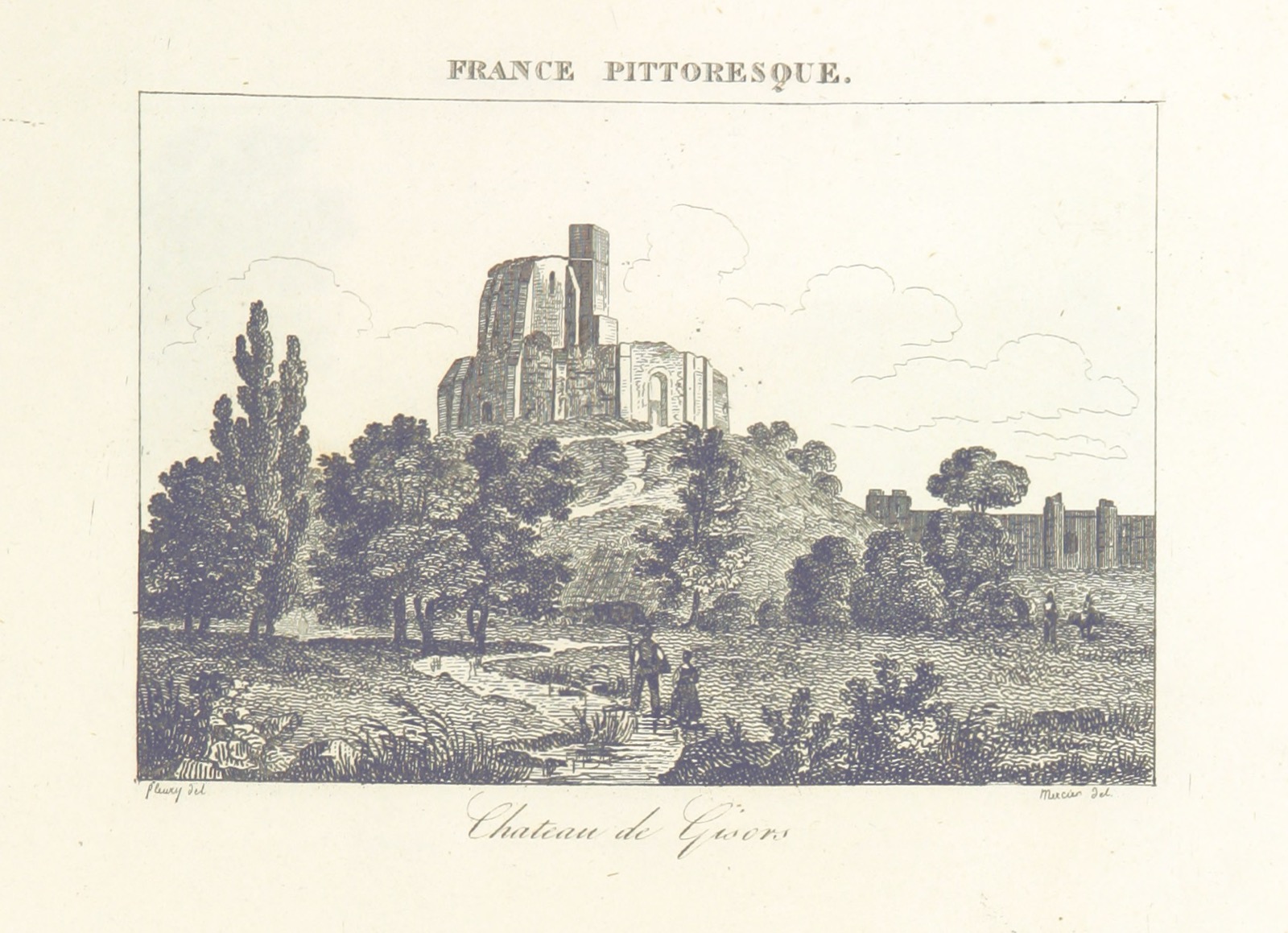
Gisors from "France pittoresque, ou description ... des départements et colonies de la France ... pur A. H".
1838 · The British Library (via Europeana)
Public domain


