France · Partial ruin
Château de Loches
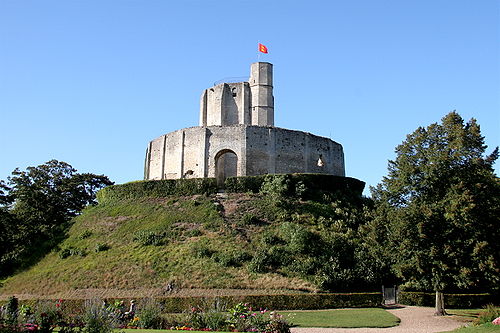
The Château de Loches is a medieval castle in Loches, Indre-et-Loire, France, dominated by a massive square keep and extensive curtain walls. Built and enlarged between the 9th and 15th centuries, it served variously as a fortress, royal residence and state prison; today the site and the adjacent Church of Saint-Ours are open to the public. Parts of the complex were damaged during the French Revolution and survive as partially ruined but restored structures.
First raised
1100
Its prime
1450
Today
Partial ruin
Ranked among Europe’s castles
As it stood in 1450
What Château de Loches looked like in its prime.
A compact hilltop castle complex dominated by a very large, nearly square stone keep rising above enclosing curtain walls and flanking towers; the keep stands four storeys high (about 37 m) with narrow vertical window slits and thick masonry. The outer curtain forms a jagged silhouette of crenellated walls and round and rectangular towers stepping down the slope into the town, with clustered steep-roofed service buildings and the twin-spired stone church closely adjacent; overall a pale, weathered ashlar appearance.
Its story
The story of Château de Loches.
From Gregory of Tours to the Counts of Anjou
Gregory of Tours records that when Ursus of Cahors (Saint Ours) arrived in 491 to found a monastery, a castrum already stood on the rocky spur above the Indre. That first building was probably timber, and nothing of its architecture survives. In 742 the place was taken by the forces of Pépin and Carloman as they put down the revolt of Hunald, duke of Aquitaine, and the castle was razed.
A new one replaced it, and in 840 Charles the Bald granted it to a nobleman of Orléans named Adaland to hold against Norse incursions. The line that mattered most arrived by marriage: Foulques le Roux, son of the prefect Ingelger, wed Roscille de Loches, who brought him the fortress. From that match grew the house of the counts of Anjou.
Foulques Nerra's Keep and the War for Touraine
The keep still standing was raised by Foulques Nerra, fourth count of Anjou, in the first third of the 11th century; dendrochronology on surviving beams puts the felling of its timbers between 1013 and 1035. It is one of the earliest large military buildings built in stone. Its entrance was set high and reached only through a small rectangular tower alongside. Inside, the ground floor held a well and two ovens, the aula filled the first level and the camera the second, while the third was given over to defence, sergeants, weapons and stores of projectiles.
Loches was an Angevin enclave inside the lands of the counts of Blois and Chartres while both houses fought for Touraine, a base from which the Angevins could raid the Blésois directly, working alongside Montrichard, Montrésor, Langeais and Montbazon. In 1011, with Foulques Nerra away on pilgrimage, the castle was entrusted to Lisoie de Basougers. After a failed assault on the fortress in 1042 the count of Blois himself was captured and shut in the keep by Geoffroy Martel, Foulques Nerra's son. The fighting ended in 1044 when Geoffroy Martel won the battle of Nouy.
Plantagenets against Capetians
Henry II came into possession of Loches through his marriage to Eleanor of Aquitaine and threw ramparts and ditches around the upper town, the bourg Saint-Ours. John Lackland handed the castle to Philippe Auguste in 1193; Richard the Lionheart took it back the following year in a siege that legend says lasted three hours, and the Plantagenets added further towers. Philippe Auguste finally took it in 1204 (the keep's fall is put a year later in some accounts), and building work at once turned Loches into a huge military fortress. From then it belonged to the royal domain and saw no further major fighting.
Charles VII, Agnès Sorel and the Royal Lodging
The royal lodging was built in the 14th century under Charles V and Charles VI. Enguerrand d'Eudin, captain of Loches from 1358 to 1364, had the fortifications, the drawbridge and the keep repaired in 1358–59. Charles VII lived here often in the company of Agnès Sorel (the first woman officially recognised as a royal favourite, to whom he gave the castle as her residence), and it was at Loches, in May 1429, that he met Joan of Arc.
From Royal Prison to Public Monument
The southern rampart towers, built by Henry II and Richard the Lionheart, held Templars in 1307 awaiting trial; Hugues de Pairaud, arrested at Poitiers with fifteen others, was kept here before being sent on to Paris. From the 15th century Louis XI (who had lived at Loches as a child but preferred Amboise) turned the place into a state prison, and it served as one until 1926. Artillery had made the old keep obsolete, and the 25-metre Tour Louis XI went up in the 15th century with a terrace laid out for cannon and cells whose limestone still carries prisoners' graffiti and carvings; the ground floor holds the torture room with its ringed iron bar. In the martelet, whose four levels run downwards rather than up, Ludovico Sforza, duke of Milan, captured by Louis XII in 1500, died in 1508 in the cell he had covered with frescoes.
Louis XVI used Loches to hold British prisoners taken during the American War of Independence. The château was pillaged and badly damaged during the Revolution; major restoration began in 1806, and parts remain ruinous. The castle was classified as a historic monument in the list of 1862, the gate of its enceinte in July 1886 and the old royal lodging in 1889. The castle and the adjacent church of Saint-Ours are open to the public.
Step inside
8 places to explore in 1450.
The record describes 8 distinct spots at Château de Loches, including 2 interiors: keep interior, single room floor, state prison chambers. Create your own photoreal reconstruction and explore every one, more scenes means more rooms, more angles, and more of the place to stand in.
Build Your Own Castle
Recreate Château de Loches with AI to explore it.
The artist rebuilds it as it stood in 1450, a photoreal reconstruction that belongs to you alone. Pay with coins, no subscription needed.
Recreate this castle →Defend this castle →Whose castle
Clans who held Château de Loches.
The families that held Château de Loches for a decade or more across its history, follow a name to its clan.
The great square keep was built in the 11th century by Fulk III, Count of Anjou.