
France · Restored
Château de Sedan
Sedan Castle (Château de Sedan) is a large fortified castle in Sedan, France, occupying a vast multi-level footprint and historically adapted for artillery. It contains extensive curtain walls, bastions and terraces and today houses a museum and hotel. The fortress evolved from a 15th-century manor into a major garrison stronghold with artillery adaptations in the 16th–17th centuries.
First raised
1424
Its prime
1700
Today
Restored
As it stood in 1700
What Château de Sedan looked like in its prime.
A vast, low-profile fortress of yellow-brown dressed stone and rubble, dominated by a long, thick curtain wall punctured by regular rectangular gunloops and small square embrasures. Rounded masonry bastions terminate the curtain, and a very large semicircular gate arch pierces the wall. Earthen terraces and a wide circular boulevard for cannon run along the ramparts. Rooflines behind the curtain are mostly low-pitched and hidden; the complex rises in multiple stone ranges up to several storeys.
Its story
The story of Château de Sedan.
The Priory Site and Évrard II's Manor, 1306–1440
A Benedictine priory of the abbey of Mouzon, Saint-Martin, stood on the rock above the Meuse before any castle did; it is recorded in 1306, and excavation indicates its church had been founded in the eleventh century. Évrard II de La Marck-Arenberg took possession of the site in 1424 through his brother-in-law Louis de Braquemont, bringing him the dowry that Guillaume de Braquemont had never provided. He held a stretch of the right bank of the Meuse from Sedan to Maastricht, and backed Charles VII against the English.
Over six years from about 1424 he raised a roughly triangular castle around the church, which became its chapel: twin entrance towers screened by a châtelet, a rectangular keep already part of the priory, and a round western tower later enlarged into the Grosse Tour. The plan can look archaic for its date, taking little account of an attacker's artillery. When Évrard died in 1440 his son Jean de La Marck reinforced the fortress and doubled its area.
Sieges Repulsed and the Four Bastions, 1495–1606
Archduke Maximilian's siege of the place failed in 1495, as did Charles V's in 1521. Robert II de La Marck, Jean's grandson, carried out the heaviest work: the circular boulevard of 1530, a princely lodging of a hundred metres along the town-side rampart begun the same year, and the governor's lodging in 1536. Around 1550 earth filling between the ramparts and a new wall taken from the lower court created the cannon terraces, thickening the curtains from 4.5 metres to 26 and enclosing eighteen small quarters for the troops within the mass.
Two triangular bastions were begun on the north-east front in 1553, the Gouverneur finished in 1557 and the Fourchu in 1559; the bastions des Dames and du Roy were delivered in 1572. By the middle of the century the castle covered 10,000 square metres. Henri II granted the lords of La Marck the title of sovereign princes. The last campaign on the defences had Marin Fourre as its first designer, then Marc-Aurèle Pazin of Ferrara from 1577 and Jean Errard of Bar-le-Duc after 1585. In 1606 the place was besieged by Henri IV and had to surrender.
Turenne, the Marfée and the Royal Garrison, 1611–1699
Marshal Turenne was born in the castle in 1611. The principality was absorbed into France after the battle of la Marfée in 1641 and the failure of Cinq-Mars's conspiracy against Richelieu in 1642: the last prince, Frédéric-Maurice de La Tour d'Auvergne, was compelled to hand the castle to Louis XIII, who imprisoned him, and to give up the principality by treaty in September 1642.
Marshal Fabert was the first governor of Sedan for the King of France, and in 1650 built the Fabert warehouses, six-storey stores for grain. The castle was turned into a garrison, and in 1699 Vauban built the porte des Princes, adapted to the progress of artillery and the only intervention here by that architect. The fortress then occupied 35,000 square metres over seven levels.
Cannonball Park to Capitulation, 1803–1873
Napoleon Bonaparte visited in 1803 and had the Sedan princes' collection of armour transferred to Paris, where some pieces are displayed in the Musée de l'Armée. The church of Saint-Martin was demolished in 1822 to install a cannonball park.
On 1 September 1870, encircled by the Prussian and Saxon armies, the Army of Châlons was defeated at the battle of Sedan. Napoleon III had the white flag raised over the fortress, and the act of capitulation was signed at the château de Bellevue between Frénois and Glaire. Following the battle the stronghold was declassified and its bastion network destroyed: some of the hornworks in front of the bastions were dynamited before the century was out, and dynamite trials on the bastion du Gouverneur and the bastion Fourchu in 1873 left both largely gutted.
Le Bagne and the City's Castle, 1917–2024
From January 1917 to November 1918 the citadel served as an internment camp for thousands of French and Belgian civilian resisters, condemned to forced labour by the German authorities. It was known locally as le Bagne. The number of dead is uncertain, but it very likely exceeded a thousand and was probably appreciably higher.
The French army ceded the castle to the town in 1962, and several restoration campaigns followed; the château-haut and its four bastions were classified as a historic monument by decree of 4 January 1965. The castle holds the municipal museum, one room of it given to the war of 1870, with a hotel in the Fabert warehouses and a restaurant within the walls. Sometimes called the largest fortress of medieval origin in Europe, it drew 145,300 visitors in 2024 and was voted « Monument préféré des Français » on 13 September 2023.
Step inside
8 places to explore in 1700.
The record describes 8 distinct spots at Château de Sedan, including 2 interiors: inner courtyard surrounded by multi-storey ranges, church of saint-martin (interior). Create your own photoreal reconstruction and explore every one, more scenes means more rooms, more angles, and more of the place to stand in.
Build Your Own Castle
Recreate Château de Sedan with AI to explore it.
The artist rebuilds it as it stood in 1700, a photoreal reconstruction that belongs to you alone. Pay with coins, no subscription needed.
Recreate this castle →Defend this castle →Whose castle
Clans who held Château de Sedan.
The families that held Château de Sedan for a decade or more across its history, follow a name to its clan.
La Marck
Built by Eberhard II von der Mark from c. 1424 and developed by his son Jean and grandson Robert II de la Marck; the principality was absorbed into France in 1642.
From the archive
Château de Sedan on paper: the measured plan and period views.
The survey plan and photographs below are the ground truth this page's reconstructions are checked against, drawn and photographed while the castle was still a working garrison. Every image is public-domain or openly licensed, with its source named.
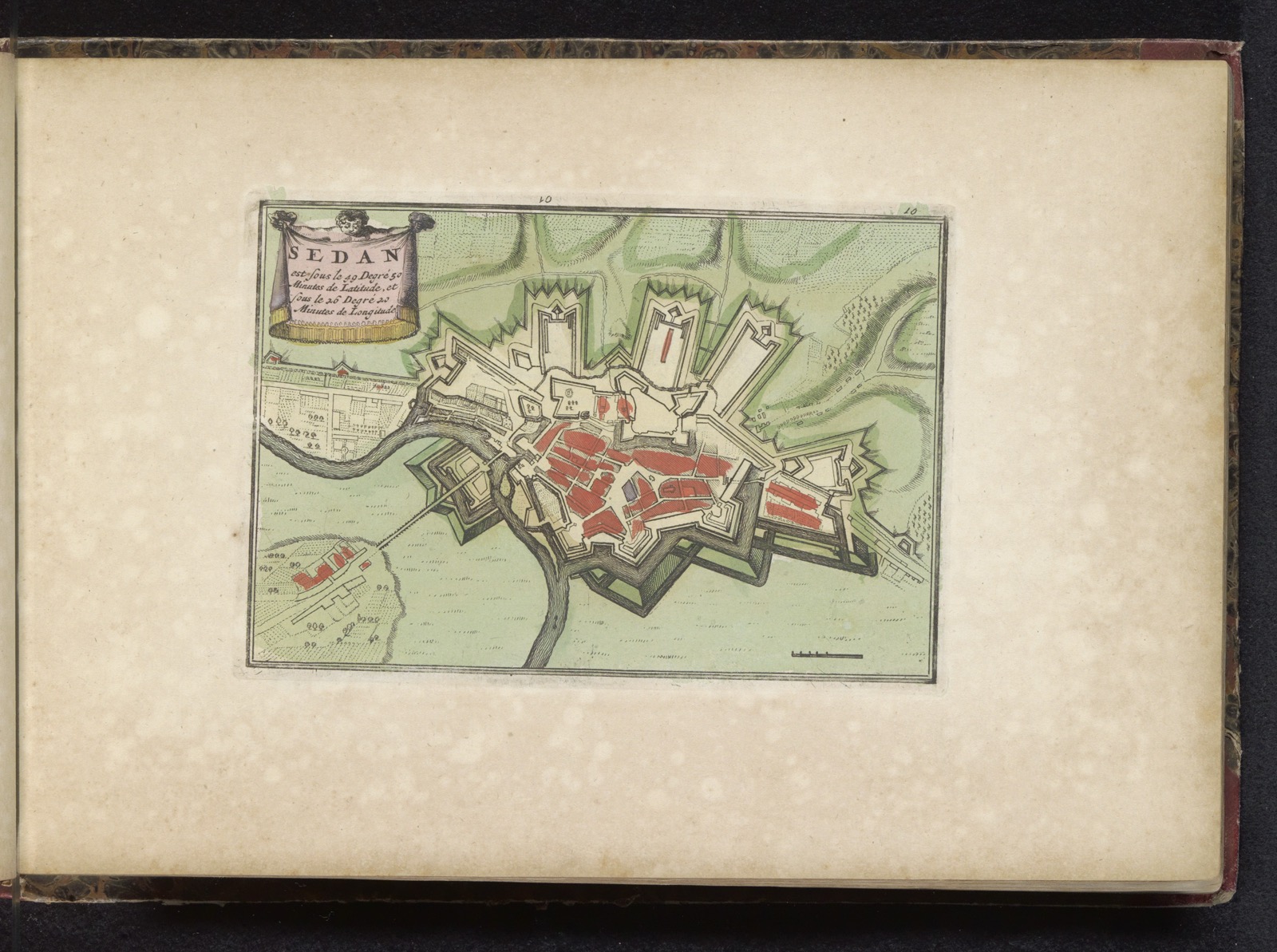
Plattegrond van Sedan
1735 · Rijksmuseum (via Europeana)
Public domain


