
France · Restored
Château de Sully
The Château de Sully in Saône-et-Loire is the largest Renaissance château of southern Burgundy, built for the Maréchal de Saulx-Tavanes. The symmetrical four-range building, flanked by angled corner towers and surrounded by a moat, was long associated with the MacMahon family and remains a private residence with parts restored.
Its prime
1575
Today
Restored
As it stood in 1575
What Château de Sully looked like in its prime.
A symmetrical, four-range Renaissance château of light beige stone set on a stone base above a water-filled moat; each corner is marked by an angled tower with a steep pyramidal or conical slate roof and finial. A central pediment interrupts the continuous sloping slate roofline above a large arched carriage portal. The ground floor is rusticated with arch-headed windows while the piano nobile displays paired pilasters alternating between windows and coved niches. An axial three-arch stone bridge gives access, with paired vernacular outbuildings facing a grassed forecourt and a fenced kitchen garden to the rear.
Its story
The story of Château de Sully.
From Hugues de Sully to the Coming of the Rabutins
The castle stands in the plain at the foot of the broad valley of the Drée, a tributary of the Arroux, at the northern end of the village of Sully in the Saône-et-Loire, between Autun and Beaune. Hugues de Sully held the fief in 1180, and Gauthier de Sully died in 1240. After the house of Sully died out, a branch of the lords of Couches took over the lordship in the thirteenth century, and Pierre de Bauffremont held it in the second half of that century.
At the end of the thirteenth century Pierre's daughter Marie de Bauffremont, dame de Couches, married Étienne I of Bourgogne-Montagu, lord of Sombernon, and their line held Sully for five generations: Philibert I about 1315, Hugues about 1362, Philibert II at the end of the fourteenth century, Jean II in 1406 and Claude about 1440. In 1469 Jeanne de Bourgogne-Montagu, marrying Hugues de Rabutin, lord of Épiry, brought him the "chastel, maison forte et forteresse" of Sully. Christophe de Rabutin was lord at the end of the fifteenth century.
Marshal Gaspard de Saulx-Tavannes and Ribonnier's Rebuilding, 1515–1581
In 1515 Christophe de Rabutin sold the estate to Jean de Saulx, husband of Marguerite de Tavannes. Their son Guillaume de Saulx-Tavannes succeeded in the first half of the sixteenth century, and about the middle of it so did his brother Gaspard, lieutenant-general of Burgundy, marshal of France and then governor of Provence, who set about rebuilding the castle. The Renaissance courtyard was raised for the marshal, a confidant of Catherine de' Medici, and of that work he had conceived and traced the plan and no more.
Gaspard died in 1573, and his widow Françoise de Montrevel took up the project, entrusting the building to Nicolas Ribonnier of Langres, who had already rebuilt the château du Pailly for the marshal and who worked the same motifs into the pilasters at both houses. In 1581 Françoise wrote that she wanted to bring the house to the same value and estimation as Le Pailly, because as it stood it was not by a long way so well built, and she wanted an equal division between her two sons. The first Saulx-Tavannes work is thought to have run to three ranges, leaving standing a fifteenth-century lodging built by the lords of Couches or by the Rabutins, in front of which the classical façade with its central pavilion was raised a little later; an older wall pierced with doors and windows survives in part behind it, and a vaulted hall recorded in old views confirms that parts of the medieval building were kept. The four square corner towers, set at an angle to the ranges, may themselves go back in part to the medieval castle.
Jean de Saulx-Tavannes's Mémoires and the Morey Purchase, 1616–1748
Jean de Saulx-Tavannes, third son of Gaspard and Françoise, succeeded at Sully in the second half of the sixteenth century as viscount of Tavannes, baron of Sully and Igornay, lord of Lugny, viscount of Ligny and sire du Donjon. Retired to the castle between 1616 and 1621, he wrote his Mémoires, given over chiefly to his father's life, and in them he set down how the castle came to be built.
In 1714 the Saulx-Tavannes sold Sully to Claude de Morey, marquis de Vianges. The Moreys had the north front and the terraces above the water of the moat built by the Parisian architect François II Franque, a native of Avignon; that outward façade of the north range dates from the beginning of the eighteenth century. On the west front a carved pediment carried two Moors supporting the Morey arms, since replaced by a clock. Jean-Baptiste de Morey, brother of Claude, died in 1748.
The Mac Mahons and the Birth of a President, 1775–1923
In the middle of the eighteenth century Charlotte Le Belin, widow and cousin of Jean-Baptiste de Morey, remarried Jean-Baptiste Mac Mahon, first marquis d'Éguilly, and his family has held Sully ever since. Charles Laure de Mac Mahon, second marquis, succeeded in 1775. In 1808 Patrice de Mac Mahon was born in the castle, the sixteenth of the seventeen children of Maurice-François, baron de Sully, comte de Mac Mahon et de Charnay, and Pélagie Edme Marie de Riquet de Caraman. He became marshal of France and first duc de Magenta, and was president of the French Third Republic from 1873 to 1879; he never owned Sully.
Charles-Marie de Mac Mahon, third marquis, succeeded in 1830, the year the chapel was rebuilt in the gothic style, and he made Sully the seat of the Rallye Bourgogne. A theatre was fitted up in 1840 in one of the buildings around the stable court, in the First Empire style and with the parterre, balcony and stage house of an Italian theatre. Charles-Henri de Mac Mahon, fourth marquis, succeeded in 1845, and Charles-Marie, fifth marquis, in 1863; to his wife, Marthe de Vogüé, are owed a great deal of work on the house, including the neo-Renaissance south front and the return of the moat to use, and about 1890 the balustrade of the stone bridge across it was dressed with a whole scheme of cannonballs and stone pyramids. At her death in 1923 the marquise left the estate to Maurice-Jean-Marie de Mac Mahon, third duc de Magenta, grandson of the president.
The Ducs de Magenta and the Listing of 1995
Philippe-Maurice-Marie de Mac Mahon became fourth duc de Magenta in 1954. The castle has been classified as a monument historique by an order of 4 July 1995. It has been the property and residence of the Mac Mahon family since the middle of the eighteenth century, remains the home of the present duchesse de Magenta and her family, and is open to visitors as one of fourteen houses on the Route des châteaux en Bourgogne du Sud. It is not to be confused with the château de Sully-sur-Loire, the house of Henri IV's minister Maximilien de Béthune and of the ducs de Sully.
Step inside
8 places to explore in 1575.
The record describes 8 distinct spots at Château de Sully, including 1 interior: interior renaissance courtyard. Create your own photoreal reconstruction and explore every one, more scenes means more rooms, more angles, and more of the place to stand in.
Build Your Own Castle
Recreate Château de Sully with AI to explore it.
The artist rebuilds it as it stood in 1575, a photoreal reconstruction that belongs to you alone. Pay with coins, no subscription needed.
Recreate this castle →Defend this castle →Whose castle
Clans who held Château de Sully.
The families that held Château de Sully for a decade or more across its history, follow a name to its clan.
Saulx-Tavanes
The Renaissance château was built for the Maréchal de Saulx-Tavanes, confidant of Catherine de' Medici.
MacMahon
Came to the MacMahons through the marriage of the heiress Charlotte de Morey to Jean-Baptiste de MacMahon; still home of the present duchesse de Magenta.
From the archive
Château de Sully on paper: the measured plan and period views.
The survey plan and photographs below are the ground truth this page's reconstructions are checked against, drawn and photographed while the castle was still a working garrison. Every image is public-domain or openly licensed, with its source named.
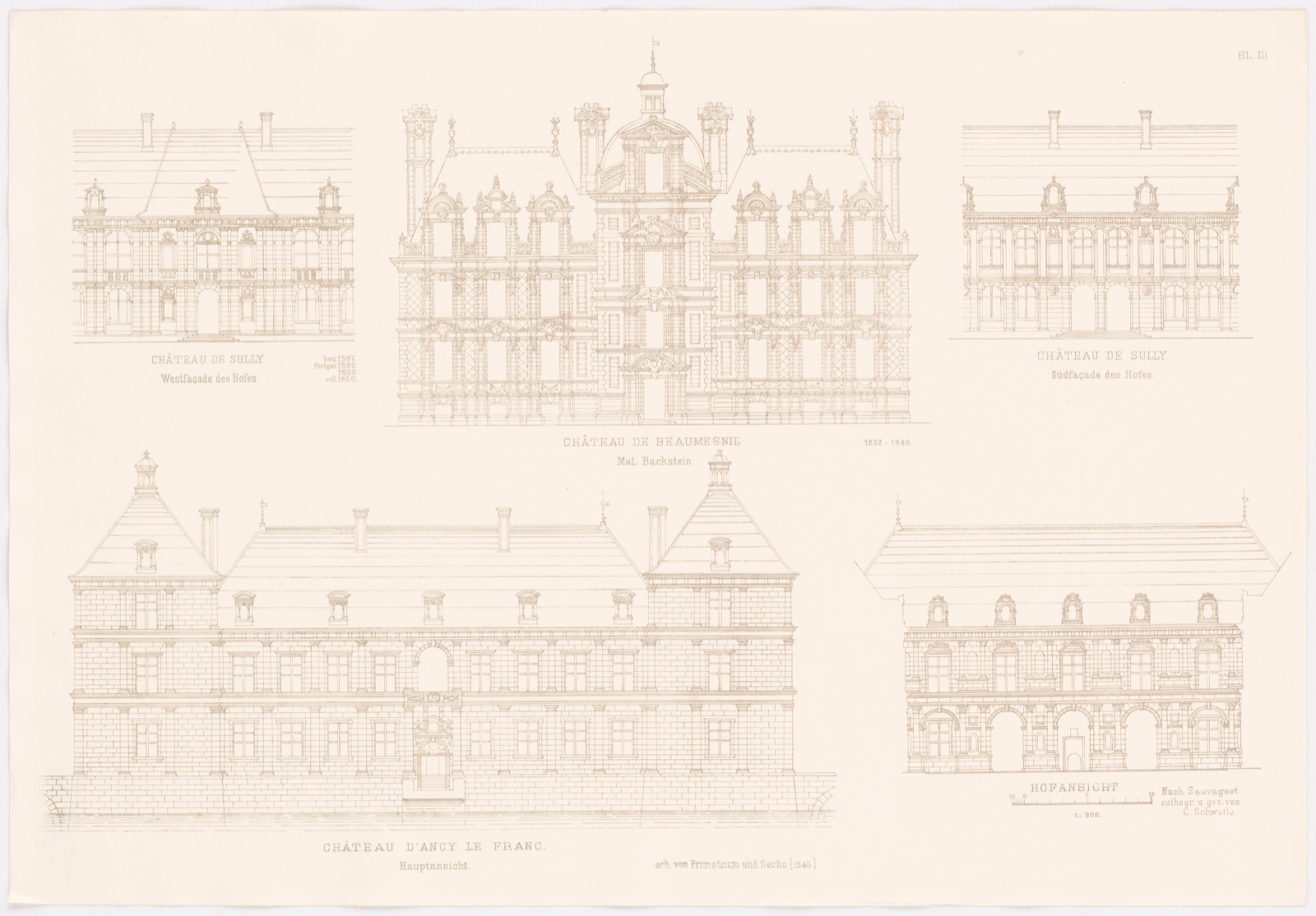
Chateau de Sully. Chateau de Beaumesnil. Chateau de d´Ancy le Franc: Ansichten (aus: Baukunst d. Renaissance i
· Museum of Architecture at Berlin Institute of Technology (via Europeana)
CC0 (no rights reserved)


