
France · Partial ruin
Château de Taillebourg
Château de Taillebourg is a medieval castle ruin on a rocky outcrop above the village of Taillebourg and the Charente valley in southwestern France. It occupied a commanding strategic position and retains a tall cylindrical donjon, stretches of curtain wall and underground vaulted rooms; the site is now a public garden with views over the valley.
Its prime
1179
Today
Partial ruin
As it stood in 1179
What Château de Taillebourg looked like in its prime.
Perched on a limestone outcrop above the Charente valley, the castle in its prime presented a tall cylindrical stone keep with a corbelled parapet and narrow arrow slits, and a system of multiple concentric curtain walls, one side backed directly onto sheer rock faces while the fourth side was defended by a triple wall. Pale grey limestone masonry, crenellated parapets along curved walls, a broad inner court and vaulted subterranean chambers cut into the bedrock completed the silhouette.
Its story
The story of Château de Taillebourg.
The Rock above the Charente and the Wedding of 1137
The château stands on a rocky outcrop above the village of Taillebourg and the valley of the Charente, in what is now the Charente-Maritime. It commanded a strategic position and was the focus of much conflict through the medieval centuries, featuring in the Saintonge War and afterwards in several episodes of the Hundred Years' War.
The castle that stood here before the surviving one gave shelter to Louis VII of France and Eleanor of Aquitaine in July 1137, immediately after their marriage; one chronicler places their wedding night at Taillebourg.
Richard the Lionheart's Siege, May 1179
In 1173 Richard had rebelled against his father Henry II, allied with his brothers Henry and Geoffrey and with Louis VII of France. When the rebellion failed, Henry II set Richard the task of bringing the rebellious lords of Aquitaine to heel. Taillebourg belonged at the time to Geoffrey de Rancon, who would later join Richard on the Third Crusade and appear as a witness to Richard's peace treaty with King Tancred of Sicily at Messina on 6 October 1190. The castle was reckoned impregnable: three sides sat above sheer rock faces, and the fourth was protected by a triple wall.
Richard invested it on 1 May 1179 and bombarded it with trebuchets. On 8 May he burned the surrounding fields and vineyards to bait the burghers holding the town walls into sallying out. He defeated them, pursued them back through the gate and laid the town waste, and the garrison, which had relied on the supplies inside the town, soon surrendered. The overthrow of Taillebourg so demoralised Geoffrey de Rancon that he surrendered his other great castle at Pons, bringing his rebellion to an end.
Saint Louis and the Battle of Taillebourg, 1242
The castle later served as the base of Louis IX of France, who stayed as the guest of Geoffrey IV of Rancon before the battle of Taillebourg in 1242, fought between the French king and Henry III.
The Counts of Taillebourg, 1423–1652
The fortress was rebuilt after 1423 by Henri de Pluqualec. Marguerite de Valois, illegitimate daughter of Charles VI, grew up here, and in 1451 Charles VII had Jacques Cœur arrested at the castle. From the fifteenth century Taillebourg was a county, its history well documented through the archives of the La Trémoille family.
The place became the favoured residence of the Coëtivy, and Louise de Coëtivy carried it in dowry to Charles de La Trémoille in 1501. It came through every siege of the Hundred Years' War and of the Wars of Religion, before being taken and destroyed during the Fronde in 1652.
From Talmont's Rebuilding to the Public Garden
Frédéric-Guillaume de La Trémoille, duke of Talmont, began enormous works of reconstruction from 1714, and on ground cleared by them had a formal French garden laid out, credited to the gardener Le Nôtre. The house he raised between 1717 and 1739 was a large U-shaped range flanked by two pavilions under slate roofs, the most important château in Saintonge in the eighteenth century. Its clock bell, given by the duke and his wife Anne de Bouillon and dated 1732, was moved after the Revolution to the church at Messac, where its inscription still names him as "COMTE DE TAILBOUR ET LIEUTENANT GÉNÉRAL DES ARMÉES DU ROY". Agrippa d'Aubigné reports that Henri IV thought the belvedere here the finest terrace in his kingdom.
During the Revolution the château was sold off in lots as national property. Left without upkeep, it was destroyed by fire in 1822. Of the fifteenth-century castle the medieval tower, the terraces and the cellars remain, with retaining walls, ditches and bridges among the surviving fortifications; two wings of the eighteenth-century outbuildings have become private houses. The remains of the château were inscribed as a monument historique on 8 March 1991 and the fortifications classified on 10 March 1995. The ruins are laid out as a public garden, and both château and garden are open to visitors.
Step inside
8 places to explore in 1179.
The record describes 8 distinct spots at Château de Taillebourg, including 1 interior: stone-vaulted underground chambers. Create your own photoreal reconstruction and explore every one, more scenes means more rooms, more angles, and more of the place to stand in.
Build Your Own Castle
Recreate Château de Taillebourg with AI to explore it.
The artist rebuilds it as it stood in 1179, a photoreal reconstruction that belongs to you alone. Pay with coins, no subscription needed.
Recreate this castle →Defend this castle →From the archive
Château de Taillebourg on paper: the measured plan and period views.
The survey plan and photographs below are the ground truth this page's reconstructions are checked against, drawn and photographed while the castle was still a working garrison. Every image is public-domain or openly licensed, with its source named.
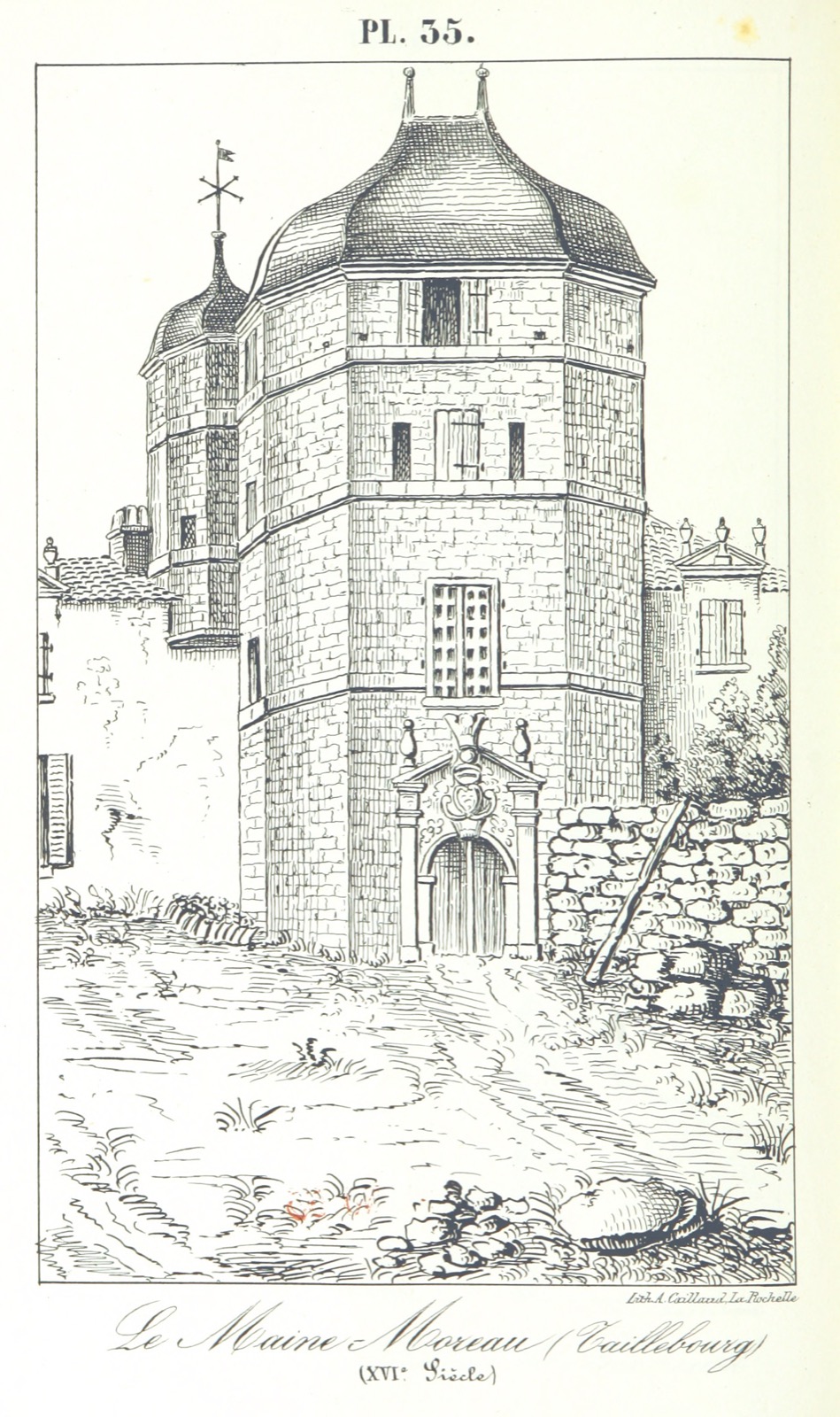
Taillebourg from "Musée Anaïs, ou choix de vues des monumens historiques de la Saintonge et de l'Aunis".
1846 · The British Library (via Europeana)
Public domain


