France · Demolished
Colline du Château
Colline du château de Nice
The Castle of Nice (Colline du Château) was a medieval and early modern military citadel built atop a 93-metre limestone hill overlooking the Bay of Nice. It stood from the 11th century until French forces ordered its destruction in 1706. Today the site is a public park offering panoramic views across the harbour and the Promenade des Anglais.
Its prime
1700
Today
Demolished
As it stood in 1700
What Colline du Château looked like in its prime.
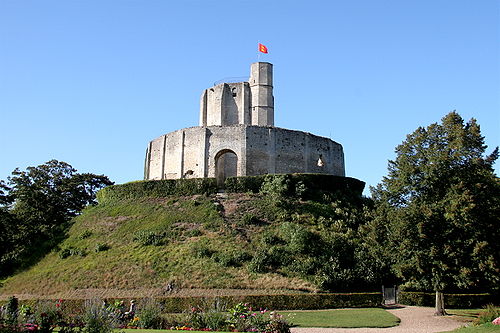
A compact military citadel crowning a 93-metre limestone outcrop, dominated by continuous stone curtain walls and raised ramparts encircling the summit and following the cliffline down to the sea; the masonry is of local pale limestone, weathered but regularly coursed. From the summit the citadel forms a low, crenellated skyline against the bay, with terraces set back from the sheer seaward cliffs and a fortified approach from the city side.
Its story
The story of Colline du Château.
From the Muro Antiquo to the Palais, 1002–1397
Nice's first recorded wall appears in donation cartularies dated precisely 20 January 1002, which mention an “ancient rampart”, muro antiquo, north of the hill by the Paillon, perhaps standing since late antiquity. The 93-metre limestone rock carries two plateaus: the southern summit, where the castle stood for seven centuries, and a lower northern platform that took the first suburbs and the citadel. Texts record an 11th-century castrum up there beside a cathedral and housing.
By 1333 the pentagonal stronghold, then styled the palais, held a guardhouse, a chapel dedicated to Lambert, a walled bailey and a prison and gibbet before the Tour Grosse, the bell tower. In 1397 the garrison under the knight Pons Laugier, lord of Ferres, came to twelve men-at-arms and a porter.
Opera Castri Nycie: Savoy Fortifies the Rock, 1388–1520
Nice's dedition to Savoy in 1388 turned a medieval hill fortress into a strategic asset: a lookout, a guard on access to the sea and leverage in international politics. The programme recorded as opera castri Nycie opened in 1436 with a spur at the western foot of the keep and a curtain running downhill to the Tour du Môle, later Saint-Elme.
The keep carried four or five towers, chief among them the square Grosse, where the Savoy flag flew behind a gate with portcullis and machicolations. Gun ports were cut into it in 1506, and in 1517–1520 an artillery front alla moderna went up before the castle gate, with broad merlons and three towers: the round Saint-Paul and Saint-Victor, and the semicircular Saint-Charles over the entrance. The upper town emptied of its civilian inhabitants.
The Franco-Ottoman Siege of 1543 and the New Citadel
In 1543 the troops of François I, joined by those of Suleiman the Magnificent, laid siege to Nice. The fortress garrison then seems to have been some three hundred soldiers with a score of guns, against about two hundred in peacetime, professional troops under a governor who was usually a Savoyard or Piedmontese noble, while the town below relied on its own militias.
The siege wrecked the northern faubourg, and Duke Emmanuel-Philibert answered by replacing it with a bastioned citadel on the pattern of Mont Alban and Villefranche; the works ran from 1577 and were never truly finished. To long-time Niçois the hill belongs to the heroine Catherine Ségurane, though her feats of arms seem to have been performed at the Porte Pairolière, in the town walls below.
Catinat, Berwick and the Fifty-Four Days, 1691–1706
The town finished a bastioned enceinte of its own just before the siege of 1691, in which Catinat's French army took both town and castle for Louis XIV. Two thousand men held the works that year, regiments of Savoy and Piedmont in the citadel and local militia on the less exposed upper walls, and the keep was destroyed in the fighting. The Treaty of Turin returned Nice to Savoy in 1696, and the duke doubled the 16th-century rampart with tenailles and demi-lunes on its weakest flanks.
The Spanish Succession set Louis XIV against Victor-Amédée II, and in spring 1705 La Feuillade's armies invested Nice. The town gave in after a few weeks; the castle did not. Four foreign units held it: the regiments of the Croix-Blanche, of Saint-Nazaire, of the Queen (Bernese mercenaries in English pay), and a Camisard battalion under Jean Cavalier. Marshal Berwick recorded fifty pieces firing back at him. Between 11 November 1705 and 4 January 1706 the batteries burned 644,296 livres of powder. Broken by 113 cannon and mortars, the castle capitulated on 4 January 1706 after fifty-four days of bombardment.
Gayot's Mines and the Garden of 1822
On 2 January 1706 Louis XIV ordered what the guns had spared to be blown flat, entrusting the task to his counsellor Gayot, whose specification left no room: the mine holes were to be sunk to the rock the walls sat on, beginning “from the first to the last stone of the fortification so that nothing remains”. The contract was let on 12 July, and trumpets and drums announced the schedule to the town; six months of blasting destroyed much of its architecture along with the fortress.
The Treaty of Utrecht handed Nice back to Victor-Amédée II in 1713, but he gave up restoring the fortifications. In July 1821 Charles-Félix offered the town a favour, the council asked for a drawing school and a botanical garden, and letters patent of 3 May 1822 granted the ground in usufruct to “embellish the surroundings of the town with public promenades and plantations”, keeping what remained of the keep, the guardhouse and the battery. Nothing was rebuilt. Castle Hill is now the best-known public garden in Nice, and a charge is fired there each day to mark noon.
Step inside
6 places to explore in 1700.
The record describes 6 distinct spots at Colline du Château, including 1 interior: inner plateau within the enceinte. Create your own photoreal reconstruction and explore every one, more scenes means more rooms, more angles, and more of the place to stand in.
Build Your Own Castle
Recreate Colline du Château with AI to explore it.
The artist rebuilds it as it stood in 1700, a photoreal reconstruction that belongs to you alone. Pay with coins, no subscription needed.
Recreate this castle →Defend this castle →Nearby