
France · Still standing
Josselin Castle
Château de Josselin
Josselin Castle (Château de Josselin) is a medieval castle in Josselin, Morbihan, Brittany, France, originally founded about 1008 and rebuilt several times; the principal surviving fabric dates from the late 14th and 15th centuries under Olivier V de Clisson and the Rohan family. The castle stands on a rocky promontory above the valley of the Oust and remains a private residence and historic monument.
First raised
1008
Its prime
1500
Today
Still standing
As it stood in 1500
What Josselin Castle looked like in its prime.
Built of local grey granite on a rocky promontory above the Oust, the castle presents a long curtain wall punctuated by multiple large cylindrical towers with conical slate roofs and small pointed turrets. The central range has a steep slate roof pierced by gabled dormer windows and a regular arrangement of mullioned openings; a continuous crenellated parapet and corbelled machicolations run along the wall. At its prime the ensemble read as a compact fortified residence combining high defensive round towers and an articulated Renaissance façade.
Its story
The story of Josselin Castle.
Guéthénoc's Rock and Henry II's Salt, 1008–1175
Guéthénoc, viscount of Porhoët, is said to have raised a first, timber castle around 1008 on a rocky spur falling sheer to the Oust, at the crossing of two Roman roads. His son Goscelinus gave the place its name. Fortified from 1025, it stood where a pilgrimage to Notre-Dame du Roncier already enriched the lords and the town below.
In 1154 Odo II of Porhoët, guardian and regent of the young Conan IV, Duke of Brittany, gathered the Breton lords to strip his ward of his inheritance. Conan sought the protection of Henry II of England, who defeated Odo. Henry came in person to direct the demolition of Josselin and had salt sown into the ruins to keep the walls down. It was pulled down in 1168 and again in 1175, and raised in 1173 by Odo, now allied to the king of France.
The Battle of the Thirty and Olivier de Clisson
In the Breton War of Succession the garrison fought the defenders of nearby Ploërmel to no clear result. To break the deadlock, thirty knights from each side met on 26 March 1351 halfway between the two places. The thirty who rode out of Josselin for Charles de Blois, under Jean de Beaumanoir, beat the champions of Ploërmel, four Bretons, six Germans and twenty Englishmen.
In 1370 the counts of Alençon and Perche made Josselin over to the Breton soldier Olivier V de Clisson, later Constable of France, in exchange for the barony of Thuit near Falaise; other accounts make it dowry from his marriage to Margaret of Rohan. On the existing castle he built what was reckoned the best-armed fortress in Brittany, its ramparts 25 metres high and studded with towers around an enormous keep. His daughter Beatrice married Alain VIII of Rohan, heir to the neighbouring viscounts. In 1389 Clisson was banished from France and condemned to death by Duke John IV; he took refuge at Josselin, John IV laid siege to it, and the struggle between them, broken by truces, ran on for the rest of his life.
Jean II de Rohan, Anne of Brittany and the Letter A, 1455–1510
Josselin passed after Clisson's death to the Rohans, and in 1455 the viscount refitted it to take artillery. In 1488 Francis II, Duke of Brittany, seized the castle and partly demolished it to punish Jean II of Rohan, a great-grandson of Clisson, for supporting the French party against him.
Francis's daughter Anne of Brittany gave Josselin back to Jean II, who turned the fortress into a residence and raised a granite range whose carved court facade, worked between 1490 and 1510, is an early example of Renaissance building. The facade carries the badge of Anne, sovereign Duchess of Brittany and Queen consort of France, over and again: the letter A beneath a cord cut in stone.
The Catholic League, the Huguenot Rohans and Richelieu's Ball
Barred from Josselin for their Protestantism, René II, Viscount of Rohan, and his kinsmen could not stop the Duke of Mercœur, Governor of Brittany, from making the castle a base for the Catholic League against Henry IV. In 1603 Henry raised the viscounty of Rohan to a duchy-peerage, and Henry, Duke of Rohan, one of the Huguenot leaders, moved his military headquarters to Pontivy.
When the duke led the Protestant revolt against Louis XIII, Cardinal Richelieu had the keep at Josselin thrown down in March 1629. It was so massive that it came down in two stages; several of the towers went with it, though the Renaissance range was spared. Richelieu's word to the duke: "My lord, into your game of skittles I have just thrown a good ball!"
Prisoners, a Cotton Mill and the Rohans' Return
After the battle of Camaret in 1694 it held English soldiers as prisoners, and after Saint-Cast in 1758 nearly 1,200 prisoners of war. The Rohans, living at court, had left it; in 1760 Louis III de Rohan-Chabot had the remains of the two great towers flanking the first gate pulled down, and in 1776 the duchess allowed a cotton mill into the ground-floor rooms to give work to the district's poor children. Under the Revolution the municipality took the building for its sessions and a grain store, and held the ci-devant nobles in the detached tower in conditions General Lazare Hoche denounced to the National Convention. It returned to the Rohans in 1799, badly decayed.
In 1822 Caroline, Duchess of Berry, persuaded the then duke, Louis-François de Rohan-Chabot, to restore it. Work began about 1855 under Jules de La Morandière, a pupil of Viollet-le-Duc, ran on under Henri Lafargue to 1904, and the castle opened to visitors around 1930. Classified a monument historique on 21 August 1928 and a classified natural site from 1948, Josselin remains the home of Josselin de Rohan, fourteenth Duke of Rohan; the gardens and ground-floor rooms are open, and the old stables hold a doll museum.
Step inside
7 places to explore in 1500.
The record describes 7 distinct spots at Josselin Castle, including 1 interior: antechamber (main entrance room). Create your own photoreal reconstruction and explore every one, more scenes means more rooms, more angles, and more of the place to stand in.
Build Your Own Castle
Recreate Josselin Castle with AI to explore it.
The artist rebuilds it as it stood in 1500, a photoreal reconstruction that belongs to you alone. Pay with coins, no subscription needed.
Recreate this castle →Defend this castle →Whose castle
Clans who held Josselin Castle.
The families that held Josselin Castle for a decade or more across its history, follow a name to its clan.
Rohan
A Rohan seat from Olivier V de Clisson's marriage to Margaret of Rohan; the Dukes of Rohan restored the castle from 1822.
de Clisson
Olivier V de Clisson acquired the lordship in 1370 and built the eight-towered fortress.
From the archive
Josselin Castle on paper: the measured plan and period views.
The survey plan and photographs below are the ground truth this page's reconstructions are checked against, drawn and photographed while the castle was still a working garrison. Every image is public-domain or openly licensed, with its source named.
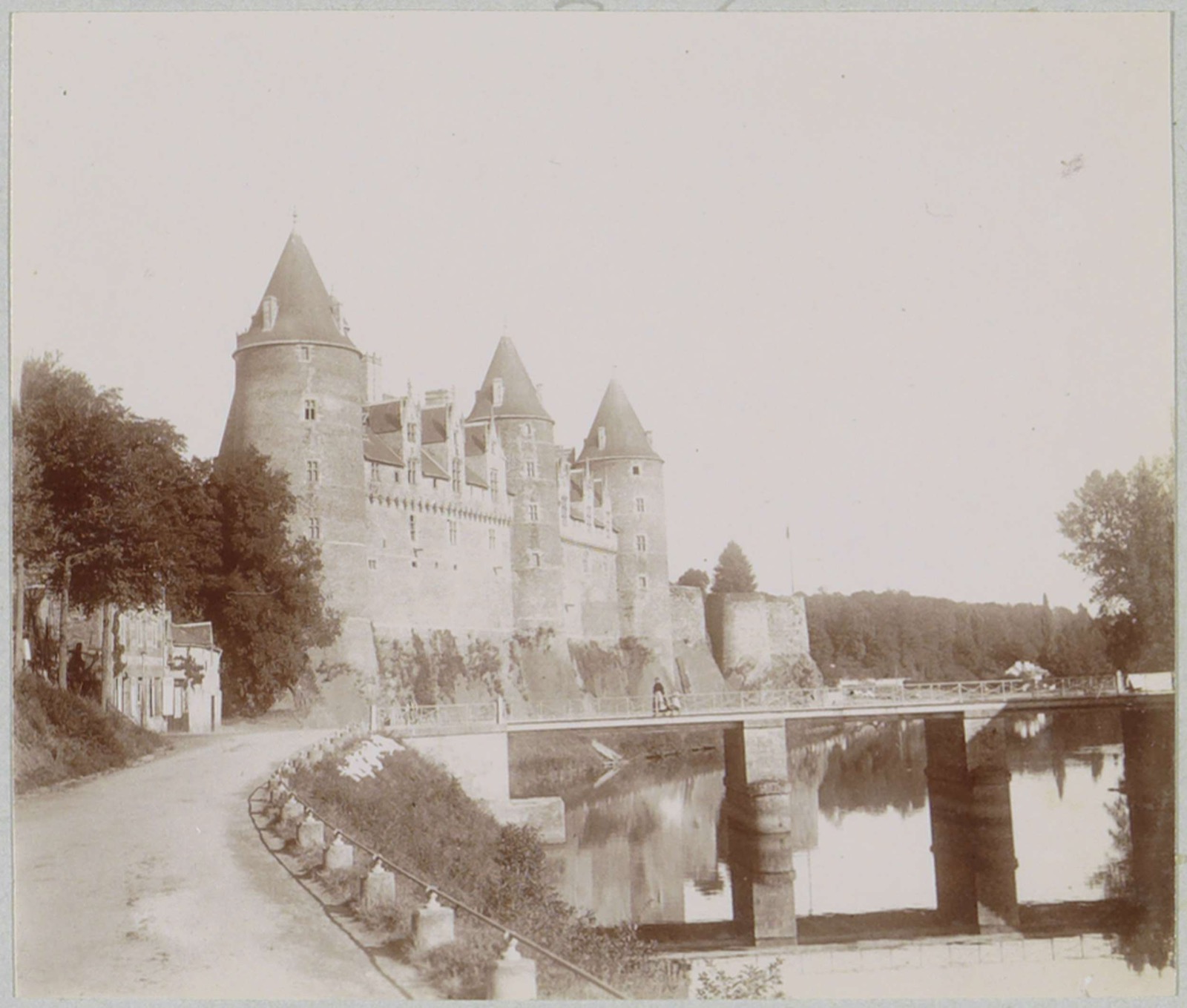
Gezicht op het Kasteel van Josselin
1901 · Rijksmuseum (via Europeana)
Public domain
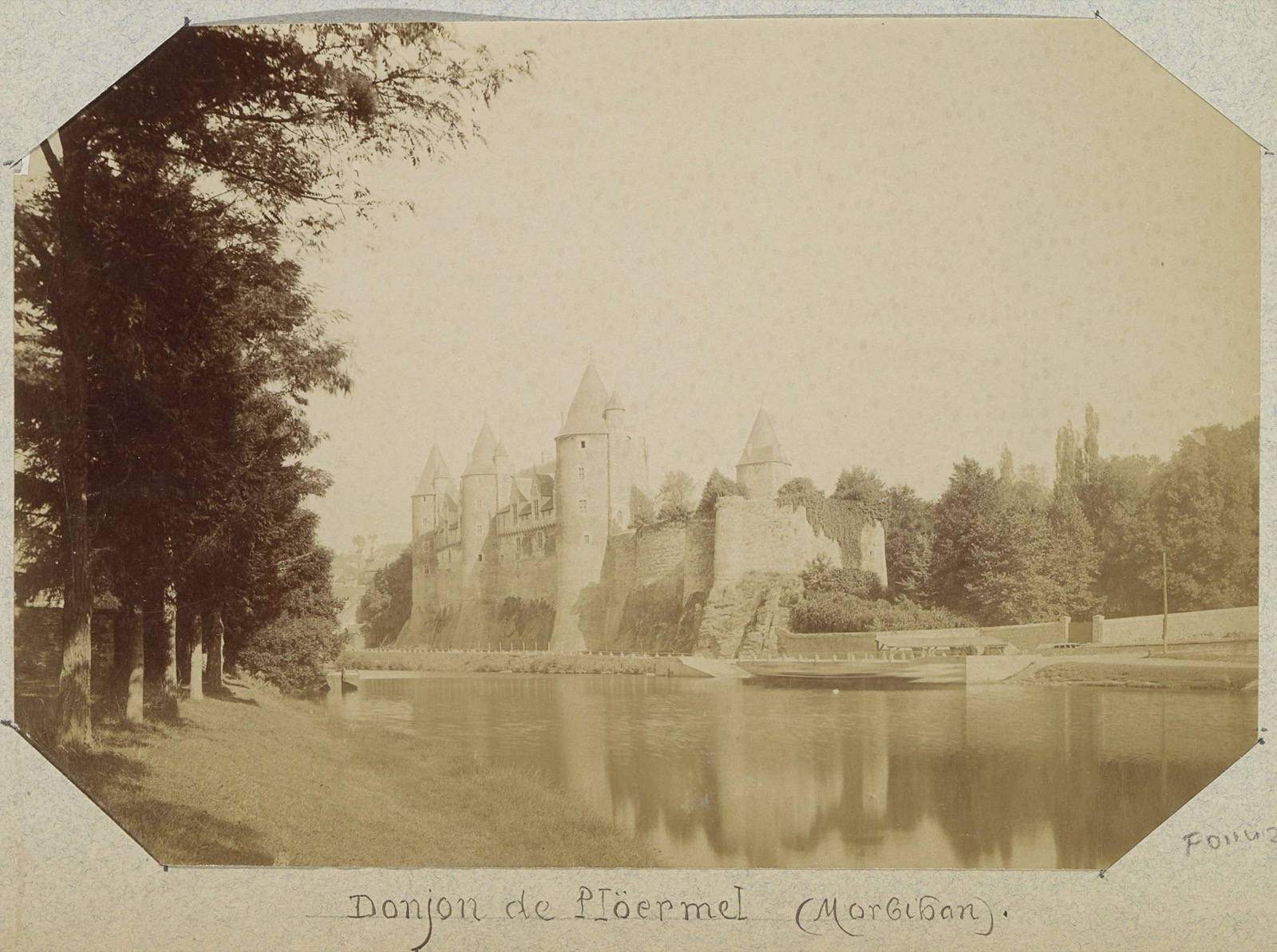
Kasteel van Josselin gezien over een water
· Rijksmuseum (via Europeana)
Public domain
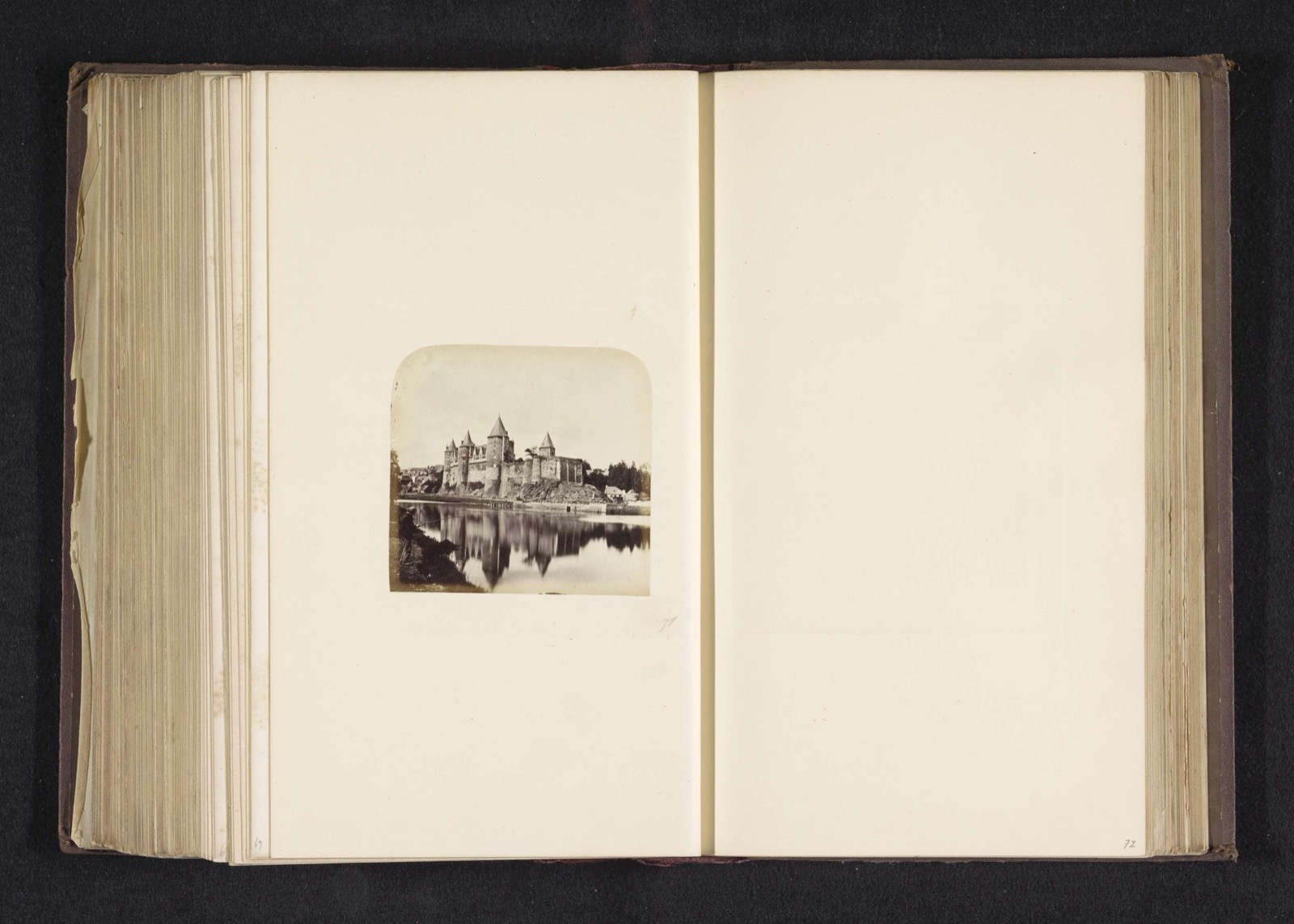
Gezicht op het kasteel van de Prince de Léon in Josselin
· Rijksmuseum (via Europeana)
Public domain


