Clan Rising
Murol Castle today

France · Partial ruin

Murol Castle

Château de Murol

The Château de Murol is a medieval castle on a volcanic basalt outcrop overlooking the town of Murol in Puy-de-Dôme, France. Built from the 12th century and heavily reinforced in the 14th–16th centuries, it comprises concentric curtain walls, a central keep and ancillary buildings and chapels; it is today a conserved ruin and tourist site.

Photograph via Wikimedia Commons

Its prime

1550

Today

Partial ruin

As it stood in 1550

What Murol Castle looked like in its prime.

Perched on a dark basalt crag, the castle presents concentric defences: a low outer curtain wall with a fortified southern gatehouse and an inner, higher curtain with towers. A tall stone keep rises from the highest point, joined by a smaller round tower and two attached chapel blocks. Remaining domestic ranges and a Renaissance pavilion sit in the outer ward below the inner castle. Walls and towers are of grey volcanic stone; the site is set above steep grassy slopes and the Couze valley.

Its story

The story of Murol Castle.

The Château de Murol rises on a volcanic basalt outcrop overlooking the town of Murol in the Puy-de-Dôme. Built from the 12th century and heavily reinforced between the 14th and 16th centuries, it comprises concentric curtain walls, a central keep, ancillary buildings and chapels.

The castle became the property of the d'Estaing family when the sole heir, Jehanne de Murol, married Gaspard d'Estaing in the 15th century. Though Richelieu ordered the destruction of numerous castles and fortresses, Murol was spared thanks to the prestige of the d'Estaings and their influence at the French court. It survives today as a conserved ruin and tourist site.

Step inside

11 places to explore in 1550.

The record describes 11 distinct spots at Murol Castle, including 6 interiors: outer courtyard with renaissance pavilion, door to the inner courtyard with family arms, inner courtyard with bakery, kitchen and outbuildings and more. Create your own photoreal reconstruction and explore every one, more scenes means more rooms, more angles, and more of the place to stand in.

Exterior approach from the valley roadSouth fortified gatehouse (outer curtain)Outer courtyard with Renaissance pavilionLower (outer) courtyardDoor to the inner courtyard with family armsInner courtyard with bakery, kitchen and outbuildingsOlder 13th-century chapelLater 15th-century chapelKeep battlements and summit viewCurtain-wall ramparts and spiral stairRemains of the gallery

Build Your Own Castle

Recreate Murol Castle with AI to explore it.

The artist rebuilds it as it stood in 1550, a photoreal reconstruction that belongs to you alone. Pay with coins, no subscription needed.

Recreate this castle →Defend this castle →

Whose castle

Clans who held Murol Castle.

The families that held Murol Castle for a decade or more across its history, follow a name to its clan.

  • Murol

    Held by the Murol family until sole heiress Jehanne de Murol's marriage in the 15th century.

  • d'Estaing

    Held by the d'Estaing family from the 15th century; their court influence led Richelieu to spare the castle.

From the archive

Murol Castle on paper: the measured plan and period views.

The survey plan and photographs below are the ground truth this page's reconstructions are checked against, drawn and photographed while the castle was still a working garrison. Every image is public-domain or openly licensed, with its source named.
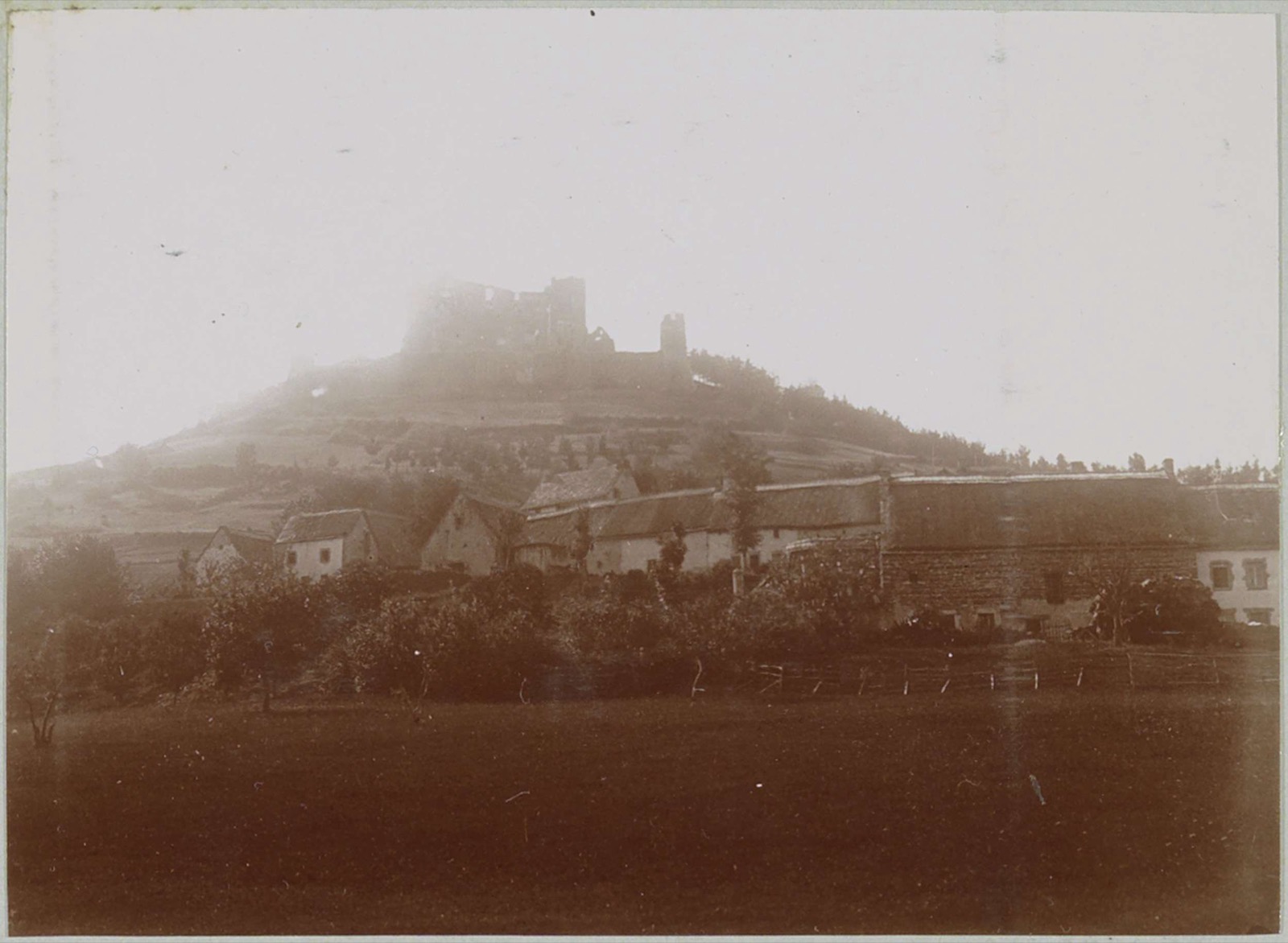
Gezicht op Murol en het plaatselijk kasteel, Murol Castle

Gezicht op Murol en het plaatselijk kasteel

· Rijksmuseum (via Europeana)

Public domain

Nearby

Landmarks within reach of Murol Castle.

Questions about Murol Castle

What is the history of Murol Castle?

Murol Castle began as a medieval stronghold in the 11th or 12th century, built on a basalt outcrop to watch several roads. It was reinforced in the 14th century, became the property of the d’Estaing family in the 15th century, and gained Renaissance buildings in the 16th century. Later abandoned and used as a prison and bandits’ hideout, it fell into ruin before its protection as a historic monument.

What is inside Murol Castle?

Murol Castle contains an outer courtyard with a Renaissance pavilion and an inner courtyard with a bakery, kitchen and outbuildings. Its surviving features also include two chapels, a gallery, a door bearing the arms of the Murol and d’Estaing families, and large kitchen and bakery fireplaces, an oven and a kneading trough.

Why was Murol Castle built, and what was it used for?

Murol Castle was built to provide surveillance over several roads. Its role later developed beyond defence: the d’Estaing family added a more comfortable Renaissance pavilion, while the castle was subsequently used as a prison and, during the Revolution, as a hideout for bandits.

Where is Murol Castle?

Murol Castle is in the Puy-de-Dôme, overlooking the town of Murol in the Auvergne-Rhône-Alpes region. It stands on a volcanic basalt outcrop above the Couze valley, at nearly 1,000 metres altitude.

When was Murol Castle built?

Murol Castle was built in stages from the 11th or 12th century, with major alterations and reinforcements in the 14th and 16th centuries. The earliest surviving remains include a Romanesque chapel and defensive walls from the 11th or 12th centuries.

Was Murol Castle ever attacked or besieged?

Murol Castle survived sieges during the Catholic League. It emerged unscathed, although no dates or attacking forces are specified in the supplied account.

Which family or clan held Murol Castle?

Murol Castle was held by the Murol family until Jehanne de Murol, the sole heiress, married Gaspard d’Estaing in the 15th century. The d’Estaing family then held it, and their influence at the French court helped Richelieu spare the castle from destruction.

What did Murol Castle look like in its prime?

In its prime, Murol Castle had concentric stone defences on a dark volcanic basalt crag. A low outer curtain wall with a fortified southern gatehouse surrounded an inner, higher curtain with towers; a tall keep, smaller round tower, chapels and a Renaissance pavilion completed the silhouette above the Couze valley.

Is Murol Castle still standing, or is it a ruin?

Murol Castle survives as a conserved partial ruin rather than an intact residence. Its walls, towers, keep, chapels, Renaissance pavilion and domestic remains are still visible, although the castle was abandoned and fell into ruin; its classification as a historic monument in 1889 helped save it.

Can you visit Murol Castle?

Murol Castle can be visited as a tourist site. It has been developed as an important tourist attraction, with guided tours, displays in the lower courtyard and access to the ramparts.
All castles of France · Castles of Europe · the best castles in Europe · explore the finished reconstructions.