
France · Demolished
Rouen Castle
Château de Rouen
Rouen Castle (Château Bouvreuil) was a fortified ducal and royal residence built by Philip II after 1204 on Bouvreuil hill north of medieval Rouen. The fortress formed a large triangular enceinte with high round towers and a dominant royal keep; most of the castle was dismantled at the end of the 16th century, though the great donjon (now called the Tour Jeanne d'Arc) survives in restored form. The surviving tower is open to the public.
Its prime
1430
Today
Demolished
As it stood in 1430
What Rouen Castle looked like in its prime.
Perched on Bouvreuil hill north of the medieval town, the castle in its prime formed a large triangular stone enclosure with high cylindrical corner towers linked by continuous curtain walls; the royal keep (the great round donjon) sat at the northern apex as the dominant element. All masonry was of light local dressed stone, the silhouette defined by round tower shafts rising above the enclosing walls and walkways, the whole intact and commanding views over Rouen.
Its story
The story of Rouen Castle.
Philip Augustus Takes Rouen, 1204
Château-Gaillard fell to Philip Augustus on 6 March 1204, Caen on 21 May, and Rouen on 24 June after forty days of siege; John had been abandoned by Norman barons who suspected him of having had his nephew Arthur of Brittany killed the year before. Philip marked the conquest by razing the ducal palace at the meeting of the Robec and the Seine, already gutted by fire in 1200, where William the Conqueror had received Harold in 1064. The new castle, begun in 1204 and finished about 1210, went up alongside a new town wall that folded the bourg and the cité into one enclosure.
He chose the hill of the Bouvreuil fief, outside the medieval town to the north and commanding it, where the ruins of the Gallo-Roman amphitheatre of Rotomagus still stood; their footing was reused as foundations. The polygonal enceinte, roughly 90 metres square, was ringed by a dry ditch six metres deep and fifteen wide, its walls carrying ten towers, with the circular grosse tour, the donjon, standing detached from the circuit. Louis IX's enlarged town wall took the castle into the city about the middle of the century; soon after 1253 a gate named for the same Bouvreuil fief was pierced in the wall beside it, and the fortress itself came to be called the château de Bouvreuil.
The Exchequer, the Garrison and the Maltôte Riot
From the completion of the works in 1210 the castle was the seat of government of the duchy. The Exchequer of Normandy met in the great hall of the royal lodging (itinerant around Normandy until 1302, then fixed at Rouen, sitting twice a year at Easter and Michaelmas), and out of it grew the Parlement de Normandie. The garrison was never large, twenty-four crossbowmen in 1210, and the place doubled as armoury and powder magazine.
In 1292, during the Maltôte riot against taxation, the king's revenue men took shelter behind its walls while the townspeople laid siege to them. The mayor, with his sergeants and the burgesses, put the rising down in blood, and Philip IV suspended the commune.
The Banquet of 5 April 1356
On 5 April 1356 John II came to Rouen in arms and had his marshal Arnaud d'Austrehem seize, in the middle of a banquet in the great hall, the men he held to have been party to the plot against his constable and friend de la Cerda: Charles of Navarre, Navarre's squire Colin Doublet, and three Norman barons, among them Jean V d'Harcourt. All but the King of Navarre were executed out of hand at the Champ du Pardon in the king's presence, Navarre himself carried off to prison at Arleux-en-Palluel near Douai. Froissart told and pictured the scene in his Chronicles. It drove the families of the dead into Edward III's camp, and a few months later John was taken prisoner at Poitiers.
Lancastrian Works and the Trial of Joan of Arc, 1419–1431
Through the English domination of 1418–1449 the castle housed the government of the King of England, and from 1419 the Lancastrians rebuilt it for gunpowder war: a square tower commanding the field gate; a boulevard, a sloped earthwork shielding the exposed northern front from artillery; a storey added to the corner tour couronnée; and a gun platform laid across the top of the donjon, whose outer door was walled up. In 1437 the garrison stood at 109 men-at-arms under John Talbot, lieutenant of the Duke of York.
Joan of Arc was imprisoned in the castle from 23 December 1430 and tried there from 21 February to 30 May 1431. She was confined in the tour couronnée, afterwards called the tour de la Pucelle; the donjon that now carries her name is wrongly associated with her, though one session of the trial was held in it, on 9 May 1431, when she was shown the instruments of torture and answered: “Truly, if you have to pull my members and my soul from my body, I shall say nothing else; and if I say something to you, I would always say to you afterwards that you made me say it by force.”
Gunpowder and the Dismantling of 1591
Charles VIII, in 1485, was the last king of France to lodge at the castle; its captaincy stayed a great man's office, held from 1466 to 1475 by Louis de Luxembourg, constable of Saint-Pol, who was beheaded on the Place de Grève for treason. Once it had ceased to be a residence maintenance lapsed, and on 24 July 1542 a fire set off the gunpowder stored there and wrecked the towers at the entrance. Vulnerable to artillery, it was ordered demolished in 1590, and the dismantling began in 1591 with the towers and ramparts, the stone going into other buildings. The donjon was spared; classified a historic monument in 1840, it was rebuilt between 1868 and 1884 and given a pointed roof, and in the Second World War the occupying German forces camouflaged it and turned it into a bunker.
Step inside
6 places to explore in 1430.
The record describes 6 distinct spots at Rouen Castle, including 1 interior: interior chamber of the royal keep (prison cell). Create your own photoreal reconstruction and explore every one, more scenes means more rooms, more angles, and more of the place to stand in.
Build Your Own Castle
Recreate Rouen Castle with AI to explore it.
The artist rebuilds it as it stood in 1430, a photoreal reconstruction that belongs to you alone. Pay with coins, no subscription needed.
Recreate this castle →Defend this castle →From the archive
Rouen Castle on paper: the measured plan and period views.
The survey plan and photographs below are the ground truth this page's reconstructions are checked against, drawn and photographed while the castle was still a working garrison. Every image is public-domain or openly licensed, with its source named.
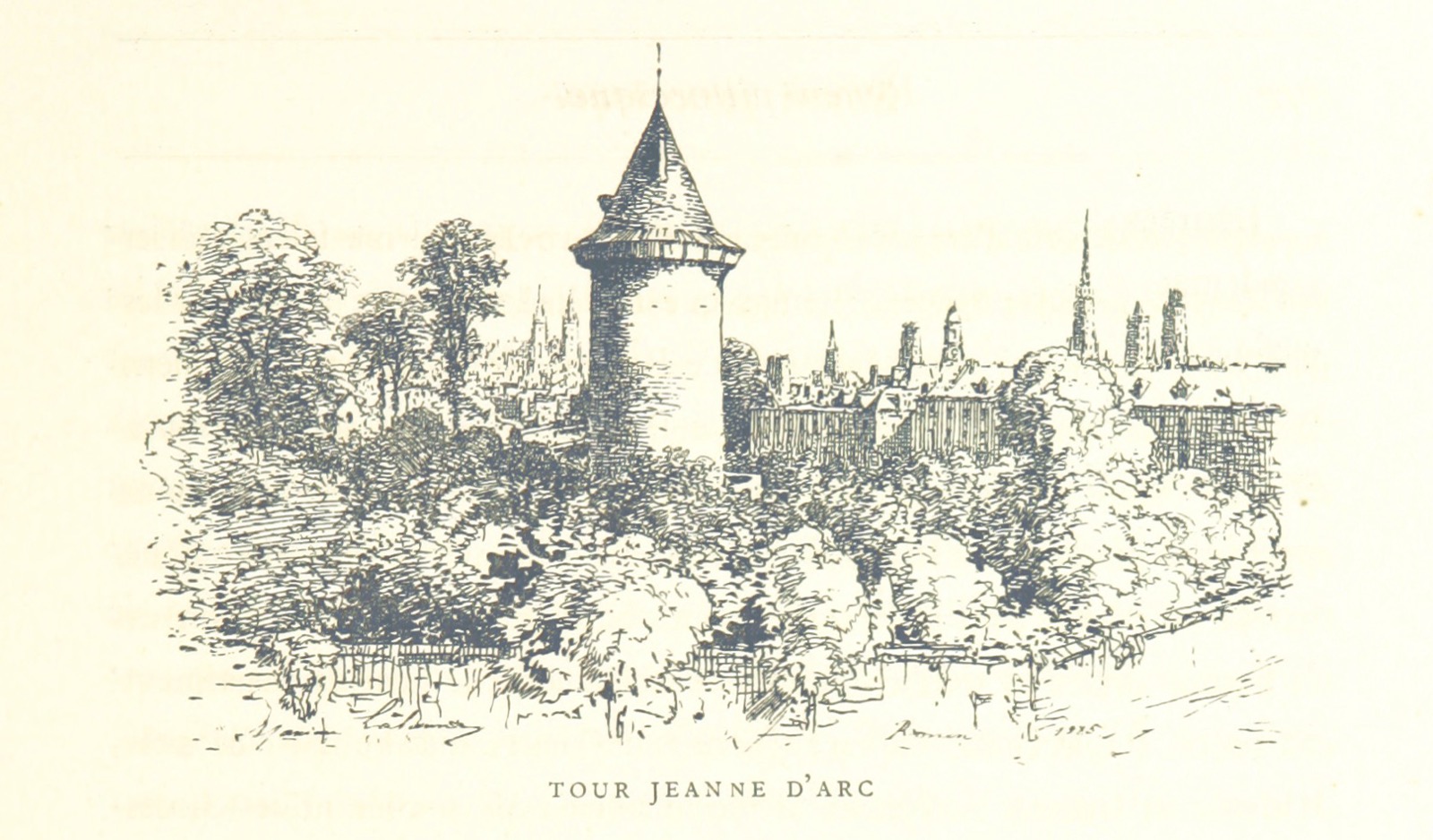
Rouen Castle from "Rouen pittoresque ... Dessins par M. Lalanne. Texte par Allais, C. de Beaurepaire, Dubosc,
1886 · The British Library (via Europeana)
Public domain

Questions about Rouen Castle
What is the history of Rouen Castle?
What is inside Rouen Castle?
Why was Rouen Castle built, and what was it used for?
Where is Rouen Castle?
When was Rouen Castle built?
Was Rouen Castle ever attacked or besieged?
What did Rouen Castle look like in its prime?
Is Rouen Castle still standing, or is it a ruin?
Who built Rouen Castle?
Can you visit Rouen Castle?
More castles of France


Explore the city


