
Germany · Ruin
Falkenstein Castle
Burg Falkenstein
Falkenstein Castle (Castrum Pfronten) is a medieval stone castle ruin on the Falkenstein summit near Pfronten in the Bavarian Alps. Built around 1270–1280 by Count Meinhard II of Tyrol, it was largely destroyed in the 17th century and has remained a ruin since. King Ludwig II purchased the site in 1883 and planned a reconstruction that was never carried out.
First raised
1280
Its prime
1280
Today
Ruin
As it stood in 1280
What Falkenstein Castle looked like in its prime.
A compact medieval stone fortress built c.1270–1280, sited on the rocky Falkenstein summit at 1,277 m. In its prime the castle presented a tight cluster of stone-built ranges and defensive masonry that follow the contours of the crag, coursed local stonework set directly on bedrock, limited apertures for light and defence, and a summit-level open area functioning as the working courtyard; contemporary roofs would have been timber and pitched.
Its story
The story of Falkenstein Castle.
Count Meinhard II's Castrum Pfronten, c. 1270–1582
Around 1270–1280, Count Meinhard II of Tyrol laid claim to the Staufer inheritance in the eastern Allgäu and, as an unmistakable show of lordship against the rival dukes of Bavaria, ordered the castrum Pfronten built on the edge of his territory in 1280. Joachim Zeune, curator of the European Castle Institute, reads it as a symbol of power set close to Füssen: from there the Lech was navigable north, and the Via Claudia Augusta ran south. The name Falkenstein only came into use in the fifteenth century, probably because of the site's unusual position; it is the highest castle site in Germany.
As early as 1290 Meinhard transferred the small fortress to the Bishop of Augsburg, Wolfhard, who undertook to pay a bailiwick due in return. The counts of Tyrol and the bishops of Augsburg had interests in common against their powerful neighbours, the dukes of Bavaria, and the three lordships met here in the Füssen area, one reason for the region's unusual concentration of castles. Falkenstein served as the seat of the Augsburg bailiffs until 1582, though the exceptional altitude often kept them from living there in winter and they seem to have settled instead in the stable building below; the administrative seat was then moved down into the valley at Ried.
Burned in the Thirty Years' War and Sold as a Ruin, 1646–1803
Towards the end of the Thirty Years' War, the Tyrolean state government ordered Falkenstein abandoned along with its neighbouring outposts of Eisenberg and Hohenfreyberg rather than let them fall intact into the hands of the advancing Swedish-Protestant army; all three were emptied and set alight in 1646. The Swedes changed their line of march shortly afterwards, making the destruction pointless, and all three castles have stood as uninhabited ruins ever since. In 1803 Falkenstein passed with the rest of the prince-bishopric of Augsburg to the Electorate of Bavaria, which soon sold the ruin to the communities of Steinach and Ösch, now districts of Pfronten.
Ludwig II's Unbuilt Fairy-Tale Castle, 1883–1886
King Ludwig II of Bavaria bought the ruin in 1883, intending to raise a castle on it in the manner of Neuschwanstein, again poised over romantic precipices, but this time in a Gothic style. The stage painter Christian Jank produced a fantastical drawing that year, and the architect Georg von Dollmann was ordered to turn it into plans and elevations; knowing Ludwig was in financial difficulty, Dollmann, or one of his assistants, produced a design for a small Gothic castle with a tall main tower, which the king rejected angrily.
The commission passed to the Regensburg architect Max Schultze, who in 1884 designed a "robber baron's castle" simplifying Jank's sketch and had a road and water line laid to the site, and, with the help of August Spieß, began work on interiors and frescoes in a secular Byzantine style. Ludwig kept intervening: he changed the bedroom's style from Gothic to secular Byzantine and finally wanted it built like a Byzantine church, with apse and altar. Schultze resigned in 1885; his successors Julius Hofmann and Eugen Drollinger, knowing the castle would probably never be built, produced extravagant, costly and impractical designs. Drollinger was drafting a fourth version of the bedroom, now fitted with stained-glass windows and a mosaic dome, when news reached him of Ludwig's death in 1886, and the plans for Falkenstein were abandoned for good.
Lightning Strike, Stabilisation and Private Ownership, 1898–1988
Lightning struck the ruin in 1898, destroying its east gable wall. Some poorly executed stabilisation work was carried out in the 1920s and again in the 1960s, and the castle passed into private ownership in 1988.
Step inside
3 places to explore in 1280.
The record describes 3 distinct spots at Falkenstein Castle, including 1 interior: summit-level courtyard. Create your own photoreal reconstruction and explore every one, more scenes means more rooms, more angles, and more of the place to stand in.
Build Your Own Castle
Recreate Falkenstein Castle with AI to explore it.
The artist rebuilds it as it stood in 1280, a photoreal reconstruction that belongs to you alone. Pay with coins, no subscription needed.
Recreate this castle →Defend this castle →From the archive
Falkenstein Castle on paper: the measured plan and period views.
The survey plan and photographs below are the ground truth this page's reconstructions are checked against, drawn and photographed while the castle was still a working garrison. Every image is public-domain or openly licensed, with its source named.
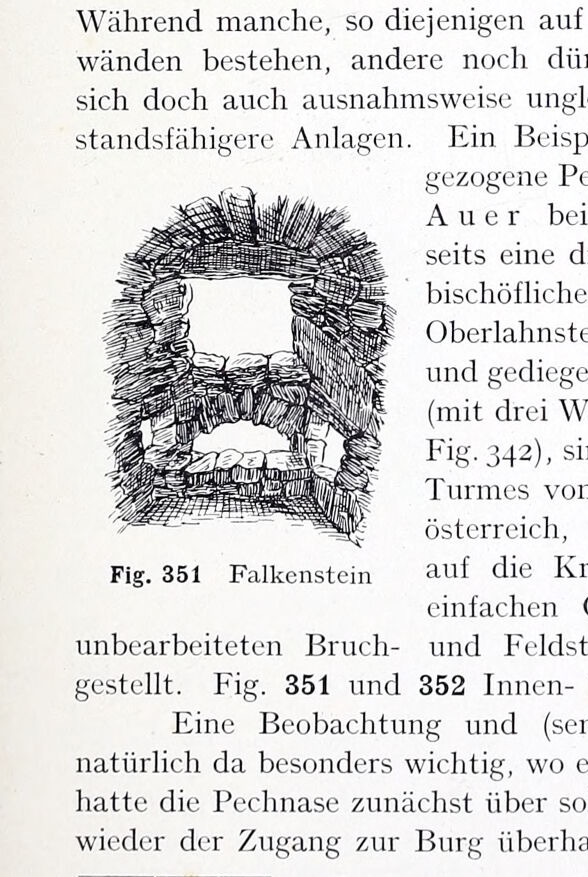
Fig. 351 Falkenstein
1912 · Otto Piper, Burgenkunde (1912)
Public domain


