Clan Rising
Fürstenberg Castle today

Germany · Partial ruin

Fürstenberg Castle

Burg Fürstenberg

Fürstenberg Castle is a medieval hilltop castle above the former village of Rheindiebach (now Oberdiebach) in Rhineland-Palatinate, Germany. Built in 1219, the site is dominated by a tall cylindrical keep and fragments of surrounding curtain walls set on a steep, vineyard-covered slope above the Rhine.

Photograph via Wikimedia Commons

First raised

1219

Its prime

1219

Today

Partial ruin

As it stood in 1219

What Fürstenberg Castle looked like in its prime.

Perched on a steep vineyard-covered hill, the castle is dominated by a single tall cylindrical stone keep with a crenellated parapet. A circuit of curtain walls and shorter tower remnants step down the hillside; masonry is largely local grey-brown sandstone with patched lighter render in places. The complex sits directly above terraced rows of vines and is approached from the slope below; at its prime the keep and curtain walls would have formed a continuous fortified silhouette against the sky.

Its story

The story of Fürstenberg Castle.

Fürstenberg was built in 1219 on the heights above Rheindiebach, then a village within the small parish of Oberdiebach, in what is now Rhineland-Palatinate, a hilltop castle set above the Rhine.

The site survives as a partial ruin dominated by its tall cylindrical keep, with fragments of the surrounding curtain walls standing on the steep, vineyard-covered slope above the river.

Step inside

7 places to explore in 1219.

The record describes 7 distinct spots at Fürstenberg Castle, including the full exterior approach. Create your own photoreal reconstruction and explore every one, more scenes means more rooms, more angles, and more of the place to stand in.

Approach from the vineyard slopeOuter bailey / courtyardBase of the cylindrical keepTop of the keep (parapet)Curtain wall walkSecondary tower (southern range)Stone access ramp / bridge

Build Your Own Castle

Recreate Fürstenberg Castle with AI to explore it.

The artist rebuilds it as it stood in 1219, a photoreal reconstruction that belongs to you alone. Pay with coins, no subscription needed.

Recreate this castle →

Castle Siege

Play Castle Siege at Fürstenberg Castle.

A strategy game played on Fürstenberg Castle’s real ground plan: the same surveyed walls shown in the archive below. Post your finite garrison on the battlements between assaults, then hold out as rams, siege towers, trebuchets and sappers arrive in ever-worse waves.

Sign in free to see the garrison muster. One castle costs 150 Clan Coins and is yours forever.

Sign in to take command →

See every castle’s leaderboard →

From the archive

Fürstenberg Castle on paper: the measured plan and period views.

The survey plan and photographs below are the ground truth this page's reconstructions are checked against, drawn and photographed while the castle was still a working garrison. Every image is public-domain or openly licensed, with its source named.
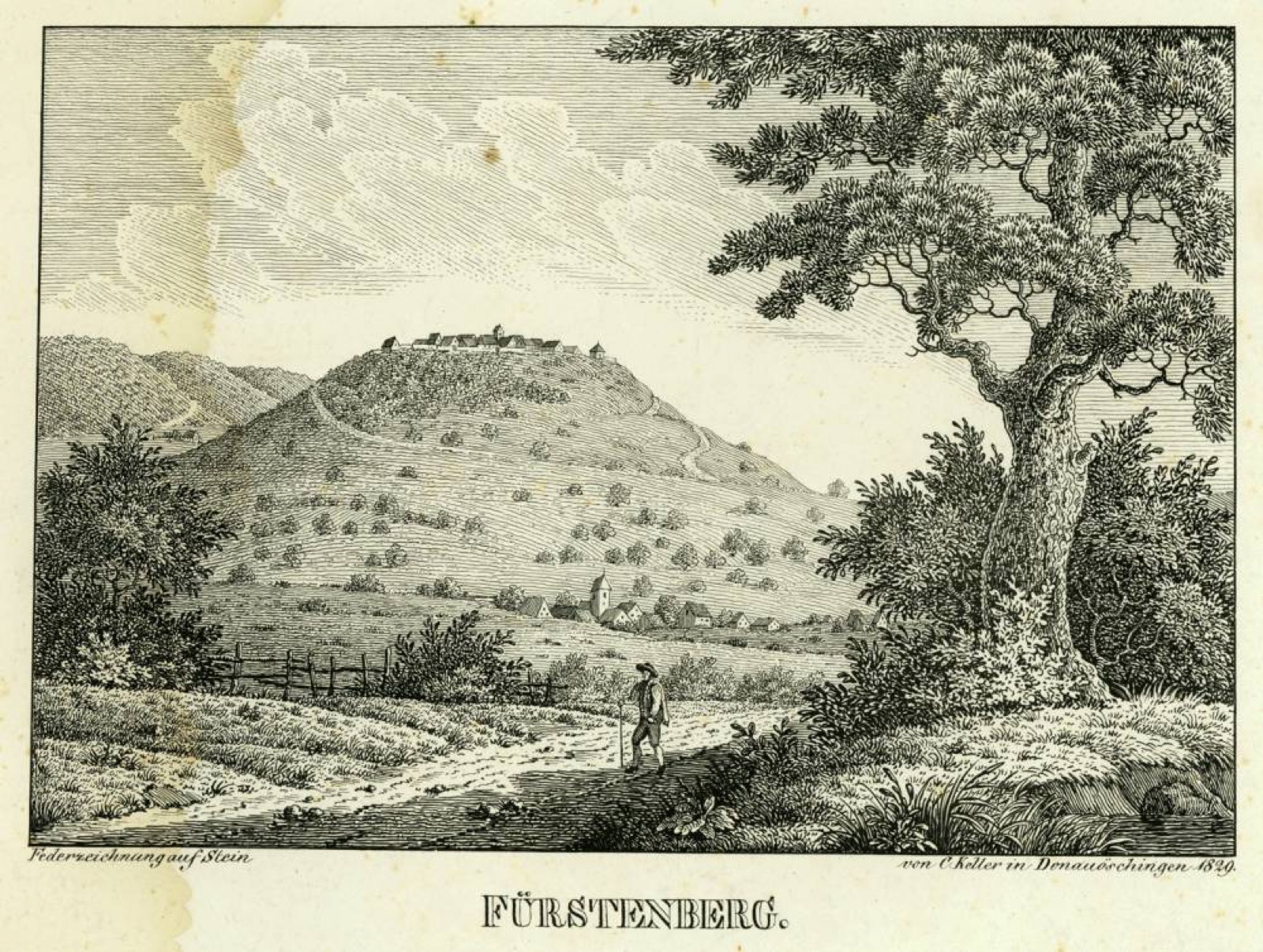
Fürstenberg, Fürstenberg Castle

Fürstenberg

· State Archives of Baden-Württemberg (via Europeana)

CC BY
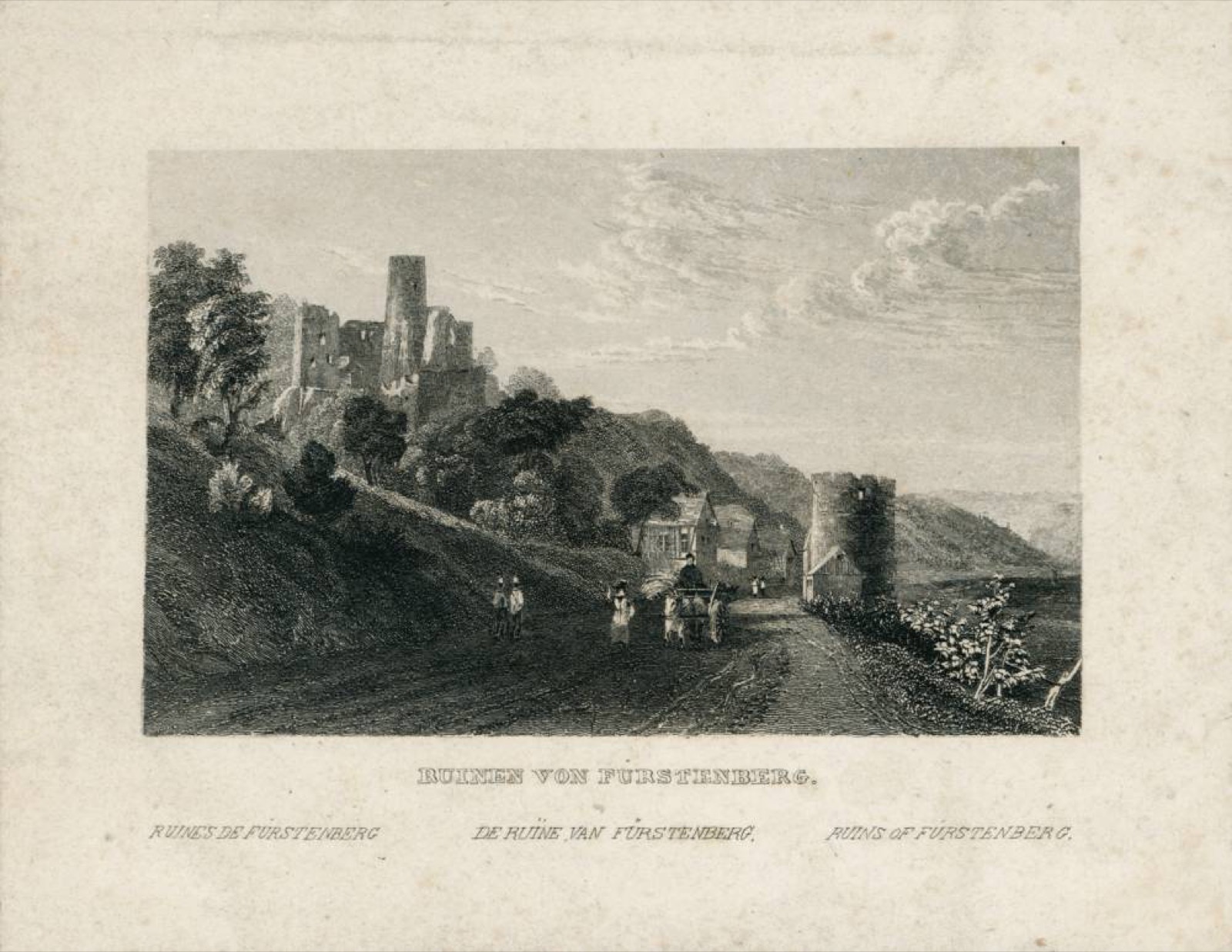
Ruinen von Fürstenberg. Ruines de Furstenberg. De Ruine van Fürstenberg. Ruins of Fürstenberg [bei Rheindiebac, Fürstenberg Castle

Ruinen von Fürstenberg. Ruines de Furstenberg. De Ruine van Fürstenberg. Ruins of Fürstenberg [bei Rheindiebac

· State Archives of Baden-Württemberg (via Europeana)

CC BY

Questions about Fürstenberg Castle

What is the history of Fürstenberg Castle?

Fürstenberg Castle was built in the 13th century to secure the archiepiscopal possessions in the Viertäler area between Manubach and Bacharach. A riverside watchtower helped enforce the payment of customs. The castle changed hands as a hereditary fief in 1243 and was later bought by the Electors Palatine in 1410; French forces destroyed it in 1689, after which it remained a ruin.

What is inside Fürstenberg Castle?

Inside Fürstenberg Castle, the main surviving spaces include the cylindrical keep, the remains of the three-storey palas and parts of the courtyard and curtain-wall defences. The keep is 26 metres high, has walls four metres thick and originally had its entrance 12 metres above ground. The palas retains wall sections up to the second storey, while the former ground floor of the keep served as a storeroom or dungeon.

Why was Fürstenberg Castle built, and what was it used for?

Fürstenberg Castle was built as a fortified stronghold to secure the archiepiscopal possessions in the Viertäler area between Manubach and Bacharach. Together with a watchtower on the Rhine, it also enforced the payment of customs. Its defensive role included a neck ditch, a shield wall, a drawbridge and fortified walls with a fighting gallery and crenellations.

Where is Fürstenberg Castle?

Fürstenberg Castle is above Rheindiebach, now a district of Oberdiebach, in Rhineland-Palatinate. It stands on a steep hillside at 152 metres above sea level in the Upper Middle Rhine Valley, near Bingen. The castle overlooks the Rhine and lies above vineyard-covered slopes.

When was Fürstenberg Castle built?

Fürstenberg Castle was built in 1219, in the 13th century. The castle was erected for Archbishop Engelbert I, and its surviving fabric includes medieval masonry from several building periods. A three-quarter tower was added around 1500 to allow firearms to flank the wall.

Was Fürstenberg Castle ever attacked or besieged?

Fürstenberg Castle was besieged by King Louis the Bavarian in 1321 and by Archbishop and Elector Balduin of Trier in 1325. During the Thirty Years’ War, Spanish troops under Ambrosio Spinola captured it in 1620, followed by Swedish troops under King Gustav Adolf in 1632. French forces finally destroyed the castle in 1689.

What did Fürstenberg Castle look like in its prime?

In its prime, Fürstenberg Castle formed a fortified silhouette on a steep, vineyard-covered hill above the Rhine. A tall cylindrical stone keep with a crenellated parapet dominated the complex, while curtain walls and shorter tower remnants stepped down the slope. The masonry was largely local grey-brown sandstone, with patched lighter render in places.

Is Fürstenberg Castle still standing, or is it a ruin?

Fürstenberg Castle is a partial ruin, with its tall cylindrical keep and fragments of the surrounding curtain walls still standing. French forces destroyed it in 1689, and it was not rebuilt in the 19th century. Original medieval masonry with surviving plaster and paint remains, and extensive conservation work began in 1993.

Who built Fürstenberg Castle?

Fürstenberg Castle was commissioned by Archbishop Engelbert I in 1219. The supplied material does not name an architect. It states that the castle was erected to secure the archiepiscopal possessions in the Viertäler area between Manubach and Bacharach.
All castles of Germany · Castles of Europe · the best castles in Europe · explore the finished reconstructions.