
Germany · Demolished
Pleissenburg
Pleißenburg
The Pleissenburg was a fortified castle and later citadel in Leipzig, originally founded in the 13th century and rebuilt as a triangular fortress under Hieronymus Lotter in 1549. It served various military, religious and civic functions over the centuries before being demolished around 1897; only the Lotter tower base and a courtyard oriel survive in the modern cityscape.
Its prime
1800
Today
Demolished
As it stood in 1800
What Pleissenburg looked like in its prime.
A triangular, peninsula fortress surrounded by a broad moat, with steep, sloped stone bastion walls at water level pierced by casemate openings. Above the masonry base rise timber-clad upper ranges with vertical boarding and red clay-tiled roofs of varying gables. A tall, multi-stage cylindrical tower with a conical/lantern roof (Lotter’s tower) dominates the complex. Wooden piers and simple timber bridges connect the fortress to the city walls; an inner courtyard contains a projecting oriel window.
Its story
The story of Pleissenburg.
The Pleissenburg was built in the 13th century by Theodoric I, Margrave of Meissen, and took its name from the Pleisse Mill Race running nearby. In 1549 it was rebuilt as a triangular fortress under Hieronymus Lotter, and served Leipzig over the centuries in military, religious and civic roles.
In the Thirty Years' War, Tilly's Catholic League army opened its attack on the Electorate of Saxony by capturing the Pleissenburg on 14 September 1631. From 1794 the Leipzig Observatory, built by the city's director of planning Johann Carl Friedrich Dauthe, stood atop the tower, visible from afar, and from 1838 to 1876 the western wing housed the Royal-Saxon Construction School founded by Albert Geutebrück. The fortress was demolished around 1897; only the base of Lotter's tower and a courtyard oriel survive in the modern cityscape.
Step inside
8 places to explore in 1800.
The record describes 8 distinct spots at Pleissenburg, including 2 interiors: castle chapel interior, casemates (former mint and vaults). Create your own photoreal reconstruction and explore every one, more scenes means more rooms, more angles, and more of the place to stand in.
Build Your Own Castle
Recreate Pleissenburg with AI to explore it.
The artist rebuilds it as it stood in 1800, a photoreal reconstruction that belongs to you alone. Pay with coins, no subscription needed.
Recreate this castle →Defend this castle →From the archive
Pleissenburg on paper: the measured plan and period views.
The survey plan and photographs below are the ground truth this page's reconstructions are checked against, drawn and photographed while the castle was still a working garrison. Every image is public-domain or openly licensed, with its source named.
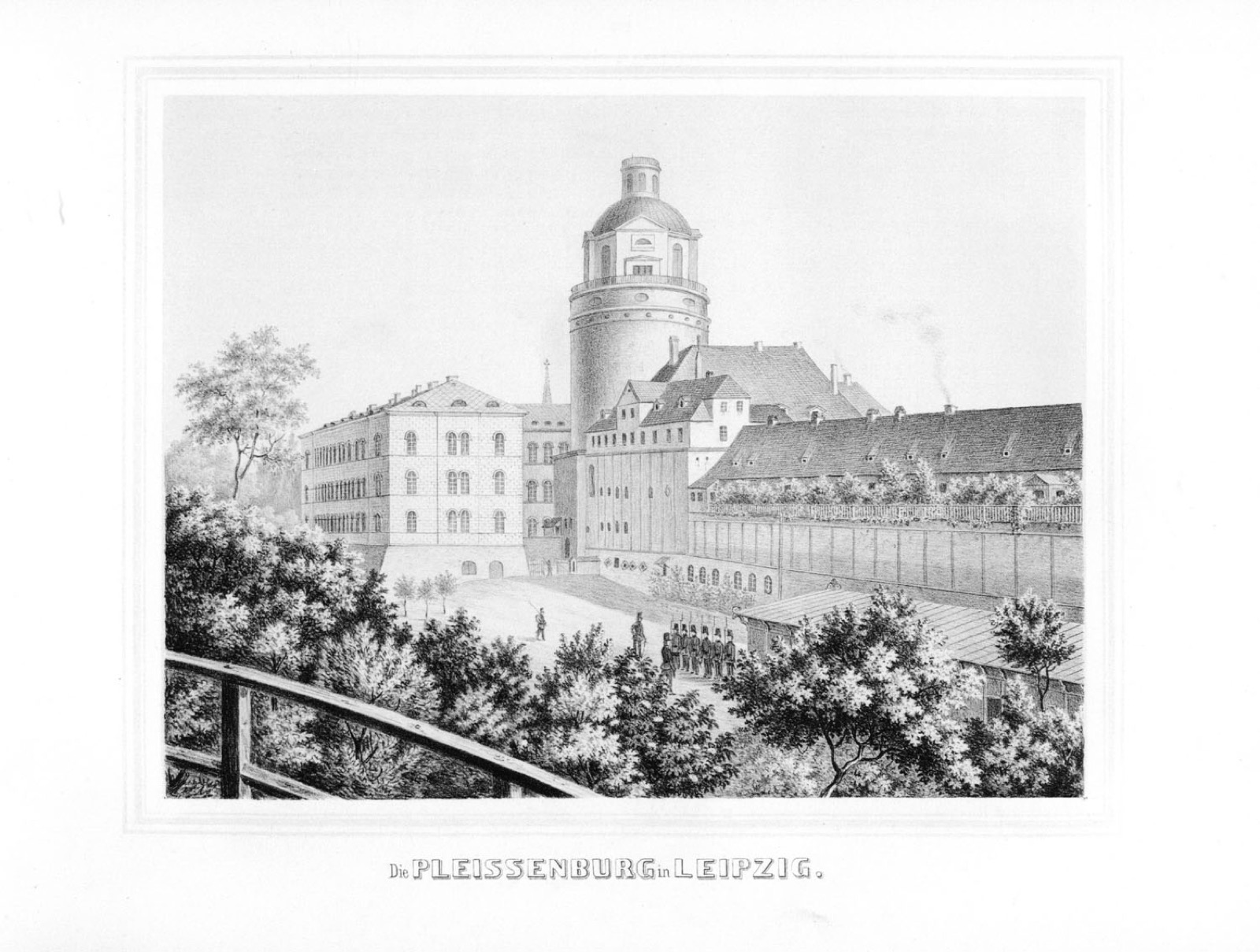
Die Pleissenburg
· Deutsche Fotothek (via Europeana)
Public domain
Nearby


