Clan Rising
Stettenfels Castle today

Germany · Restored

Stettenfels Castle

Burg Stettenfels

Stettenfels Castle is a medieval hilltop castle above the town of Untergruppenbach in Baden-Württemberg, Germany. Remodeled as a Renaissance residence under the Fuggers, it sits on a sandstone ridge surrounded by a broad moat and is used today for cultural events and public visits.

Photograph via Wikimedia Commons

First raised

1000

Its prime

1594

Today

Restored

As it stood in 1594

What Stettenfels Castle looked like in its prime.

Perched on a sandstone ridge, the castle presents a compact, elongated mass of pale sandstone walls topped by steep red-tiled roofs. Three round towers with conical tiled caps punctuate the curtain wall; a massive stone gatehouse is reached by a wide bridge spanning a broad water-filled moat. The castle encloses a pointed triangular courtyard dominated by a central fountain and ringed by multi-storey residential ranges with regular windows and ground-floor stone archways.

Its story

The story of Stettenfels Castle.

From 1356 Stettenfels was owned by Burkhard, Knight of Sturmfeder, and from 1462 to 1478 by the Lords of Helmstatt. Duke Ulrich of Württemberg's victory in the Landshut War of Succession made the castle a Württemberg fief in 1507 under Marshal Konrad Thumb of Neuburg, whose son Hans Konrad sold the fief in 1527 to Philip of Hirnheim, the Reformer of Gruppenbach.

In 1551 Anton Fugger, nephew of Jakob the Rich, acquired the castle grounds, and under the Fuggers, Hans Fugger among them, Stettenfels was remodelled as a Renaissance residence. Karl Eugen, Duke of Württemberg, acquired the site in 1747; the municipality of Gruppenbach followed in 1829, then a run of private owners from the tanner Friedrich Korn in 1852 to the farmer Christian Hildt in 1888, before which the site housed the state forestry office.

The castle sits on a sandstone ridge east of the historic town centre, ringed by a broad moat with three old towers. A massive bridge and gatehouse lead into a triangular courtyard dominated by a fountain and the historic staircase tower. Most of the buildings date back to the Renaissance castle; the moat is accessible and now holds a fixed stage, and the complex is used for cultural events and public visits.

Step inside

9 places to explore in 1594.

The record describes 9 distinct spots at Stettenfels Castle, including 1 interior: inside the staircase tower. Create your own photoreal reconstruction and explore every one, more scenes means more rooms, more angles, and more of the place to stand in.

Approach up the sandstone ridgeBridge and gatehouseMoat edge and waterTriangular courtyard with fountainResidential façade and ground-floor arcadesInside the staircase towerRooftop view from a round towerOld bailey areaFarm buildings east of the castle

Build Your Own Castle

Recreate Stettenfels Castle with AI to explore it.

The artist rebuilds it as it stood in 1594, a photoreal reconstruction that belongs to you alone. Pay with coins, no subscription needed.

Recreate this castle →

Castle Siege

Play Castle Siege at Stettenfels Castle.

A strategy game played on Stettenfels Castle’s real ground plan: the same surveyed walls shown in the archive below. Post your finite garrison on the battlements between assaults, then hold out as rams, siege towers, trebuchets and sappers arrive in ever-worse waves.

Sign in free to see the garrison muster. One castle costs 150 Clan Coins and is yours forever.

Sign in to take command →

See every castle’s leaderboard →

Whose castle

Clans who held Stettenfels Castle.

The families that held Stettenfels Castle for a decade or more across its history, follow a name to its clan.

  • Sturmfeder

    Owned from 1356 by Burkhard, Knight of Sturmfeder.

  • Helmstatt

    Held by the Lords of Helmstatt, 1462–1478.

  • Thumb of Neuburg

    Held as a Württemberg fief by Marshal Konrad Thumb of Neuburg from 1507 until his son sold it in 1527.

  • Hirnheim

    Held by Philip of Hirnheim, the Reformer of Gruppenbach, from 1527.

  • Fugger

    Acquired by Anton Fugger in 1551; the Fuggers remodelled Stettenfels as a Renaissance residence.

From the archive

Stettenfels Castle on paper: the measured plan and period views.

The survey plan and photographs below are the ground truth this page's reconstructions are checked against, drawn and photographed while the castle was still a working garrison. Every image is public-domain or openly licensed, with its source named.
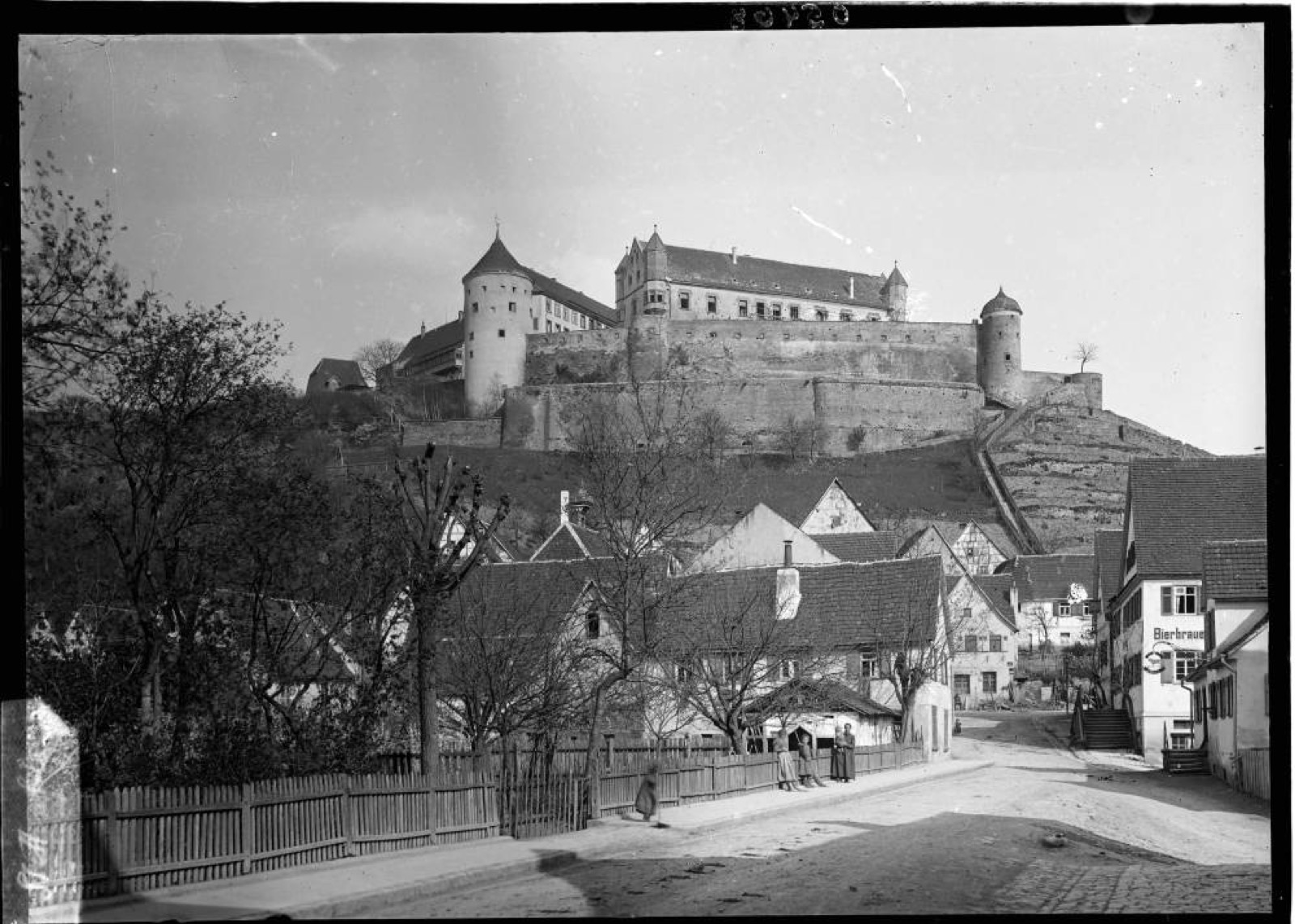
Stettenfels Ortsbild im Hintergrund die Burg Stettenfels, Stettenfels Castle

Stettenfels Ortsbild im Hintergrund die Burg Stettenfels

· State Archives of Baden-Württemberg (via Europeana)

CC BY

Nearby

Landmarks within reach of Stettenfels Castle.

Questions about Stettenfels Castle

What is the history of Stettenfels Castle?

Stettenfels Castle was built in the 11th century as a medieval hilltop castle. From 1356 it belonged to Burkhard, Knight of Sturmfeder, and it became a Württemberg fief after the 1504 Landshut War of Succession. Anton Fugger acquired it in 1551, and Hans Fugger had it remodelled as a Renaissance residence in 1576. It burnt down in 1594 and was rebuilt.

What is inside Stettenfels Castle / what can you see in it?

Inside Stettenfels Castle, the historic staircase tower is a notable feature, and the castle encloses a triangular courtyard with a fountain. Residential buildings surround the courtyard, with ground-floor archways that are now largely walled. Most of the buildings date from the Renaissance castle, while the staircase tower has undergone later rebuilding.

Where is Stettenfels Castle?

Stettenfels Castle is in Untergruppenbach, above the town in Baden-Württemberg. It stands east of the historic town centre on a sandstone ridge. The castle is in the Heilbronn area and is surrounded by a broad moat.

When was Stettenfels Castle built?

Stettenfels Castle was first raised around 1000, placing its origins in the 11th century. The site record gives the first-raised year as 1000, while the historical description dates construction to the 11th century. Its present complex developed in later phases, including the Renaissance remodelling under the Fuggers.

Was Stettenfels Castle ever attacked or besieged?

Stettenfels Castle was captured by Württemberg forces in 1504 during the Landshut War of Succession. The victory of Duke Ulrich brought the castle into Württemberg possession, and it became a Württemberg fief in 1507 under Marshal Konrad Thumb of Neuburg. The supplied history does not state whether the castle resisted or describe a siege.

Which family or clan held Stettenfels Castle?

Stettenfels Castle was held by several families and noble houses. Burkhard, Knight of Sturmfeder, owned it from 1356; the Lords of Helmstatt held it from 1462 to 1478; and the Thumb of Neuburg held it as a Württemberg fief from 1507 until its sale in 1527. Philip of Hirnheim then held it, followed by Anton Fugger and the Fuggers from 1551.

What did Stettenfels Castle look like in its prime?

At its prime, Stettenfels Castle presented a compact, elongated mass of pale sandstone walls beneath steep red-tiled roofs. Three round towers with conical tiled caps punctuated the curtain wall, while a stone gatehouse stood beyond a broad water-filled moat. Inside, residential ranges enclosed a pointed triangular courtyard with a central fountain.

Is Stettenfels Castle still standing or is it a ruin?

Stettenfels Castle is still standing and is described as restored rather than ruined. It burnt down in 1594 but was rebuilt by Wendel Dietrich, and the buildings were repeatedly renovated in the 18th, 19th and 20th centuries. Most of the buildings date from the Renaissance castle, although the staircase tower has been rebuilt more recently.

Can you visit Stettenfels Castle?

Stettenfels Castle is open to the public. It is used for cultural events, including concerts, theatre performances and a medieval festival, and the grounds include a permanent beer garden. Private owners also rent parts of the castle complex for events such as receptions.
All castles of Germany · Castles of Europe · the best castles in Europe · explore the finished reconstructions.