
Germany · Restored
Schloss Muskau
Schloss Muskau (Neues Schloss) is a 19th-century Neo‑Renaissance schloss in Bad Muskau, Saxony, set at the centre of the extensive English landscape Muskau Park. The New Palace was largely the work of Prince Hermann von Pückler-Muskau and served as the compositional centre of the park; it burned in 1945 and was reconstructed in the early 21st century.
Its prime
1845
Today
Restored
As it stood in 1845
What Schloss Muskau looked like in its prime.
A symmetrical, three‑storey red-painted main block with pale cream stone dressings and steep red-tile roofs; the roofline is broken by steep stepped gables, ornate pinnacles and rectangular chimneys. The entrance front has a raised, balustraded stone terrace with broad central steps and a central stone portico. A tall domed corner tower with a layered lantern rises at the left end, smaller turrets punctuate the corners, and the palace sits before a wide, manicured lawn within an English landscape park.
Its story
The story of Schloss Muskau.
The Neisse Toll and the Veste Muskau, 1245–1551
Two important trade roads crossed at Muskau on the Lusatian Neisse, and the earliest fortifications on the site served to secure them and the toll station at the river crossing. The fortified place is first mentioned in 1245; on present understanding it was a moated castle dominated by a tower. Restoration work on the New Palace from 1996 exposed its nucleus in the cellar of the south wing: the foundation of a castle tower of at least three solid storeys, a palas some 16.50 metres long set against it to the west and, east of the tower, a bridge house through which the castle could be left southwards towards the Neisse ford. A firm date cannot be given without further excavation, though the tower is thought to reach back into the 13th century.
Little secure documentary material survives for the earliest holders. Around 1253 Margrave Henry the Illustrious of Meissen is recorded as owner of the toll at Muskau, though whether the Meissen line held the castle itself or had granted it out cannot be answered; nor is it certain that the brothers Berold and Thidricus de Muschov, named in charters of Duke Boleslaw of Silesia, were lords here, although the witness lists of the charters of 1249 and 1251 make a Lusatian connection more likely than not. The first unambiguously attested owner is Bodo von Ileburg, who held the castle from about 1316 to 1361. In that year he made over the Veste Muskau to Heinrich von Kittlitz as a bridal gift, and the enfeoffment charter granted by the Emperor Charles IV gave the place the predicate Veste, one of the sovereign designations that only a few Upper Lusatian fortifications were entitled to carry. By 1365 Kittlitz no longer held the castle on the Neisse. Heinrich von Penzig came into possession of it in 1366, and his family kept castle and lordship until 1444; the extensive lands the Penzigs bought in the Muskau heath probably made further building necessary in those years, and by the late 14th century farm buildings and quarters for the burgmen stood north of the main castle.
With Wenzel von Bieberstein the lordship passed in 1447 to a significant Bohemian house. By the middle of the 15th century the castle had grown into a widely extended defensive work in two parts, an outer bailey lying south of the main castle, both secured by a system of ditches. Its builders used the ground: the marshy Neisse lowland covered the approach from south, east and north, so that only a tower-like bastion was needed at the northern outbuildings, while towards the western terraces stood an armed ring wall with a defensive tower to the south-west and a fortified bridge house at the outer bailey. The town-facing gatehouse survives as the building later called the Old Palace. A north tower was set into the western ring wall after Bieberstein granted Muskau town rights in 1452, a grant that also put the building of the town's own defences in hand. Ulrich V von Bieberstein had the first palace-like alterations made between 1520 and 1530, and when Christoph von Bieberstein died childless in 1551 Muskau reverted to the King of Bohemia as a lapsed fief.
The Fire of 1586, the War and the Callenberg Palace, 1558–1798
From 1558 to 1589 the lordship was held by the Schoenaich family, and Fabian von Schoenaich began the building of a comprehensive palace. A fire in 1586 destroyed large parts of the castle and forced a thorough renewal, and the rebuilding changed the character of the place: the military and social conditions of the early modern period no longer called for a defensible castle, while the rising absolutism of the age wanted a building fit for display. The first description of the result comes in the urbarium drawn up for the Emperor Rudolf II in 1590/93, where a valuation of 5,000 talers shows a considerable structure. The buildings of the outer bailey took on step by step the function of a home farm.
In 1597 Rudolf II sold the lordship to Wilhelm zu Dohna, and with the sale Muskau became allodial property rather than a fief. Under the Dohnas the west wing was joined to the northern building, producing a first three-wing complex of which no picture or description has come down. In 1643 the Thirty Years' War brought destruction to the palace, and the following year the marriage of the heiress Katharina von Dohna carried Muskau to the family von Callenberg, which held palace and lordship for four generations until 1798. Curt Reinicke I von Callenberg rebuilt it between 1646 and 1653 as a Baroque three-wing range; because the old foundations were reused, the north wing does not sit square with the rest and the two side wings are of unequal width.
Callenberg was at the same time Landvogt of Upper Lusatia and responsible for the restoration of the Ortenburg at Bautzen, and it is supposed that the Italian stuccoists working there, Julio Vineti and Johann Comotan, were also employed at Muskau; the knights' hall, recently reconstructed from photographs, would be theirs. The family went on building: a garden palace, later called the Kavaliershaus, went up, and the disused defensive gatehouse facing the town was converted into an administrative house. Curt Reinicke II von Callenberg, lord from 1672 to 1709, had a second drawbridge thrown eastwards after 1672 to connect the palace directly with the Baroque garden, which made it necessary to raise the inner courtyard to first-floor level. A lithograph of 1742 records the state the family left.
Pückler's Park and the Debts of 1845, 1798–1846
The Pückler family held the lordship and the palace buildings from 1798 to 1845. From 1815 Prince Hermann von Pückler-Muskau (1785–1871) laid out the landscape park at his own behest, the largest and one of the best known English landscape gardens in central Europe, running along both banks of the Lusatian Neisse and lying today on both sides of the German-Polish border that follows the river. Paths radiated from the palace, which he intended as the compositional centre of the whole; the pleasure ground drew on the ideas of Humphry Repton, whose son John Adey Repton worked at Muskau from 1822.
Pückler's mark on the buildings was made largely by demolition. From 1817 the old fortress walls, defence works and drawbridges came down; from 1824 the moats around the palace were filled in, and the stables and the farm buildings of the outer bailey were pulled down in the same year. The orangery was twice taken down and rebuilt elsewhere because its position did not suit the design of the park, and a new one to a design by Ludwig Persius was begun in 1844. In clearing away the fortifications he brought the old fortified palace to an end and made the present building possible.
He also planned an elaborate modernisation by Karl Friedrich Schinkel, with wide bridges linking the New Palace, the Old Palace and the theatre in the Kavaliershaus into a range more than 300 metres long. The plates of his Andeutungen über Landschaftsgärtnerei of 1834 show it as though built, but the cost defeated it, and of the whole scheme only the great palace ramp was carried out, between 1825 and 1827. The park was still being extended in 1845, when his enormous debts forced him to sell the patrimony. Prince Frederick of the Netherlands acquired it the following year and engaged Eduard Petzold, Pückler's pupil and a landscape gardener of standing, to complete the design.
Prince Frederick and the Arnims, 1846–1934
Prince Frederick gave the New Palace the form it carries today. Between 1863 and 1866 the architects Maximilian Franz Strasser and Hermann Wentzel rebuilt it for him in Neo-Renaissance style, and the Old Palace and the Kavaliershaus were brought into the same idiom, realising Pückler's idea that the three buildings governing the park should read as one. In 1857 two lions, the heraldic beast of the Dutch prince, were set on the cheeks of the palace ramp to a design by the Berlin sculptor Albert Wolff; and in 1863 sandstone figures of earlier lords of Muskau, among them Fabian von Schoenaich, Carl Christoph von Dohna and Curt Reinicke II von Callenberg, were placed in the niches above the Old Palace door. Frederick died in 1881, and in 1883 his daughter Marie, Princess of the Netherlands and Princess of Wied, sold the lordship to Count Traugott Hermann von Arnim.
The Arnims held Muskau until 1945. Under them a mausoleum was built east of the Neisse in 1888 by Julius Carl Raschdorff, the home farm complex was completed in 1901/1902 and a riding hall went up beside it in 1922/1923. After the death of Count Hermann von Arnim the interiors were remodelled between 1919 and 1925 by the Berlin practice of Alfred Breslauer and Paul Salinger. Some of the family's decisions answered to business rather than to conservation, among them the demolition of Pückler's glasshouses to clear ground for a paper factory in the park and the awkwardly attached ballroom and kitchen wing put on the north side of the New Palace in 1934; in the same year Count Hermann von Arnim-Muskau converted the Kavaliershaus into a widow's seat for his mother Sophie von Arnim. Of the Neo-Renaissance dress given to the Old Palace and the Kavaliershaus nothing now survives, the Arnim works of about 1934 and the reconstruction after the Second World War between them having removed it.
The Burning of 1945 and the Long Reconstruction, since 1945
From February 1945 a German defensive line ran through the park, and the fighting on 16 April, when the Red Army took Muskau, did heavy damage to the buildings and to the trees. The estate was expropriated that year and the palace buildings became the property of the town of Muskau. At the end of May 1945 Soviet soldiers carried the furnishings of the New Palace out of doors; soldiers and townspeople joined in the looting that followed, and a Leipzig art dealer named Wieland, apparently authorised to do so, took valuable works away by lorry. Soviet soldiers then burned the New Palace down. The mausoleum east of the Neisse was destroyed in the war and its ruin taken away, and the sandstone figures from the Old Palace were badly damaged; parts of them stand today in the New Palace staircase. The Kavaliershaus was one of the few buildings in the park to come through without war damage, and served as the hospital from 1946 to 1949 before being handed over on 12 May 1950 to the moor bath of Bad Muskau.
Two phases can be told apart in what followed. Until 1989 the palace buildings were turned to use as recreation and health facilities: the moor bath opened in the Kavaliershaus in 1950, the palace nursery reopened with a tropical show house in 1959, and the front of the orangery was restored in 1971 to take the park administration. The burnt shell of the New Palace, by then no more than outer walls and a few ground-floor vaults, was cleared of rubble in 1950; studies and projects for rebuilding it were put forward from the 1960s but none was carried out before the end of the German Democratic Republic. The park was placed under monument protection in 1955, yet a long argument over cultural policy meant that reconstruction of the Old Palace began only in 1965, and it was taken back to its older Baroque state rather than to the refinements of Prince Frederick's time; new figures for the niches above its door, carved by the Dresden sculptor Werner Hempel, were installed in 1974.
From 1989 the work was directed at restoring the buildings as part of Pückler's park. Urgent measures to secure the ruin of the New Palace were taken in 1990; on 1 January 1992 park and palace passed to the Free State of Saxony, which placed the properties in the foundation Fürst-Pückler-Park Bad Muskau, set up in 1993, so that money and administration could be concentrated on them. The orangery was restored in 1994, the home farm buildings between 1995 and 2004 and the palace ramp in 2004/05; new lions, paid for by donation, returned to the ramp in 2009 and 2010. The targeted restoration of the New Palace began in 1995 and was completed in 2013. The park has been a UNESCO World Heritage Site since 2 July 2004, and the palace is a protected monument. The Old Palace holds the town museum and the register office; the New Palace carries the foundation's visitor information, the permanent exhibition on the park's creator and a training school for young park gardeners, and its south-west tower is open to be climbed for the view over the park.
Step inside
8 places to explore in 1845.
The record describes 8 distinct spots at Schloss Muskau, including the full exterior approach. Create your own photoreal reconstruction and explore every one, more scenes means more rooms, more angles, and more of the place to stand in.
Build Your Own Castle
Recreate Schloss Muskau with AI to explore it.
The artist rebuilds it as it stood in 1845, a photoreal reconstruction that belongs to you alone. Pay with coins, no subscription needed.
Recreate this castle →Defend this castle →Whose castle
Clans who held Schloss Muskau.
The families that held Schloss Muskau for a decade or more across its history, follow a name to its clan.
Pückler-Muskau
The Neues Schloss and its landscape park were largely the work of Prince Hermann von Pückler-Muskau.
Arnim
Bought by the Count von Arnim from Princess Marie of the Netherlands, who had inherited Muskau on Prince Frederick's death in 1881.
From the archive
Schloss Muskau on paper: the measured plan and period views.
The survey plan and photographs below are the ground truth this page's reconstructions are checked against, drawn and photographed while the castle was still a working garrison. Every image is public-domain or openly licensed, with its source named.
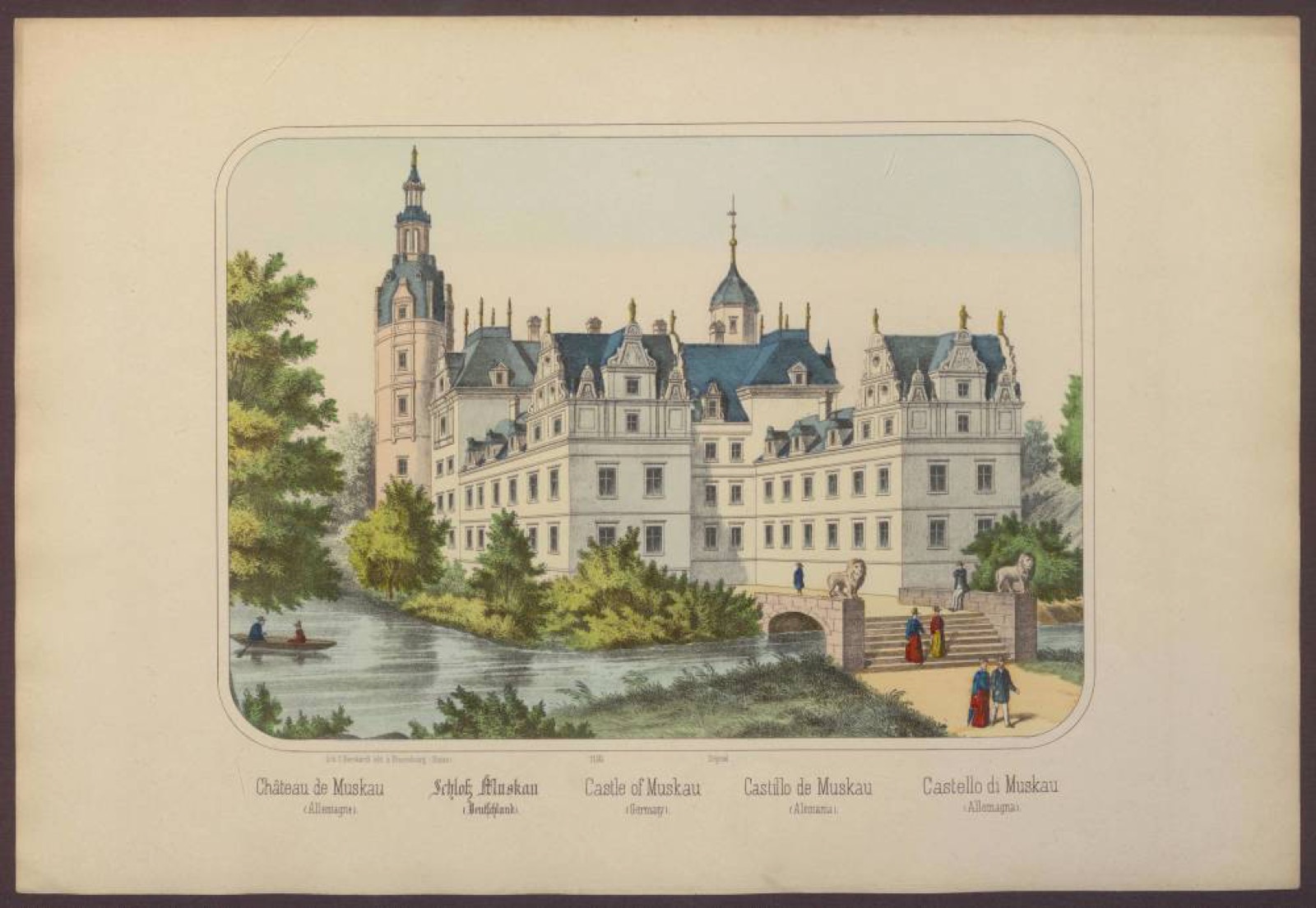
Schloss Muskau (Deutschland)
· State Archives of Baden-Württemberg (via Europeana)
CC BY
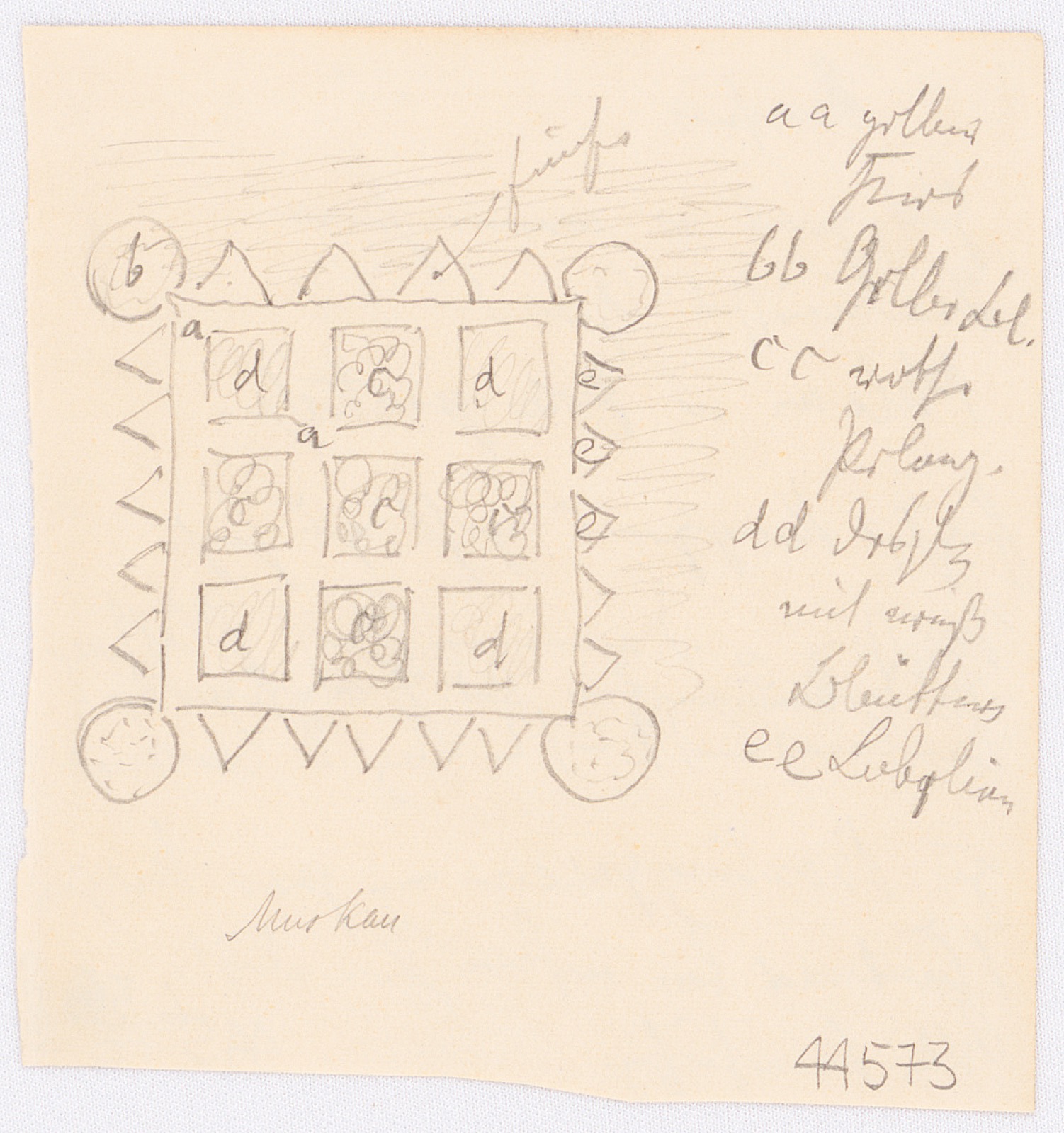
Gartengestaltung Schloss Muskau: Grundriss Beetanlagen mit Pflanzplan
· Museum of Architecture at Berlin Institute of Technology (via Europeana)
CC0 (no rights reserved)
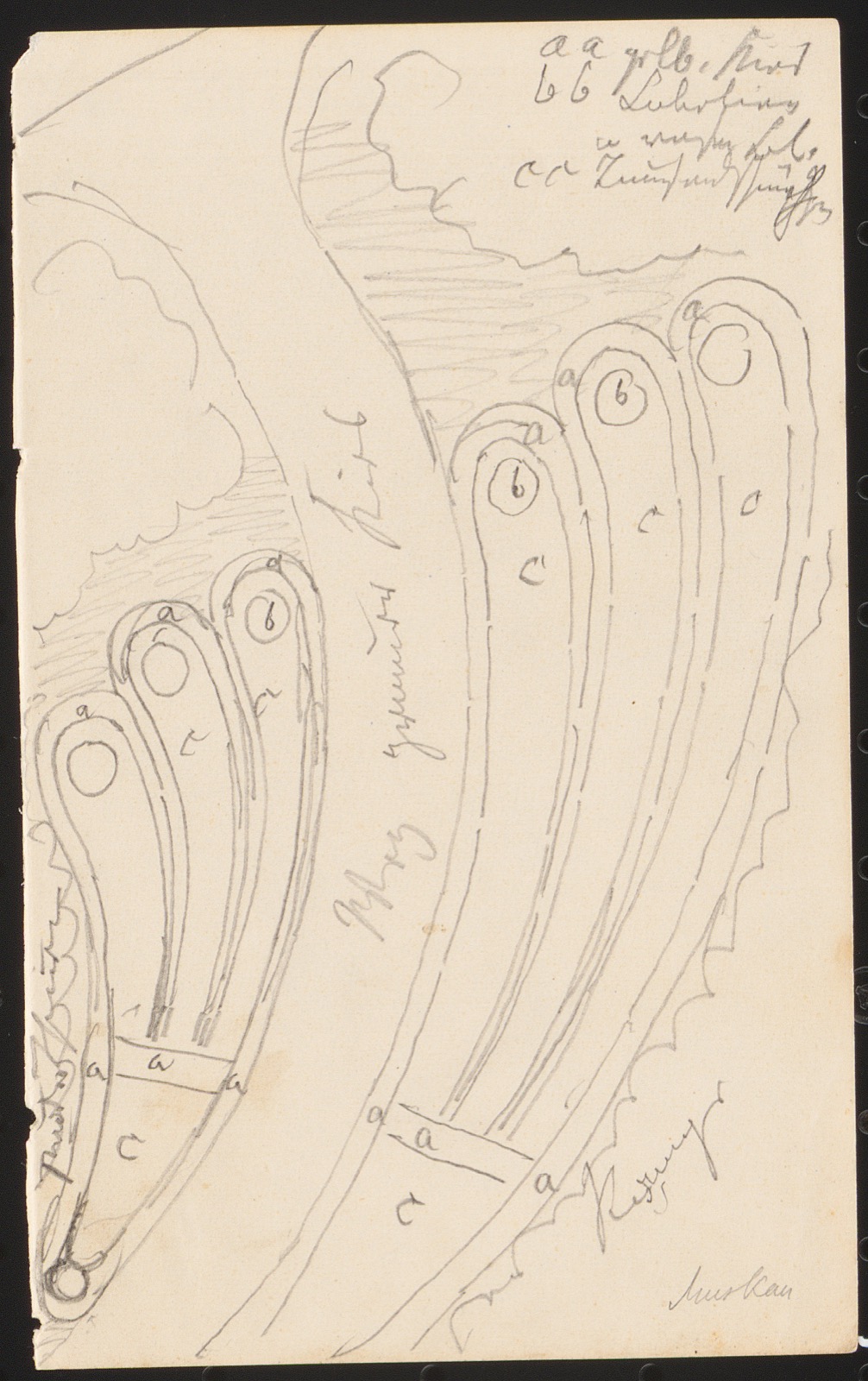
Gartengestaltung Schloss Muskau: Grundriss Beetanlagen mit Pflanzplan
· Museum of Architecture at Berlin Institute of Technology (via Europeana)
CC0 (no rights reserved)


