
Germany · Restored
Wartburg
Wartburg is a medieval hilltop castle near Eisenach in Thuringia, Germany, notable for its largely Romanesque palas and long defensive walls. It preserves substantial 12th–15th century fabric alongside later restorations and today functions as a museum and cultural monument.
First raised
1067
Its prime
1207
Today
Restored
As it stood in 1207
What Wartburg looked like in its prime.
Perched on a southwest-facing precipice above Eisenach, Wartburg presents a long, continuous curtain wall with a timbered covered gallery, a large rectangular palas block of warm-brown quarried stone and steep red-tiled roofs, and a tall square bergfried (keep) with crenellated parapet and flag. A prominent gatehouse with drawbridge and barbican provides the only approach; the complex clusters palas, towers and half-timbered service buildings along the cliff edge, all complete and roofed in the prime appearance.
Its story
The story of Wartburg.
Louis the Springer's Carted Earth, from about 1067
Louis the Springer, count of Schauenburg, laid the Wartburg's foundation about 1067 on a precipice above Eisenach and the Hörsel valley. The summit was not quite his, and the founding legend supplies the remedy: earth carted up from his own lands and spread on the rock, so that his knights could drive their swords into it and swear the blades stood in Louis's own ground.
The castle first appears in writing in 1080, as Wartberg, in Bruno of Merseburg's account of the Saxon War. Louis's men had attacked a contingent of King Henry IV during the Investiture Controversy, and in 1113 he was held at Dortmund for joining a rising against Henry V, buying his freedom by surrendering the Wartburg to the emperor. In 1131 his son Ludwig I was raised to landgrave of Thuringia by King Lothair.
The Palas and the Invented Sängerkrieg
Ludwig II, landgrave from 1140 to 1172, was the great builder of the line. The Palas raised under him in the second half of the twelfth century is reckoned the best-preserved non-ecclesiastical Romanesque building north of the Alps.
From 1172 to 1211 the Wartburg was among the most important princely courts in the German Reich. Hermann I, landgrave from 1190 to 1216, spent freely on poets: Walther von der Vogelweide came, and Wolfram von Eschenbach wrote part of Parzival here in 1203. Out of that literary court the Sängerkrieg was later built, a minstrels' contest supposedly held in 1206 or 1207 and in truth a fiction, assembled from the surviving literature by Dietrich von Apolda after 1298 and by the Eisenach chronicler Johannes Rothe. Wagner took the legend for Tannhäuser.
Elisabeth of Hungary and the Last Ludowinger
Elisabeth, daughter of the king of Hungary, was sent to the Wartburg at four to be raised as consort to Landgrave Ludwig IV, and married him in 1221. When he died on crusade in 1227 she gave herself to poverty and the care of the poor and sick; in 1228 she left for Marburg with her confessor Konrad, died there in 1231 at twenty-four, and was canonised five years later.
Heinrich Raspe IV, the last Ludowinger, ruled from 1227 to 1247 and made the Wartburg his sole residence. Anti-king to Frederick II, he died childless there in February 1247, and the Thuringian–Hessian war of succession followed; the landgraviate passed to his nephew Henry III of Meissen. It remained the seat of the Thuringian landgraves until 1440.
Junker Jörg and the Prisoner in the South Tower
The Diet of Worms outlawed Luther in 1521 and banned his writings across the Empire. On the evening of 4 May, riding home, he was seized near Schloss Altenstein by men of Frederick the Wise in a staged capture and brought to the Wartburg for his safety. He stayed until 1 March 1522 under the name Junker Jörg, in a small room meant as a gentleman's prison, and there translated the New Testament from Greek into German: not the first German Bible, but the one that circulated most widely.
In 1540 Fritz Erbe, an Anabaptist farmer from Herda, was shut in a cellar dungeon beneath the South Tower, reached only through a hole in the floor above. He would not abjure, and died there in 1548; clearing work in 1925 uncovered his name, scratched into the rock by his own hand. The castle slid into disuse thereafter, worst after the Thirty Years' War, through which it had sheltered the ruling family of Saxe-Weimar.
The Festival of 1817 and Karl Alexander's Rebuilding
On 18 October 1817 some 500 students of the new Burschenschaften met at the Wartburg to mark the third centenary of the Reformation and the fourth anniversary of the victory over Napoleon, under the motto "Honour, Freedom, Fatherland", calling for a united Germany with a constitution of its own. Books were burned in effigy, scraps of parchment bearing their titles going on the fire in place of the volumes themselves. Karl Ludwig Sand, who murdered the writer August von Kotzebue two years later, was in the crowd; a second festival followed in 1848.
Grand Duke Karl Alexander of Saxe-Weimar-Eisenach ordered the reconstruction in 1838 and had the castle rebuilt as a national monument in neo-Romanesque style. Hugo von Ritgen led what became his life's work, finished in 1890, the year after he died; none of the wall paintings are medieval.
The dynasty fell with the revolution of 1918, and the Wartburg Stiftung was founded in 1922 to maintain the castle. The armoury's roughly 800 pieces, including armour of Henry II of France, were taken by Soviet occupation forces in 1946; a few came back from the USSR in the 1960s and the rest have never been traced. The GDR rebuilt extensively in 1952–54 and marked the castle's 900th anniversary in 1967. UNESCO listed the Wartburg in 1999.
Step inside
12 places to explore in 1207.
The record describes 12 distinct spots at Wartburg, including 7 interiors: rittersaal (knight's hall), speisesaal (banquet hall), sängersaal (minstrels' hall) and more. Create your own photoreal reconstruction and explore every one, more scenes means more rooms, more angles, and more of the place to stand in.
Build Your Own Castle
Recreate Wartburg with AI to explore it.
The artist rebuilds it as it stood in 1207, a photoreal reconstruction that belongs to you alone. Pay with coins, no subscription needed.
Recreate this castle →Defend this castle →Whose castle
Clans who held Wartburg.
The families that held Wartburg for a decade or more across its history, follow a name to its clan.
Saxe-Weimar-Eisenach
Refuge of the ruling family of Saxe-Weimar after the Thirty Years' War; under the House of Saxe-Weimar-Eisenach, Grand Duke Karl Alexander ordered the castle's reconstruction in 1838.
From the archive
Wartburg on paper: the measured plan and period views.
The survey plan and photographs below are the ground truth this page's reconstructions are checked against, drawn and photographed while the castle was still a working garrison. Every image is public-domain or openly licensed, with its source named.
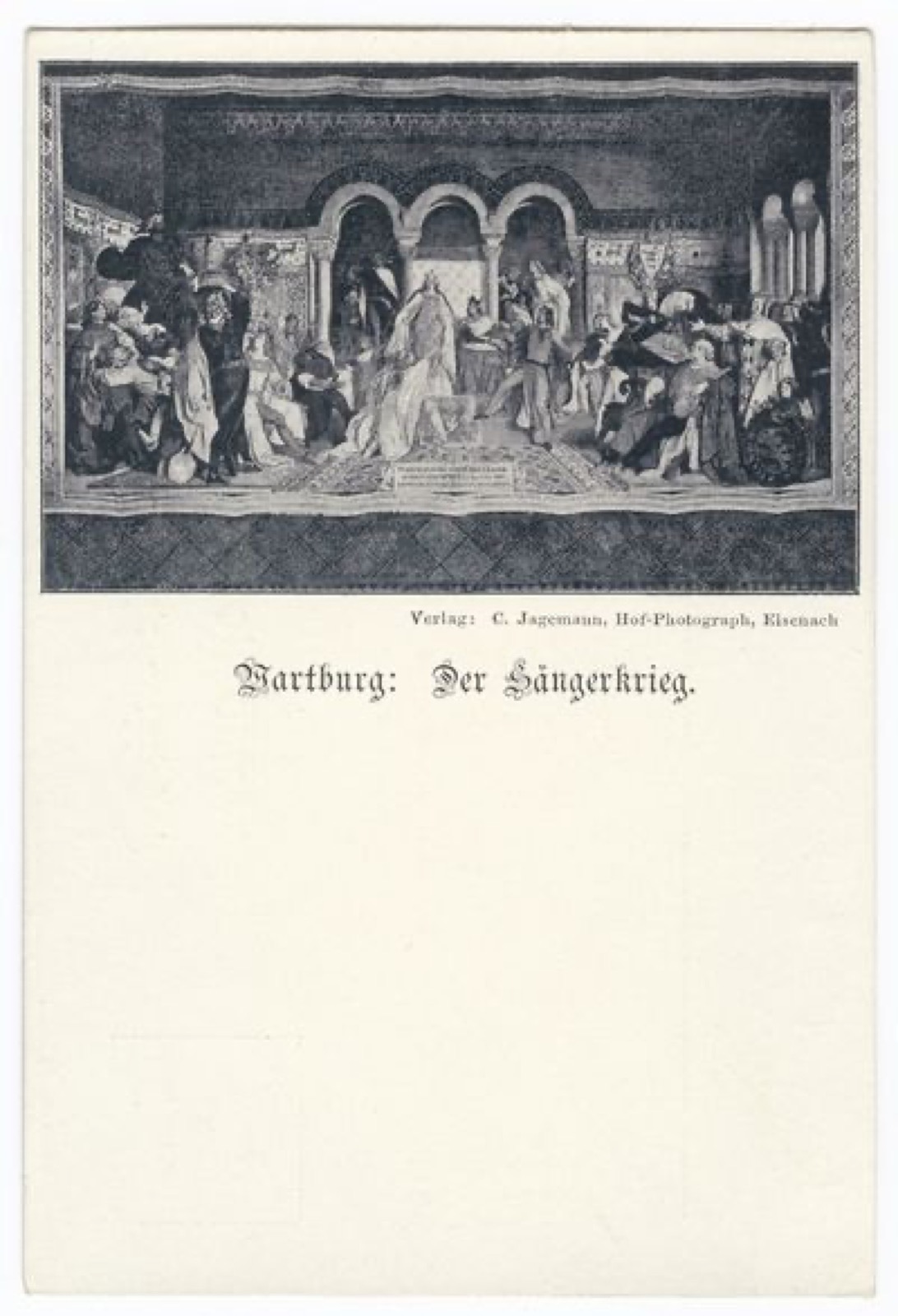
Wartburg
1895 · Kassel University Library (via Europeana)
CC BY-SA
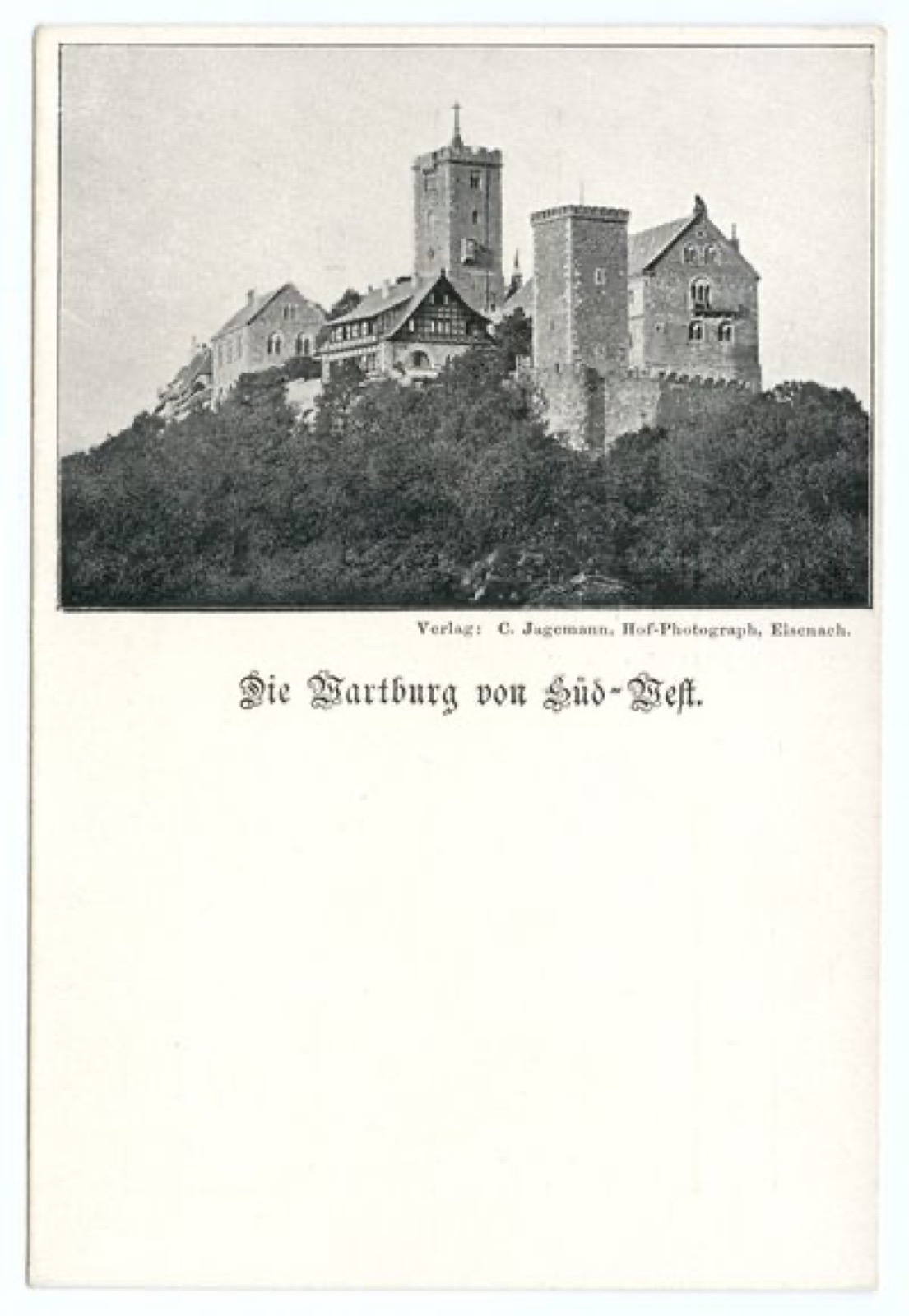
Wartburg
1895 · Kassel University Library (via Europeana)
CC BY-SA
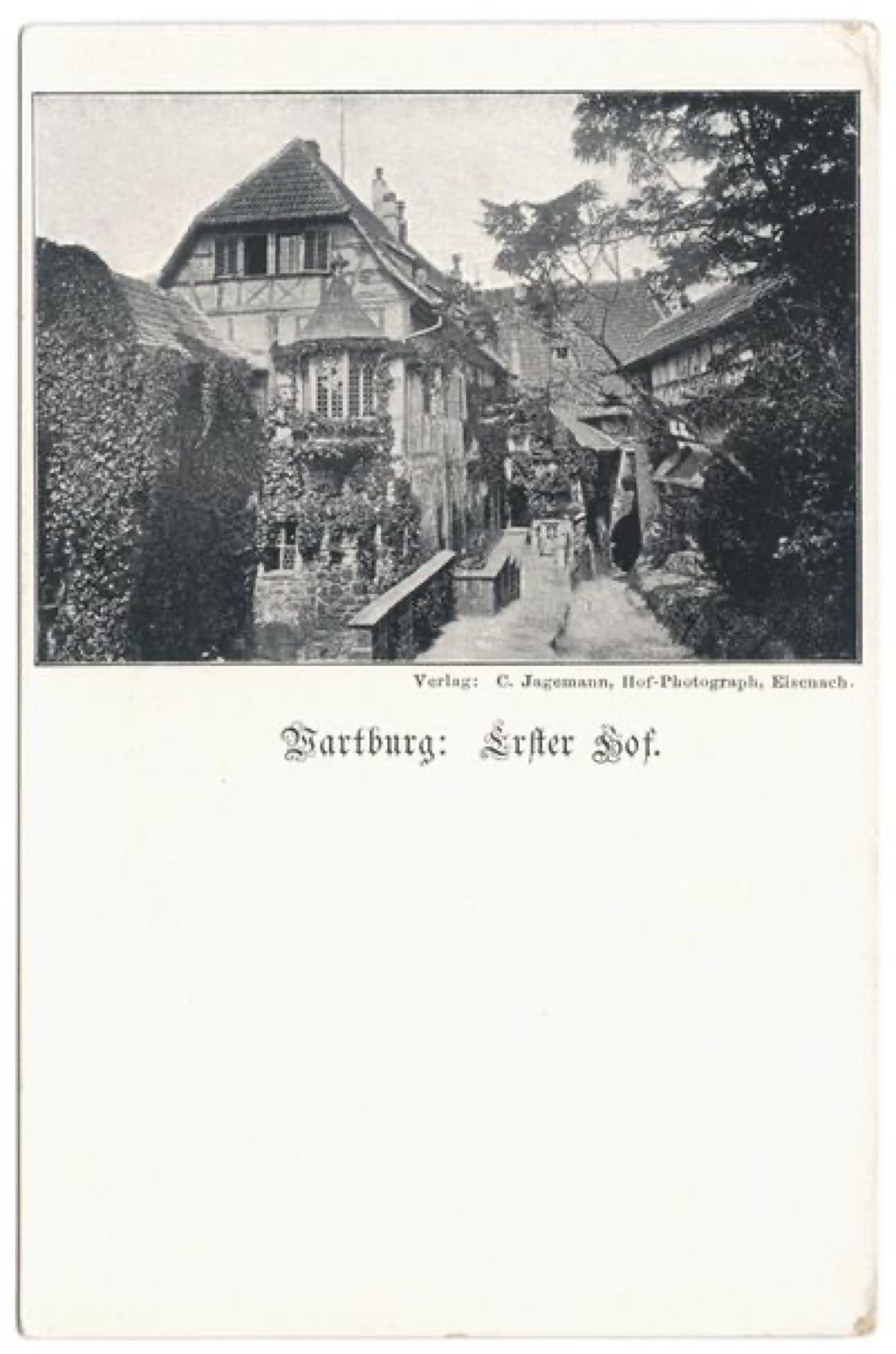
Wartburg
1895 · Kassel University Library (via Europeana)
CC BY-SA


