
Germany · Still standing
Königstein Fortress
Festung Königstein
Königstein Fortress is a large hilltop fortress on a 9.5-hectare table hill above the left bank of the River Elbe in Saxony, Germany. The site comprises over fifty buildings, extensive high sandstone curtain walls and bastions, and was long used as a state prison, arsenal and secure refuge; today it survives intact as a museum complex.
Its prime
1895
Today
Still standing
Ranked among Europe’s castles
As it stood in 1895
What Königstein Fortress looked like in its prime.
Perched on a 240-metre-high sandstone table hill above the Elbe, the fortress is ringed by continuous high sandstone curtain walls with angular bastions and a long rampart run. Behind the walls rise multi-storey plastered buildings with steep, dark slate roofs and regularly spaced small windows. The plateau contains clustered stone and plaster structures, gatehouses, artillery battery walls with firing points and paved courtyards; the ensemble sits on exposed rock faces and cut sandstone foundations.
Its story
The story of Königstein Fortress.
The King's Rock, 1233–1459
The oldest written record of a castle on the Königstein is a deed of King Wenceslas I of Bohemia dated 1233, naming a witness as "Burgrave Gebhard of Stein". The rock's full name appears in the Upper Lusatian Border Charter of 1241, which Wenceslas sealed in lapide regis, at the rock of the king. The plateau belonged to the Kingdom of Bohemia, and as the Elbe carried more trade its kings built it up into a fortified place commanding the north of their territory. Charles IV, king and later emperor, spent 5 to 19 August 1359 here, signing shipping privileges from the rock.
Over the next fifty years the castle was pledged repeatedly, among others to the Donins; because that family were enemies of the margraves of Meissen, the margraves took it in 1408 during the Dohna Feud that had run since 1385. Its transfer to the Margraviate of Meissen was completed only on 25 April 1459, once the Treaty of Eger had fixed the Saxon–Bohemian border.
Christian I Builds the Strongest Fortress in Saxony
Water came from cisterns and rainwater until Conrad König sank a well 152.5 metres through the rock between 1563 and 1569. Between 1589 and 1591/97 Prince-Elector Christian I and his heirs had the castle rebuilt into the strongest fortification in Saxony, under the electoral ordnance-master Paul Buchner. The jagged table hill was closed off all round with high walls, breastwork and round watch-turrets; the rampart run measures 1,800 metres, with walls up to 42 metres high above steep sandstone faces. Buchner's gatehouse went up from 1589 to 1591, and the Streichwehr of 1591 sealed a cleft in the rock with five casemates cut for cannon covering the gate.
Work resumed after the Thirty Years' War with Wolf Caspar von Klengel's John George Bastion of 1667–1669. After the fortress was absorbed into the fortification system of the new German Empire in 1871, battery ramparts with eight gun positions were raised between 1870 and 1895 to give all-round defence against an attack that never came, the last large building work.
The Capitulation at the Lilienstein, 1756, and Krietzschwitz, 1813
The dukes and electors used the fortress as a refuge in wartime, as a hunting lodge and maison de plaisance, and as a dreaded state prison; its actual military weight was rather slight. At the opening of the Seven Years' War in 1756, Prince-Elector Frederick Augustus II could only watch helplessly from the Königstein as his army capitulated to the Prussians without a fight at the foot of the Lilienstein across the Elbe; the commandant from 1753 was Lieutenant General Michael Lorenz von Pirch. In August 1813 the clash at Krietzschwitz was fought before the gates, a precursor to Kulm and Leipzig.
The fortress took in the Saxon state reserves and secret archives in wartime, and the Dresden art treasures were stored here in 1756 and again in 1813; the deep casemates served the same purpose in the Second World War. It was never taken in fighting, its reputation after Christian I's rebuilding forbidding enough to deter attack; the one man to get up the walls was the chimney sweep Sebastian Abratzky, who climbed the vertical sandstone in 1848. Military value ebbed away as long-range guns improved, and Lieutenant Colonel Heinicke, the last commandant, held the post until 1913, when the fortress was stood down; under the Treaty of Versailles it was largely disarmed in 1920.
State Prison and Oflag IV-B
Until 1922 the Königstein was the best-known state prison in Saxony. The Crypto-Calvinists were held here: Caspar Peucer from 1574 to 1586, and Nikolaus Krell, chancellor of the Electorate, from 1591 to 1601. The cabinet minister Count Karl Heinrich von Hoym killed himself in his cell during his imprisonment of 1734–1736. The anarchist Mikhail Bakunin was confined here in 1849–1850, the social democrat August Bebel in 1872–1874, and the dramatist Frank Wedekind in 1899–1900.
The fortress served as a prisoner-of-war camp during the Franco-Prussian War and both world wars, holding French and Russian officers in the First World War. From 1939 to 1945 it was run as Oflag IV-B, holding Polish, French, British, Dutch and American officers; the French general Bertrand Fagalde, captured just after Dunkirk, was held from 1940 to 1945, and General Henri Giraud, held from 1940, escaped on 17 April 1942. After the war the Red Army used it as a military hospital, and from 1949 to 1955 it served as a Jugendwerkhof for the re-education of young offenders and youths who did not fit the image of a socialist society. The GDR's Ministry of Culture declared it a museum on 29 May 1955; ownership passed to the Free State of Saxony in 1991.
Step inside
10 places to explore in 1895.
The record describes 10 distinct spots at Königstein Fortress, including 5 interiors: magdalenenburg courtyard and provisions magazine, central well shaft (152.5 m), st. john's hall / new armoury (johannissaal / neues zeughaus) and more. Create your own photoreal reconstruction and explore every one, more scenes means more rooms, more angles, and more of the place to stand in.
Build Your Own Castle
Recreate Königstein Fortress with AI to explore it.
The artist rebuilds it as it stood in 1895, a photoreal reconstruction that belongs to you alone. Pay with coins, no subscription needed.
Recreate this castle →Defend this castle →From the archive
Königstein Fortress on paper: the measured plan and period views.
The survey plan and photographs below are the ground truth this page's reconstructions are checked against, drawn and photographed while the castle was still a working garrison. Every image is public-domain or openly licensed, with its source named.
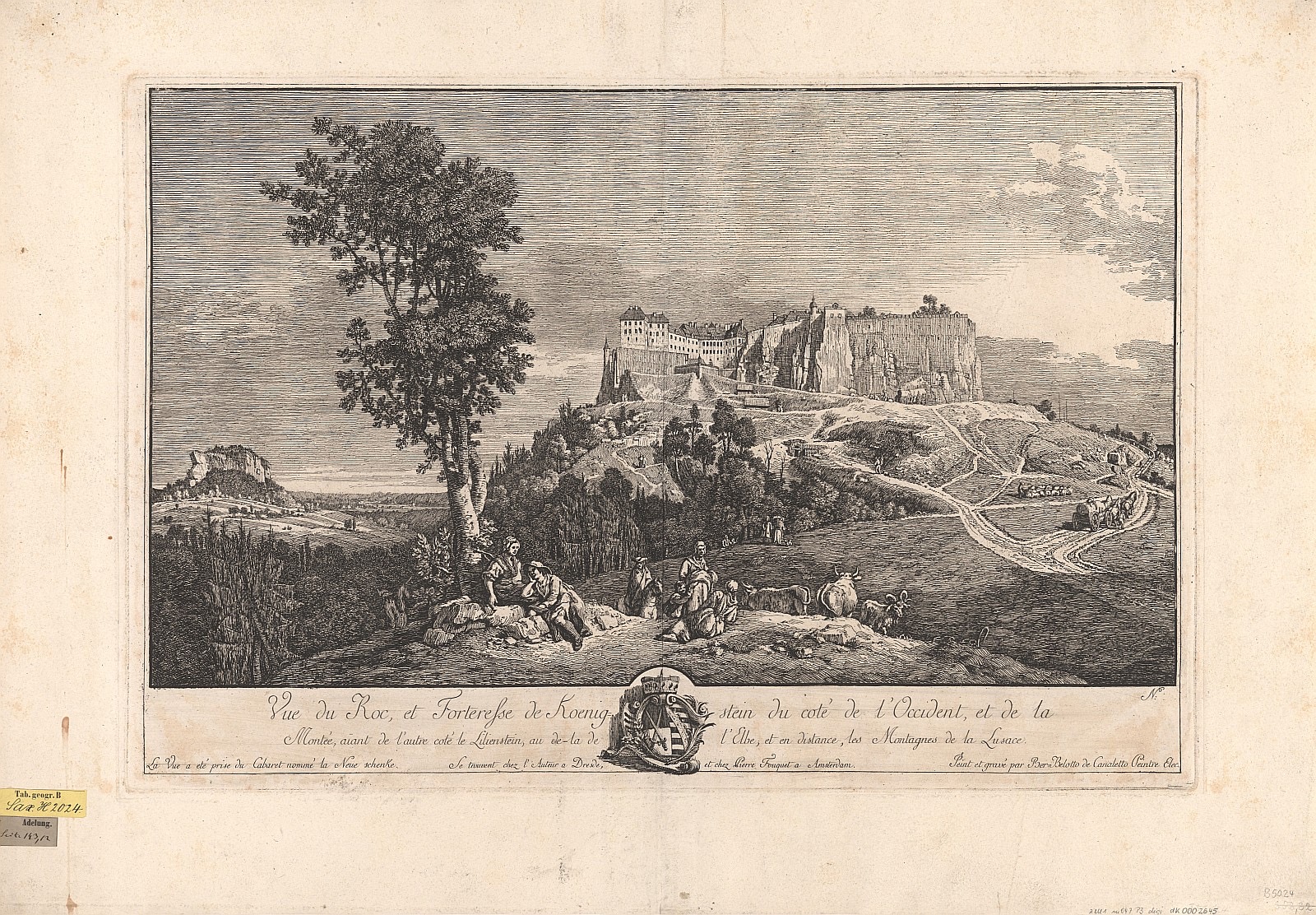
View of Königstein Fortress, engraving copper, 1748
· Deutsche Fotothek (via Europeana)
CC BY-SA
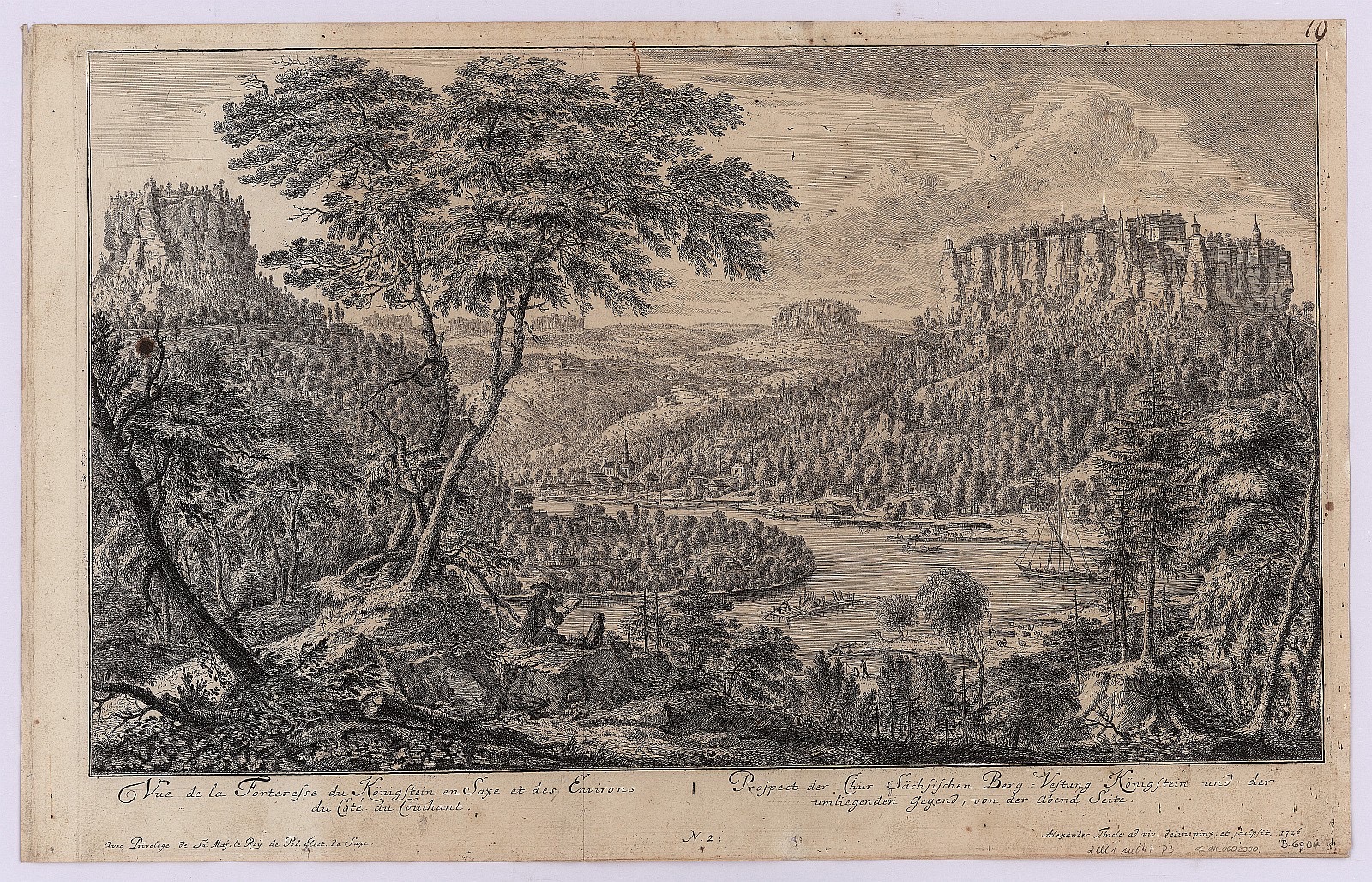
Ansicht der Festung Königstein, Kupferstich, 1726
· Deutsche Fotothek (via Europeana)
CC BY-SA
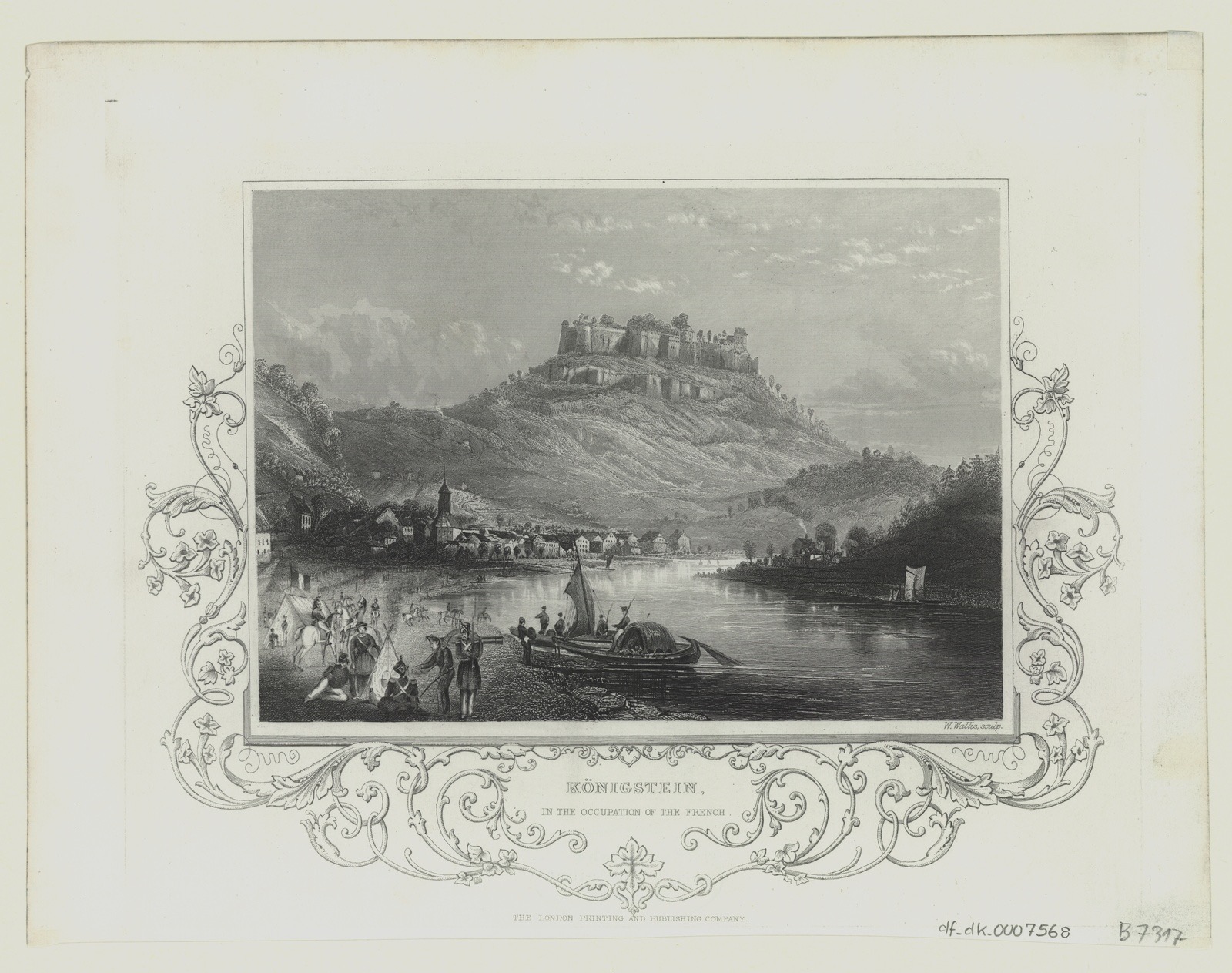
View of Königstein Fortress, steel engraving, from 1813
· Deutsche Fotothek (via Europeana)
CC BY-SA


